|
||||||||||||||||
A SHORT COURSE ON SYNTHETIC GENOMICS [7.30.09]
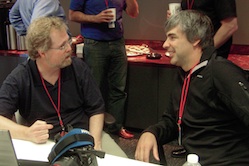
On July 24, 2009, a small group of scientists, entrepreneurs, cultural impresarios and journalists that included architects of the some of the leading transformative companies of our time (Microsoft, Google, Facebook, PayPal), arrived at the Andaz Hotel on Sunset Boulevard in West Hollywood, to be offered a glimpse, guided by George Church and Craig Venter, of a future far stranger than Mr. Huxley had been able to imagine in 1948. In this future — whose underpinnings, as Drs. Church and Venter demonstrated, are here already — life as we know it is transformed not by the error catastrophe of radiation damage to our genetic processes, but by the far greater upheaval caused by discovering how to read genetic sequences directly into computers, where the code can be replicated exactly, manipulated freely, and translated back into living organisms by writing the other way. "We can program these cells as if they were an extension of the computer," George Church announced, and proceeded to explain just how much progress has already been made. ... — George Dyson, from The Introduction Edge Master Class 2009 AN EDGE SPECIAL PROJECT GEORGE CHURCH, Professor of Genetics at Harvard
Medical School and Director, Center for Computational
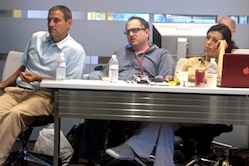
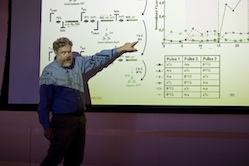
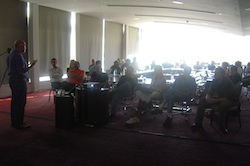
Genetics, and Science Advisor to 23 and Me, and J. CRAIG VENTER, Founder of Synthetic Genomics, Inc. and President of the J. Craig Venter Institute and the J. Craig Venter Science Foundation, taught the Edge Master Class 2009: "A Short Course In Synthetic Genomics" at The Andaz Hotel in West Hollywood, the weekend of July 24th-26th. On Saturday the 25th the class traveled by bus to Space X near LAX, where Sessions 1-4 were taught by George Church. On Sunday, the Class was held at The Andaz in West Hollywood. Craig Venter taught Session 5 and George Church taught Session 6. The topics covered over the course of a rigorous 2-day progam of six lectures included:
The entire Master Class is available in high quality HD Edge Video (about 6 hours). The Edge Master Class 2009 advanced the themes and ideas presented in the historic Edge meeting "Life: What A Concept!" in August 2007. [Click here to go to videos or scroll down the page.] ___ |
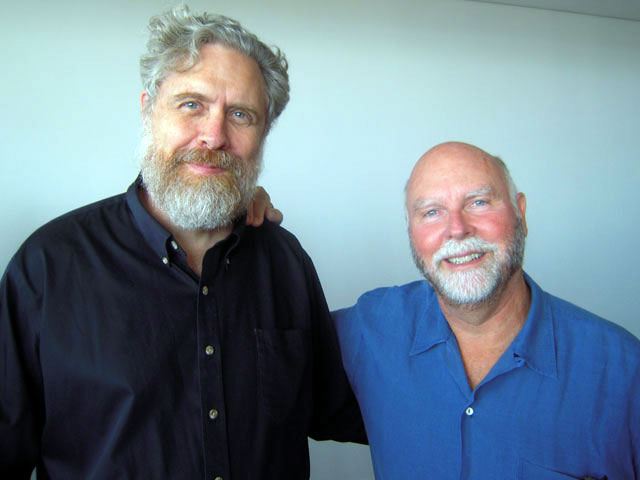
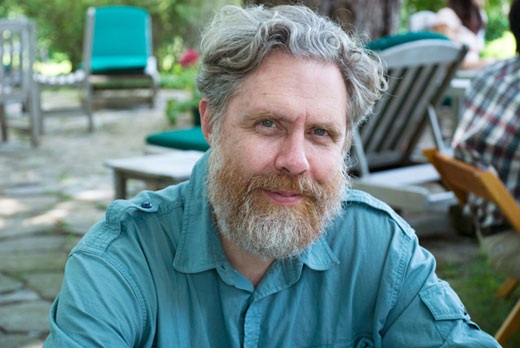
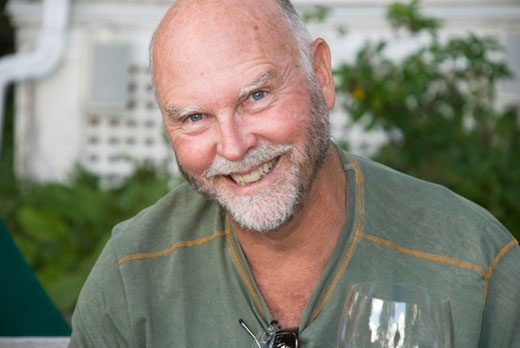
GEORGE CHURCH & CRAIG VENTER |
GEORGE
M. CHURCH is Professor of Genetics, Harvard Medical School;
Director, Center for Computational Genetics; Science
Advisor to 23andMe. He invented the broadly-applied concepts of molecular multiplexing and tags, homologous recombination methods, and array DNA synthesizers. Technology transfer of automated sequencing & software to Genome Therapeutics Corp. resulted in the first commercial genome sequence (the human pathogen, H. pylori, 1994). He has served in advisory roles for 12 journals (including Nature Molecular Systems Biology), 5 granting agencies and 24 biotech companies (e.g. recently founding Codon Devices and LS9). Current research focuses on integrating biosystems-modeling with the Personal Genome Project & synthetic biology.
J. CRAIG VENTER is regarded as one of the leading scientists of the 21st century for his invaluable contributions in genomic research, most notably for the first sequencing and analysis of the human genome published in 2001 and the most recent and most complete sequencing of his diploid human in genome in 2007. In addition to his role at SGI, he is founder and chairman of the J. Craig Venter Institute. He was in the news last week with the announcement that SGI had received a $600 million investment from ExxonMobil to develop biofuels from algea. Venter was the founder of Human Genome Sciences, Diversa Corporation and Celera Genomics. He and his teams have sequenced more than 300 organisms including human, fruit fly, mouse, rat, and dog as well as numerous microorganisms and plants. He is the author of A Life Decoded, as well as more than 200 research articles and is among the most cited scientists in the world. He is the recipient of numerous honorary degrees, scientific awards and a member of many prestigious scientific organizations including the National Academy of Sciences. |
INTRODUCTION: APE AND ESSENCE Sixty-one years ago Aldous Huxley published his lesser-known masterpiece, Ape and Essence, set in the Los Angeles of 2108. After a nuclear war (in the year 2008) devastates humanity's ability to reproduce high-fidelity copies of itself, a reversion to sub-human existence had been the result. A small group of scientists from New Zealand, spared from the catastrophe, arrives, a century later, to take notes. The story is presented, in keeping with the Hollywood location, in the form of a film script. On July 24, 2009, a small group of scientists, entrepreneurs, cultural impresarios and journalists that included architects of the some of the leading transformative companies of our time (Microsoft, Google, Facebook, PayPal), arrived at the Andaz Hotel on Sunset Boulevard in West Hollywood, to be offered a glimpse, guided by George Church and Craig Venter, of a future far stranger than Mr. Huxley had been able to imagine in 1948. In this future — whose underpinnings, as Drs. Church and Venter demonstrated, are here already— life as we know it is transformed not by the error catastrophe of radiation damage to our genetic processes, but by the far greater upheaval caused by discovering how to read genetic sequences directly into computers, where the code can be replicated exactly, manipulated freely, and translated back into living organisms by writing the other way. "We can program these cells as if they were an extension of the computer," George Church announced, and proceeded to explain just how much progress has already been made. The first day's lectures took place at Elon Musk's SpaceX rocket laboratories — where the latest Merlin and Kestrel engines (built with the loving care devoted to finely-tuned musical instruments) are unchanged, in principle, from those that Theodore von Karman was building at the Jet Propulsion Laboratory in 1948. The technology of biology, however, has completely changed. Approaching Beverly Hills along Sunset Boulevard from Santa Monica, the first indications that you are nearing the destination are people encamped at the side of the road announcing "Star Maps" for sale. Beverly Hills is a surprisingly diverse community of interwoven lives, families, and livelihoods, and a Star Map offers only a rough approximation of where a few select people have their homes. Synthetic Genomics is still at the Star Map stage. But it is becoming Google Earth much faster than most people think. GEORGE DYSON, a historian among futurists, is the author of Baidarka; Project Orion; and Darwin Among the Machines. George Dyson's Edge Bio Page |
"For those seeking substance over sheen, the occasional videos released at Edge.org hit the mark. The Edge Foundation community is a circle, mainly scientists but also other academics, entrepreneurs, and cultural figures. ... Edge's long-form interview videos are a deep-dive into the daily lives and passions of its subjects, and their passions are presented without primers or apologies. The decidedly noncommercial nature of Edge's offerings, and the egghead imprimatur of the Edge community, lend its videos a refreshing air, making one wonder if broadcast television will ever offer half the off-kilter sparkle of their salon chatter. — Boston Globe |
THE CLASS |
Stewart Brand, Biologist, Long Now Foundation; Whole Earth Discipline |
|
Constructing Life from Chemicals [1:21] |
|
Multi-enzyme, multi-drug, and multi-virus resistant life [1:06] |
|
Humans 2.0 [33:15] |
SESSION 5 @ THE ANDAZ [7.26.09] |
SESSION 6 @ THE ANDAZ [7.26.09] Engineering humans, pathogens and extinct species [40:35] |
Thanks to Alex Miller and Tyler Crowley of Mahalo.com for shooting, editing, and posting the videos of the Edge Master Class 2009. |
 George Church |
 Craig Venter |
|
|
|
|
|
|
|
David Gross, Frank Schirrmacher, Lawrence Krauss, Denis Dutton, Tim O'Reilly, Ed Regis, Victoria Stodden, Jesse Dylan, George Dyson, Alexandra Zukerman DAVID GROSS "I should have accepted your invitation. I have been listening to the Master Class on the Web — fascinating. I am learning a lot and I wish I had been there. Thanks for the invite and thanks for putting up the videos. ... Invite me again..." FRANK SCHIRRMACHER I watched sessions 1 to 6. This is breathtaking. The Edge Master Class must have been spectacular and frightening. Now DNA and computers are reading each other without human intervention, without a human able to understand it. This is a milestone, and adds to the whole picture: we don't read, we will be read. What Edge has achieved collecting these great thinkers around is absolutley spectacular. Whenever I find an allusion to great writers or thinkers, I find out that they all are at Edge. LAWRENCE KRAUSS What struck me was the incredible power that is developing in bioinformatics and genomics, which so resembles the evolution in computer software and hardware over the past 30 years. George Church's discussion of the acceleration of the Moore's law doubling time for genetic sequencing rates,, for example, was extraordinary, from 1.5 efoldings to close to 10 efoldings per year. When both George and Craig independently described their versions of the structure of the minimal genome appropriate for biological functioning and reproduction, I came away with the certainty that artificial lifeforms will be created within the next few years, and that they offered great hope for biologically induced solutions to physical problems, like potentially buildup of greenhouse gases. At the same time, I came away feeling that the biological threats that come with this emerging knowledge and power are far greater than I had previously imagined, and this issue should be seriously addressed, to the extent it is possible. But ultimately I also came away with a more sober realization of the incredible complexity of the systems being manipulated, and how far we are from actually developing any sort of comprehensive understanding of the fundamental molecular basis of complex life. The simple animation demonstrated at the molecular level for Gene expression and replication demonstrated that the knowledge necessary to fully understand and reproduce biochemical activity in cells is daunting. Two other comments: (1) was intrigued by the fact that the human genome has not been fully sequenced, in spite of the hype, and (2) was amazed at the available phase space for new discovery, especially in forms of microbial life on this planet, as demonstrated by Craig in his voyage around the world, skimming the surface, literally, of the ocean, and of course elsewhere in the universe, as alluded to by George. Finally, I also began to think that structures on larger than molecular levels may be the key ones to understand for such things as memory, which make the possibilities for copying biological systems seem less like science fiction to me. George Church and I had an interesting discussion about this which piqued my interest, and I intend to follow this up. DENIS DUTTON Astonishing. TIM O'REILLY George Church asked "Is life a qualitative or quantitative question?" Every revolution in science has come when we learn to measure and count rather than asking binary qualitative questions. Church didn't mention phlogiston, but it's what came to mind as a good analogy. Heat is not the presence or absence of some substance or quality, but rather a measurable characteristic of a complex thermodynamic system. Might not the same be true of life? ... ED REGIS Almost fifteen years ago, in a profile of Leroy Hood, I quoted Bill Gates, who said: "The gene is by far the most sophisticated program around." ... At the Edge Master Class last weekend I learned the extent to which we are now able to reprogram, rework, and essentially reinvent the gene. This gives us a degree of control over biological organisms — as well as synthetic ones — that was considered semi-science fictional in 1995. Back then scientists had genetically engineered E. coli bacteria to produce insulin. ... VICTORIA STODDEN Craig Venter posed the question whether it is possible to reconstruct life from its constituent parts. Although he's come close, he hasn't done it (yet?) and neither has anyone else. Aside from the intrinsic interest of the question, its pursuit seems to be changing biological research in two fundamental ways encapsulated Venter's own words ... JESSE DYLAN What a revelation the The Master Class in Synthetic Genomics was. In addition to being informative on so many literal levels it reinforced the mystery and wonder of the world. George Church and Craig Venter were generous to give us a glimpse of where we are today and fire the imagination of where we are going. It's all science but seems beyond science fiction — living forever, reprogramming genes, resurrecting extinct species. ... GEORGE DYSON We speak of reading and writing genomes — but no human mind can comprehend these lengthy texts. We are limited to snippet view in the library of life. As Edge's own John Markoff reported from the recent Asilomar conference on artificial intelligence, the experts "generally discounted the possibility of highly centralized superintelligences and the idea that intelligence might spring spontaneously from the Internet." ... ALEXANDRA ZUKERMAN
[...] |
|
GENETIC ENGINEERING [ED. NOTE: Among the attendees of the recent Edge Master Class 2009 — A Short Course on Synthetic Genomics, was science writer Ed Regis (What Is Life?) who was commissioned by Frank Schirrmacher, Co-Publisher and Feuilleton Editor of Frankfurter Allgemeine Zeitung to write a report covering the event. A German translation of Regis's article was published on August 15th by FAZ along with an accompanying article. The original English language version is published below with permission.]
GENETIC ENGINEERING In their futuristic workshops, the masters of the Synthetic Genomics, Craig Venter and George Church, play out their visions of bacteria reprogrammed to turn coal into methane gas and other microbes programmed to create jet fuel 14. August 2009 — John Brockman is a New York City literary agent with a twist: not only does he represent many of the world's top scientists and science writers, he's also founder and head of the Edge Foundation (www.edge.org), devoted to disseminating news of the latest advances in cutting-edge science and technology. Over the weekend of 24-26 July, in Los Angeles, Brockman's foundation sponsored a "master class" in which two of these same scientists — George Church, a molecular geneticist at Harvard Medical School, and Craig Venter, who helped sequence the human genome — gave a set of lectures on the subject of synthetic genomics. The event, which was by invitation only, was attended by about twenty members of America's technological elite, including Larry Page, co-founder of Google; Nathan Myhrvold, formerly chief technology officer at Microsoft; and Elon Musk, founder of PayPal and head of SpaceX, a private rocket manufacturing and space exploration firm which is housed in a massive hangar-like structure near Los Angeles International Airport. The first day's session, in fact, was held on the premises of SpaceX, where the Tesla electric car is also built. Synthetic genomics, the subject of the conference, is the process of replacing all or part of an organism's natural DNA with synthetic DNA designed by humans. It is essentially genetic engineering on a mass scale. As the participants were to learn over the next two days, synthetic genomics will make possible a variety of miracles, such as bacteria reprogrammed to turn coal into methane gas and other microbes programmed to churn out jet fuel. Still other genomic engineering techniques will allow scientists to resurrect a range of extinct creatures including the woolly mammoth and, just maybe, even Neanderthal man. The specter of "biohackers" creating new infectious agents made its obligatory appearance, but synthetic genomic researchers are, almost of necessity, optimists. George Church, one of whose special topics was "Engineering Humans 2.0," told the group that "DNA is excellent programmable matter." Just as automated sequencing machines can read the natural order of a DNA molecule, automated DNA synthesizing machines can create stretches of deliberately engineered DNA that can then be placed inside a cell so as to modify its normal behavior. Many bacterial cells, for example, are naturally attracted to cancerous tumors. And so by means of correctly altering their genomes it is possible to make a species of cancer-killing bacteria, organisms that attack the tumor by invading its cancerous cells, and then, while still inside them, synthesizing and then releasing cancer-killing toxins. But tumor-killing microbes were only a small portion of the myriad wonders described by Church. Another was the prospect of "humanized" or — even "personalized" — mice. These are mammals whose genomes are injected with bits of human DNA for the purpose of getting the animals to produce disease-fighting antibodies that would not be rejected by humans. A personalized mouse, whose genome was modified with some of your very own genetic material, would produce antibodies that would not be rejected by your own body. Beyond that is the possibility of creating synthetic organisms that would be resistant to a whole class of natural viruses. There are two ways of doing this, one of which involves creating DNA that is a mirror-image of natural DNA. Like many biological and chemical substances, DNA has a chirality or handedness, the property of existing in either left-handed or right-handed structural forms. In their natural state, most biological molecules including DNA and viruses are left-handed. But by artificially constructing right-handed DNA, it would be possible to make synthetic living organisms whose DNA is a mirror-image of the original. They would be resistant to conventional enzymes, parasites, and predators because their DNA would not be recognized by the mirror-image version. Such synthetic organisms would constitute a whole new "mirror-world" of living things. Church is also founder and head of the Personal Genome Project, or PGP. The project's purpose, he said, is to sequence the genomes of 100,000 volunteers with the goal of opening up a new era of personalized medicine. Instead of today's standardized, one-size-fits-all collection of pills and therapies, the medicine of the future will be genomically tailored to each individual patient, and its treatments will fit him or her as well as a made-to-order suit of clothes. Church also speculated that knowledge of the idiosyncratic features that lurk deep within each of our genomes — genetic differences that give rise to every person's respective set of individuating traits — will bring us an unprecedented level of self-understanding, and, therefore, will allow us to chart a more intelligent and informed course through life. Toward the end of the first day Elon Musk, for whom the word charismatic could have well been coined, described a genomic transformation of another type. While a video of his Falcon 1 rocket being launched from the Kwajalein Atoll in the South Pacific played in the background, Musk spoke about sending the human species to the planets. That might have seemed an unrealistic goal were it not for the fact that on 13 July, just twelve days prior to the Edge event, SpaceX had successfully launched another Falcon 1 rocket that had placed Malaysia's RazakSAT into Earth orbit. Earlier, competing against both Boeing and Lockheed, SpaceX had won NASA's Commercial Orbital Transportation Services competition to resupply cargo to the International Space Station. Then, like an emperor leading his subjects, Musk gave the conference attendees a tour of his spacecraft manufacturing facility. We saw the rocket engine assembly area, several launch vehicle components under construction, the mission operations area, and an example of the company's Dragon spacecraft, a pressurized capsule for the transport of cargo or passengers to the ISS. "This is all geared to extending life beyond earth to a multiplanet civilization," Musk said of the spacecraft. Suddenly, his particular version of the future was no longer so unbelievable. The leadoff speaker on the second and last day of the conference was J. Craig Venter, the human genome pioneer who more recently cofounded Synthetic Genomics Inc., an organization devoted to commercializing genomic engineering technologies. One of the challenges of synthetic genomics was to pare down organisms to the minimal set of genes needed to support life. Venter called this "reductionist biology," and said that a fundamental question was whether it would be possible to reconstruct life by putting together a collection of its smallest components. Brewer's yeast, Venter discovered, could assemble fragments of DNA into functional chromosomes. He described a set of experiments in which he and colleagues created 25 small synthetic pieces of DNA, injected them into a yeast cell, which then proceeded to assemble the pieces into a chromosome. The trick was to design the DNA segments in such a way that the organism puts them together in the correct order. It was easy to manipulate genes in yeast, Venter found. He could insert genes, remove genes, and create a new species with new characteristics. In August 2007, he actually changed one species into another. He took a chromosome from one cell and put it into different one. "Changing the software [the DNA] completely eliminated the old organism and created a new one," Venter said. Separately, Venter and his group had also created a synthetic DNA copy of the phiX virus, a small microbe that was not infectious to humans. When they put the synthetic DNA into an E. coli bacterium, the cell made the necessary proteins and assembled them into the actual virus, which in turn killed the cell that made it. All of this happened automatically in the cell, Venter said: "The software builds its own hardware." These and other genomic creations, transformations, and destructions gave rise to questions about safety, the canonical nightmare being genomically engineered bacteria escaping from the lab and wreaking havoc upon human, animal, and plant. But a possible defense against this, Venter said, was to provide the organism with "suicide genes," meaning that you create within them a chemical dependency so that they cannot survive outside the lab. Equipped with such a dependency, synthetic organisms would pose no threat to natural organisms or to the biosphere. Outside the lab they would simply die. That would be good news if it were true, because with funding provided by ExxonMobil, Venter and his team are now building a three to five square-mile algae farm in which reprogrammed algae will produce biofuels. "Making algae make oil is not hard," Venter said. "It's the scalability that's the problem." Algae farms of the size required for organisms to become efficient and realistic sources of energy are expensive. Still, algae has the advantage that it uses CO2 as a carbon source — it actually consumes and metabolizes a greenhouse gas — and uses sunlight as an energy source. So what we have here, potentially, are living solar cells that eat carbon dioxide as they produce new hydrocarbons for fuel. George Church had the final say in a lecture entitled "Engineering Humans 2.0." Human beings, he noted, are limited by a variety of things: by their ability to concentrate and remember, by the shortness of their lifespans, and so on. Genomic engineering could be used to correct all these deficiencies and more. The common laboratory mouse, he noted, had an average lifespan of 2.5 years. The naked mole rate, by contrast, lives ten times longer, to the ripe old age of 25. It would be possible to find the genes that contributed to the longevity of the naked mole rat, and by importing those genes into the lab mouse, you could slowly increase its longevity. An analogous process could also be tried on human beings, increasing their lifespans and adding to their memory capacity, but the question was whether it was wise to do this. There were always trade-offs, Church said. You may engineer humans to have bigger and stronger bones, but only at the price if making them heavier and more ungainly. Malaria resistance is coupled with increased susceptibility to sickle cell anemia. And so on down the list. In a conference characterized by an excess of excess, Church provided a welcome cautionary note. But then he proceeded to pull out all the stops an argued that by targeted genetic manipulation of the elephant genome it might be possible to resurrect the woolly mammoth. And by doing the same to the chimpanzee genome, scientists could possibly resurrect Neanderthal man. "Why would anyone want to resurrect Neanderthal man?" a conference participant asked. "To create a sibling species that would give us a fresh outlook on ourselves," Church answered. Humans were a monoculture, he said, and monocultures were biologically at risk. His answer did not satisfy all of those present. "We already have enough Neanderthals in Washington," Craig Venter quipped, thereby effectively bringing the Edge Master Class 2009 to a close. Ed Regis is the author of several science books, most recently, What Is Life? Investigating the Nature of Life in the Age of Synthetic Biology |
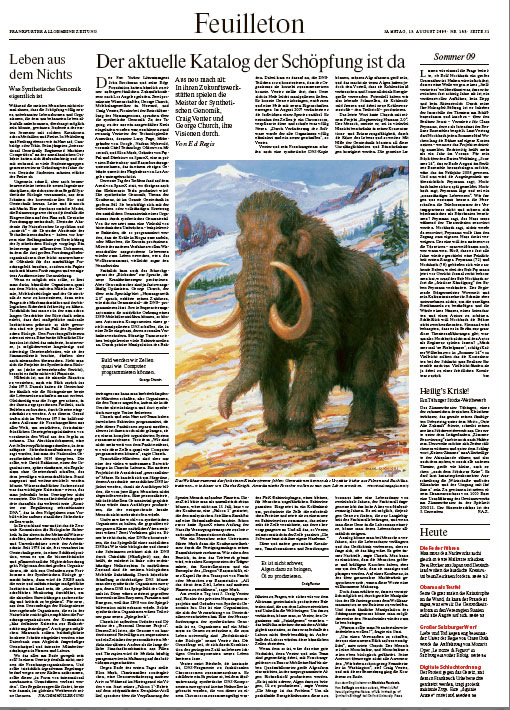
THE WALKMAN OF GENETIC ENGINEERING: THE MOVE FROM SCIENCE TO A NEW WORLD OF PRODUCTS [Walkman der Gentechnik; Der Schritt von der Wissenschaft zu einer neuen Warenwelt] ...Genetic engineering is now at a point where computer science was around the mid-eighties. The early PCs were limited as to purpose and network. In two and a half decades, the computer has led us into a digial world in which every aspect of lives has been affected. According to Moore's Law, the performance of computers doubles every 18 months. Genetic engineering is following a similar growth. On the last weekend in July, Craig Venter and George Church met in Los Angeles to lead a seminar on synthetic genetic engineering for John Brockman's science forum Edge.org. Genetic engineering under Church has been following the grwoth of computer science growing by a factor of tenfold per year. After all, the cost of sequencing a genome dropped from three billion dollars in 2000 to around $50 000 dollars as Stanford University's Dr. Steven Quake genomics engineer announced this week. 17 commercial companies a;ready offer similar services. In June, a "Consumer Genetics" exhibition was held in Boston for the first time. The Vice President of Knome, Ari Kiirikki, assumes that the cost of sequencing a genome in the next ten years will fall to less than $1,000. In support for this development, the X-Prize Foundation has put up a prize of ten million dollars for the sequencing of 100 full genomes within ten days for the cost of less than $10,000 dollars per genome sequenced. |
|
Süddeutsche Zeitung, 13.08.2009 Von aktuellen Entwicklungen aus der schönen neuen Welt der Genom-Sequenzierung berichtet Andrian Kreye: "Am letzten Juliwochenende trafen sich Craig Venter und George Church in Los Angeles, um für John Brockmans Wissenschaftsforum Edge.org ein Seminar über synthetische Gentechnik zu leiten. Die Gentechnik, so Church, habe die Informatik dabei längst hinter sich gelassen und entwickle sich mit einem Faktor von zehn pro Jahr. Immerhin - der Preis für die Sequenzierung eines Genoms ist von drei Milliarden Dollar im Jahr 2000 auf rund 50.000 Dollar gefallen, wie der Ingenieur der Stanford University Dr. Steven Quake diese Woche bekanntgab. 17 kommerzielle Firmen bieten ihre Dienste schon an." |
There is a growing consensus (at least in Silicon Valley) that the information age is about to give way to the era of synthetic genetics. That was underscored recently when Harvard geneticist George Church and J. Craig Venter — of the race to decode the human genome fame — gave lectures before a small group of scientists, technologists, entrepreneurs, and writers in West Hollywood. The event, billed as "A Short Course on Synthetic Genetics", was organized by John Brockman, the literary impresario (and book agent for several New York Times reporters, including this one) who publishes the cybersalon-style website www.edge.org, a forum dedicated to scientists (many of whom are his clients) and their ideas. In roughly six hours of lectures both scientists tried to convey how the world will be changed by the ability to routinely read genetic sequences into computing systems and then store, replicate, alter and insert them back into living cells. The rate at which this technology is now improving puts silicon to shame. Dr. Church noted that between 1970 and 2005 gene sequencing had taken place on a Moore’s Law pace, improving at about 1.5 times per year. Since then it has improved at the rate of an order of magnitude, or ten times annually. In the process the cost of sequencing the human genome has plunged from $3 billion to $5 thousand and continues to fall. Dr. Church identified 17 companies and one "open source" project all pursuing different technologies to further push down cost and speed up the pace of sequencing. As a consequence, the structure of the emerging synthetic genetics industry is beginning to mirror that of the semiconductor and computer industries, which are based on modular components and design tools. The key to the vast growth of the computer industry took place during the 1970s when physicist Carver Mead helped give the industry a standard design approach based on modular components. Now that appears to be happening in the synthetic biology world as well. For someone who has spent the past three decades writing about computing, Dr. Venter’s talk was eye-opening. "I view DNA as an analog information system," he said. " and I hope to convince you in fact that it is absolutely the software of life." [...] |
John
Brockman, Editor
and Publisher |
|Top| |