

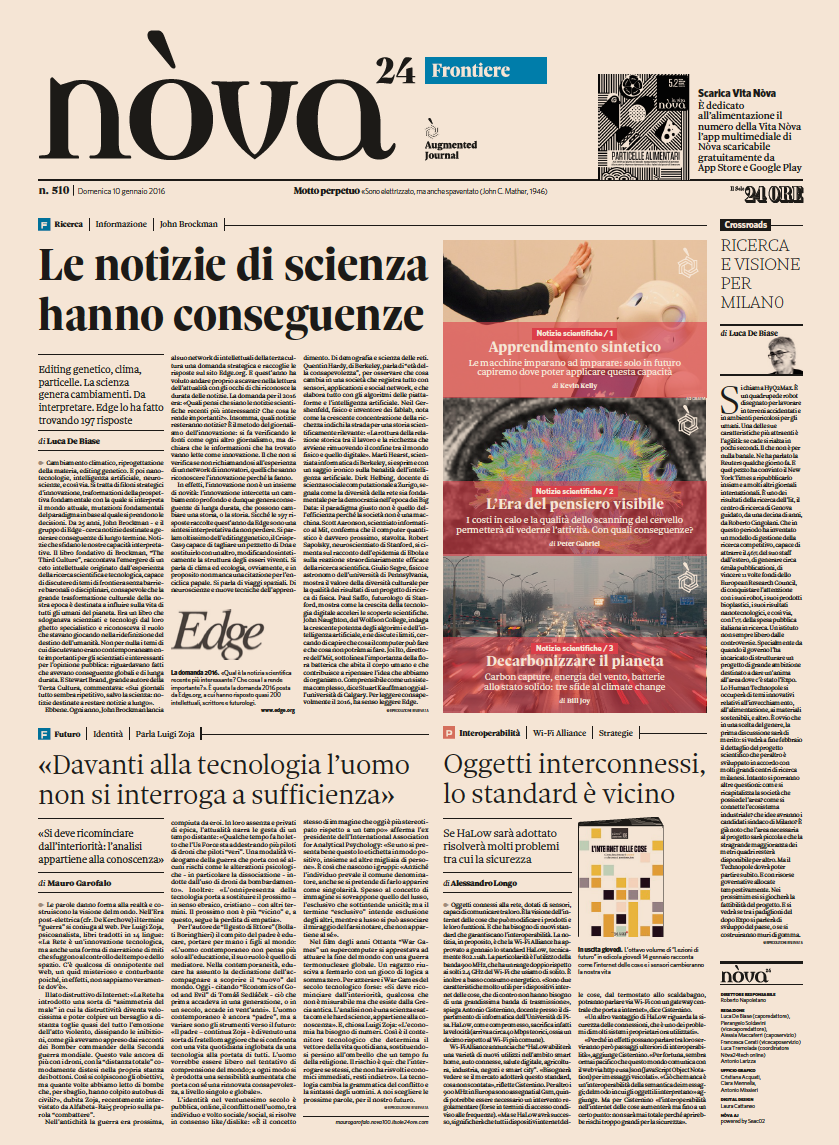
On the site Edge.org discussed the dangers of artificial intelligence (AI) in November, led by Stephen Hawking and philosopher Nick Bostrom has recently warned of what superior and possibly malevolent artificial intelligences could get up to. Only two people were worth reading: Jaron Lanier , which is critical to AI, and Rodney Brooks , which is positive. ...

The cultural entrepreneur, John Brockman, has brought together the 25 most important scientific minds to discern artificial intelligence. His reflections are reflected in the book "Possible minds: 25 ways of looking at AI".
This book gathers the inspiration of the mathematician-philosopher Norbert Wiener who wrote about the place of machines in society that ended with a warning: "We will never receive the right answers to our questions unless we ask the right questions ... The time is too late ... , and the choice of good and evil knocks on our door ”.
Among the participants in Brockman's new book is an interesting essay by Harvard College professor Steven Pinker, under the title "Tech prophecy and the underappreciated causal power of ideas" (Technological prophecy and underestimated causal power of ideas). . . .

. . . Current algorithms generally work best when they look at a set number of circumstances and make predictions from those variables. That’s why AI can be good at chess or even the board game Go! In fact, this ability for AI to work within the confines of a specific problem set is what allows it to work very quickly to resolve a specific problem.
In John Brockman’s Possible Minds: 25 Ways of Looking at AI, David Deutsch observes that “a mere AI is incapable of having any such ideas, because the capacity for considering them has been designed out of its constitution.” AI is not creative and has a hard time predicting the unknown. This is a big problem in regard to predicting violent actions. . . .

. . .That Explains Everything: Beautiful, Profound and Elegant Ideas About How the World Works, edited by John Brockman . . . a well-known cultural dynamizer whose trajectory has taken place in the world of New York avant-garde art, science, publishing, software and the Internet . . . the founder and editor of Edge.org, a website dedicated to scientific discussions in which the world's most brilliant thinkers participate, of what he has called the "Third Culture".
It is no exaggeration to say that each page gives us a surprise, about animals, planets, diseases, the limits of rationality, about the idea of beauty, the different ways of facing reality (empiricism and rationalism), optical illusions, snowflakes, lemons, cats, turtles, birds, frogs . . . and in this book there is everything as in apothecary.

Picking up C. P. Snow's glove in his famous lecture on the two cultures, the scientific and the humanistic, John Brockman founded three decades ago EDGE, a modern Bloomsbury Circle in which high personalities swarm and that every year asks a question. The one we are dealing with here asks about "the most beautiful, profound or elegant explanation" and is answered by, among others, psychiatrist Judith Rich Harris, neuroscientist David Eagleman, physicist Carlo Rovelli, anthropologist Helen Fisher, philosopher Daniel Dennett, archaeologist Christine Finn and even musician Brian Eno, in an anthology entitled That Explains It All (Deusto). There are, of course, very diverse answers: natural selection, magnetism, entropy, germs, the principle of uncertainty... The result is an attempt at natural philosophy in which the apparent border between sciences and humanities seems to be blurred. Is it that this never existed?

John Brockman, writer and editor, created a website called Edge (edge, or boundary) in which a conversation takes place between the academic world and an intellectually curious audience. That page was classified in the same category as magazines such as The New Yorker and The Economist. Brockman considered himself heir to the artist J. L. Byars, who last century organized a club of very diverse thinkers and said that to reach the edge of knowledge one had to ask others the questions they ask themselves.
Discussions in Edge could be collected today in a manuscript of more than ten million words. One of his initiatives was the annual publication of a book with various answers to a great question he asked. This year, to celebrate twenty years of the initiative (and to close it), Brockman decided not to ask a question, but to ask each participant for his, that last unknown that won't let him sleep. The book has more than 300 pages; each has only a brief question printed and the name of the one who asks it. Natural and social scientists, writers, artists and entrepreneurs participated.

Here are our picks for worthwhile books to read during each year of life, from 1 to 100, along with some of the age-appropriate wisdom they impart.
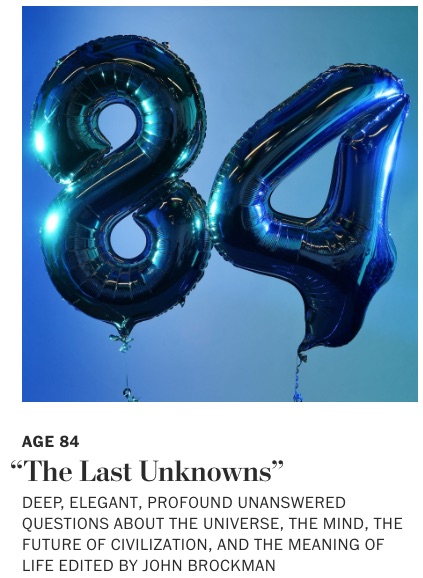
With time and wisdom to spare, there may be no better moment to ponder life’s big mysteries.

"An erratic, but intriguing, selection of essays from many of the world’s leading (western) thinkers about artificial intelligence and the nature of humanity."
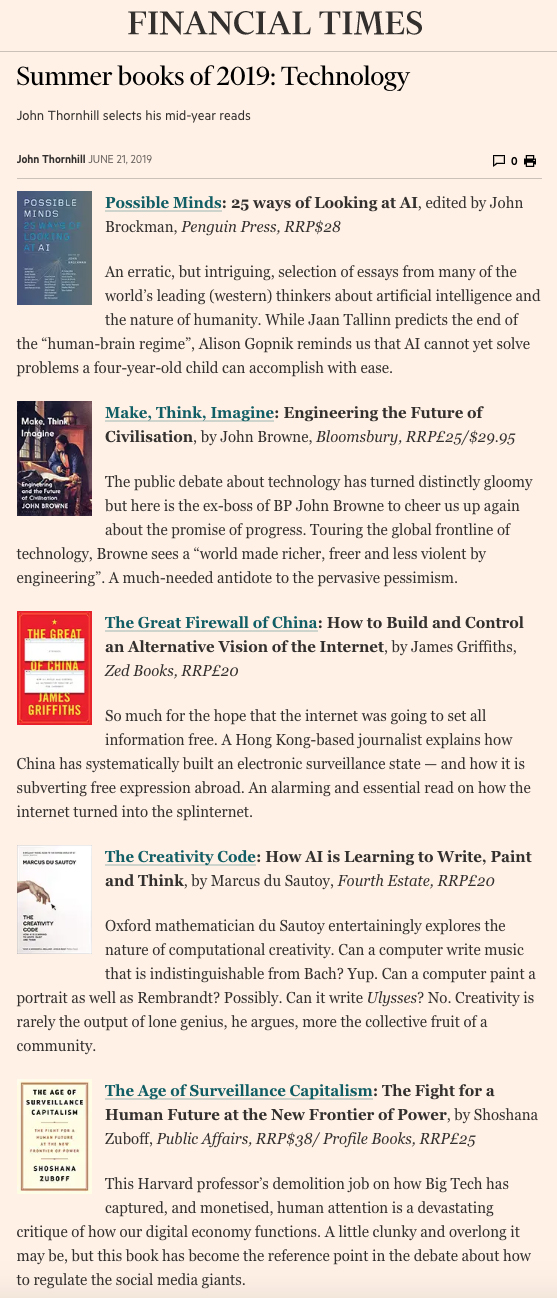

. . . 4. John Brockman, editor, The Last Unknowns: Deep, Elegant, Profound UNANSWERED QUESTIONS About the Universe, the Mind, the Future of Civilization, and the Meaning of Life. My nominated question was: “How far are we from wishing to return to the technologies of the year 1900?” NB: you get only the questions, not the answers. . . .

What is elegance for scientists? This is the kind of question that John Brockman, one of the most unique editors of our time, and also a sort of cultural animator of the scientific elite, asks his pupils once a year for the online magazine Edge.org. He is inspired by cutting-edge intellectual societies such as the Algonquin Roundtable and the Bloomsbury Group. A few years ago, he asked all those brains, "What's your favorite beautiful, deep, or elegant explanation?" There was an avalanche of responses, and Deusto has just published them in Spanish. . . .
My favourite physicist, Frank Wilczek, believes that simplicity leads to depth, elegance and beauty, adding: "There are few processes as elegant as building a baby following the DNA program."

George Bernard Shaw once said, “There are those that look at things the way they are, and ask why? I dream of things that never were, and ask why not.” At the essence of Shaw’s quote lies the notion that questions matter. However, not all questions are created equal and in order to extract the most usefulness from it, the right question needs to be formulated. It’s a case of lock and key. The right question opens doors and allows people to explore what was once stowed away. The Last Unknowns (William Morrow) is a veritable treasure trove of these type of questions. . . .
The Last Unknowns is a loosely organized compendium of queries. One page, one question. Without any guidance, the topics meander but like a flâneur on the streets of Paris, aimlessly wandering but with the solitary purpose of discovery. They run the thematic gamut. . . .
So does The Last Unknowns provide any answers? Not in a single instance. That isn’t what the book was designed to accomplish. Does it get the mental wheels turning in directions they may never have done before? Absolutely. . . .

In his latest book, This Idea is Brilliant, John Brockman collects from a stunning array of scientists and thinkers, the concepts they value most in their various disciplines: scientific humility; the anthropocene; exponential growth; synaptic transfer; information pathology; and so on.
The philosopher Melanie Swan chooses “Included Middle” as her favourite concept ... The Included Middle – the notion that two contesting positions can exist side by side in a complex new reality – is a robust and promising model for addressing any situation.
Could the Included Middle provide a conceptual model for social analysis and nation building in South Africa? In a complex society, might it be possible to be both peacefully and robustly united and divided at the same time? . . .

John Brockman's most recent book, The Last Unknowns poses this interesting question, what would be the question you would like to be reminded of: your last question?
This is how the world's brightest minds must respond . . . to this question from Brockman who is editor of edge.org, probably "the most intelligent place in the world" and through which, by a delicate process, the most creative minds were selected today, including the renowned curator of the City of Ideas, the Mexican Dr. Andrés Roemer, along with personalities such as Steven Pinker or the Israeli Dan Arely.
"Can you prove it?" is the question asked by Dr. Andres Roemer, a question that we also ask in many cases, with his speakers at the Festival of Creative Minds. . . .

REVIEW ESSAY
. . . A fascinating map of AI’s likely future and an overview of the difficult choices that will shape it . . . A sense of respect for the human mind and humility about its limitations runs through the essays in Possible Minds.

John Brockman's Edge Question Series books have been fascinating to follow for over a decade now. With titles like This Explains Everything: Deep, Beautiful, and Elegant Theories of How the World Works, What We Believe but Cannot Prove: Today's Leading Thinkers on Science in the Age of Certainty, The Universe: Leading Scientists Explore the Origin, Mysteries, and Future of the Cosmos, and What Should We Be Worried About?: Real Scenarios That Keep Scientists Up at Night, the series clearly doesn't shy away from big questions—and there are so many more like that asked in the series, which has sold over a million copies.
The Last Unknowns: Deep, Elegant, Profound Unanswered Questions about the Universe, the Mind, the Future of Civilization, and the Meaning of Life, the conclusion to the series, hits bookstore shelves today. Being the last of the series, it is fitting that it leaves us with some of today's great thinkers' last questions. ...
Below, we have the introduction to the book, written by another of today's great minds—the author of Thinking, Fast and Slow—Daniel Kahneman. In it, he talks about what makes the series, and the site that it spawned from, so special.

This summer’s nonfiction releases range from the intriguing to the empowering, and every one is utterly engrossing. Here are our recommendations of the top nonfiction books arriving this summer — reads that will transport you to the mysterious depths of the ocean, place you in the middle of history, and take you on powerful inner journeys. Publishers’ descriptions included below.
1. The Last Unknowns, edited by John Brockman
This is a little book of profound questions — unknowns that address the secrets of our world, our civilization, the meaning of life. Here are the deepest riddles that have fascinated, obsessed, and haunted the greatest thinkers of our time, including Nobel laureates, cosmologists, philosophers, economists, prize-winning novelists, religious scholars, and more than 250 leading scientists, artists, and theorists. In The Last Unknowns, John Brockman, publisher of Edge.org, asks “a mind-blowing gathering of innovative thinkers” (Booklist): “What is ‘The Last Question,’ your last question, the question for which you will be remembered?”

3) Is superintelligence impossible?
John Brockman, the author of By The Late John Brockman and The Third Culture, chats with David Chalmers and Daniel C. Dennett about the growing world of AI. . . . Mr. Chalmers starts by saying that he believes superintelligence is possible. Then he goes on to explain why and how it can happen and what are the challenges that would arise.
Mr. Dennett concurs with what Mr. Chalmers said. He goes on to talk about the “possible”. There are lots of things that are possible, and philosophers love to talk about what’s possible, but many things that are obviously possible are never going to be actual. It’s possible to build a bridge across the Atlantic. We’re not going to do it, not now, not in a hundred years, not in a thousand years. It would cost too much money and would be a foolish endeavor. He also says that we ourselves are AIs. “We’re robots made of robots made of robots. We’re actual. In principle, you could make us out of other materials. Some of your best friends in the future could be robots” he says. . . .

Our greatest living scientist constructs a history of the theory of evolution, linking together the work of six visionaries from Charles Darwin to Svante Pääbo by way of Motoo Kimura, Ursula Goodenough and Richard Dawkins. The outlier in the six is H.G. Wells, the novelist. According to Dyson, Wells was the first person to grasp the significance of “cultural evolution”, a process said here to be at least equal in importance to biological evolution. Cultural evolution consists of “changes in the life of our planet caused by the spread of ideas rather than by the spread of genes”

Mirrors today are so commonplace we barely give their origins a second thought.
In 1999, in a discussion on Edge.org, Bill Gates – founder of the Microsoftcorporation – and his peers mused over the greatest inventions of the past 2,000 years.
Tor Norretranders, the Danish science writer, nominated the humble mirror, which he equated with the advent of clothing, manners and behaviour, noting that it gave us the first notion of self-consciousness.

Can Technology Threaten Democracy? What are the real risk factors of war? Are we really losing the skill of manual skills or the new darkness? These questions and many others will answer today's leading scientists and thinkers in the fascinating book titled What Should We Be Worried About?
Brockman has managed to bring together a marvelous publication that gives an overview of what we can fear, or what we can learn from. Rather than claiming a patent on the truth, it is in the spirit of the objective message of science. At the very least, it is fascinating to read about things that disturb leading scientists and thinkers.

To ring in the New Year in the most depressing and hope-crushing way possible, Dyson sat down with Edge.org.

Do you believe in books finding you? This Idea Is Brilliant, a book edited by edge.org founder John Brockman, found me last week. I don’t know if somebody had gifted it, or did I buy and forget about it? But I am just grateful for it. Published in 2018, it keeps its promise of assembling “lost, overlooked, and under-appreciated scientific concepts everyone should know”.
Most of the concepts are narrated in small essays. But the one that stayed with me is a paragraph—yes, it is only one-paragraph long —by recording producer Brian Eno on ‘Confirmation Bias’. His observation resonated in the week of cricketer Hardik Pandya’s online inquisition or persecution, depending on what your own bias or belief is!

That's what we mean by understanding how our digitized world works. But the science historian George Dyson continues to look and looks for the digital to raise an analogous revolution. And that, he warns, could take the book out of his hands.

[ED. NOTE: George Dyson, Kafka, Heidegger, Pirsig, Arendt, Wiener, and EDGE…]
George Dyson dedicates an interesting essay in Edge to explore digital evolution from a human system to an algorithm that no longer depends on human programmers, and the worrying implications of this phenomenon. But Dyson does not settle for the diagnosis and explores an original proposal for a solution: returning cybernetics to its analogue heart.
For Dyson, what we know today as a digital revolution has not ended, but it has mutated into something very different, abandoning the possibility of the first years and leaving behind its "childhood". For a long time, computer science has not responded to the old paradigm of machines controlled by instructions that, in turn, have been designed by humans, who supervise execution. . . .
"The search engine, initially an attempt to map human meaning, now defines human meaning. It controls, rather than simply catalogs or indexes, human thought..." [Continue reading George Dyson's "Childhood's End"]
Could 2019 be the year that these and other emergent technologies evolve from merely creepy to potentially totalitarian? In a New Year’s Day column published on Edge, a Web site devoted to discussions about science, technology, and philosophy, George Dyson, the science historian and author, argues that we’ve reached an inflection point. “Once it was simple: programmers wrote the instructions that were supplied to the machines,” Dyson writes. “Since the machines were controlled by these instructions, those who wrote the instructions controlled the machines.” Today, code itself has come alive: algorithms sift through our search histories, credit-card purchases, and geolocation to model our personalities and anticipate our desires. For this, a small number of people such as Mark Zuckerberg, Jeff Bezos, Sergey Brin, and Larry Page, have become unimaginably rich.
In the beginning of the essay, Dyson cites the novel Childhood’s End, written by Arthur C. Clarke in 1953, which tells the story of a peaceful alien invasion of Earth by mysterious “Overlords” who “bring many of the same conveniences now delivered by the Keepers of the Internet to Earth.” As Dyson points out, this story, much like our own story, “does not end well.”
Powerful short essay on the digital revolution. The map has become the territory. “We assume that a search engine company builds a model of human knowledge and allows us to query that model, or that some other company builds a model of road traffic and allows us to access that model. This fits our preconception that an army of programmers is still in control somewhere, but it is no longer the way the world works. The search engine is no longer a model of human knowledge, it is human knowledge. If enough drivers subscribe to a real-time map, traffic is controlled with no central model except the traffic itself. The social network is no longer a model of the social graph, it is the social graph” (1,250 words)

Over at EDGE.org, the must-read hub of intellectual inquiry and head-spinning science, Boing Boing pal and legendary book agent John Brockman is launching a new series of essays "from important third culture thinkers to address the empirically-driven and science related hot-button cultural issues of our time." First up is author George Dyson's "Childhood's End," a provocative riff on how the digital revolution has stripped much of our individual agency and that "to those seeking true intelligence, autonomy, and control among machines, the domain of analog computing, not digital computing, is the place to look."

What is our concern?...This is the question that John Brockman has laid down to dozens of the most influential experts in the world on his Edge.org site (according to The Guardian, "the smartest web site in the world"). He asked them to confess what they were most concerned about, and to show them why the topics should be addressed....
Individual responses complement each other and consist of a multi-layered and ambiguous image of the contemporary world. Last but not least, the published texts, some of which have been printed in advance by the Respekt weekly, together, create a fascinating insight into what the leading scholars and thinkers are concerned about, what issues they are worried about or who, on the other hand, have ceased to worry.

Once a year, John Brockman asks a question from leading scientists in a wide range of disciplines, whose multifaceted answers are intended to tell something about the current state of knowledge. "What do you think is the most interesting (scientific) news of our time, what is the significance of this news?" was last year's survey. A book that not only spreads future optimism.

John Brockman, curator of the online salon edge.org for current debates on research, has asked 175 renowned experts from, among others, AI research, psychology and brain research: "What should we think of artificial intelligence?" (S. Fischer, 2017). The short essays give a good overview of the current debate and present equally pessimistic and optimistic assessments.

It is impossible to come away from reading This Idea Is Brilliant without a greater respect for the near incomprehensible vastness of the field of scientific enquiry and a humbling realisation at the depth of ignorance the reader might have towards so many subjects. . . .
This book is a veritable treasure trove of thought, a sort of modern vade mecum, guaranteed to broaden the reader’s horizons.

Robots are not afraid that some patient will file their claim, do not have to pay student loans from medical studies, do not accumulate savings in the event of a trial. Maybe that's what they need to entrust to our health?
Everything you would like to know about artificial intelligence, but you are afraid to ask. The book What To Think About Machines That Think, the excerpts of which we present, are 186 short essays by eminent contemporary representatives of people of science, culture and social life. They make up a wide overview of artificial intelligence.
John Brockman, a New York publisher, editor, founder of the Edge.org website and think tank, has been asking the most interesting minds in the world of science and art for more than 20 years, asking for innovative, original answers.

LITERARY agent and provocateur John Brockman has turned popular science into a sort of modern shamanism, packaged non-fiction into gobbets of smart thinking, made stars of unlikely writers and continues to direct, deepen and contribute to some of the most hotly contested conversations in civic life.
This Idea Is Brilliant is the latest of Brockman’s annual anthologies drawn from edge.org, his website and shop window. It is one of the stronger books in the series. It is also one of the more troubling, addressing, informing and entertaining a public that has recently become extraordinarily confused about truth and falsehood, fact and knowledge.
Edge.org’s purpose has always been to collide scientists, business people and public intellectuals in fruitful ways. This year, the mix in the anthology leans towards the cognitive sciences, philosophy and the “freakonomic” end of the non-fiction bookshelf. It is a good time to return to basics: to ask how we know what we know, what role rationality plays in knowing, what tech does to help and hinder that knowing, and, frankly, whether in our hunger to democratise knowledge we have built a primrose-lined digital path straight to post-truth perdition. . . .

John Brockman has run out of questions. Brockman, a literary agent, runs the science and philosophy site Edge.org. Every year for 20 years, he has asked leading thinkers to answer a particular question, such as: “What questions have disappeared?” or: “What do you believe is true even though you cannot prove it?” This year, though, Brockman announced that he has no more questions left. So he asked his final question: “What is the last question?”
“Judge a man by his questions rather than by his answers,” Voltaire insisted. Questions help us define what we don’t know and force us or others to justify what we think we do know.
Asking questions is relatively easy. Asking good questions is surprisingly difficult. A bad question searches for an answer that confirms what we already know. A good question helps to reset our intellectual horizons. It has an answer that we can reach, yet unsettles what we already know. ...

The questions of how science and technology are transforming life and society are among the greatest intellectual challenges that surprisingly few of today's intellectuals take on. One of the first to do so was FAZ editor Frank Schirrmacher, who died in 2014. So it was not only an gesture of respect, but also an attempt at a programmatic continuation, when the publisher of the weekly Freitag, Jakob Augstein, dedicated a symposium on digital debate to Frank Schirrmacher. . . .
If you want to get an idea of where the future debates are headed, we recommend the internet forum edge.org, directed by the science impresario John Brockman, who had always been an important source for Schirrmacher. For the last twenty years, Brockman has posed an annual question to his network of visionaries, artists, and Nobel laureates. This year, he ended the project by asking everyone to ask one last question.
When the biologist David Haig asks: "What will be the use of 99% humanity for the 1%?", he still poses a question aimed at current digital changes of in society. But if the anthropologist Dorsa Amir asks “Are the simplest bits of information in the brain stored at the level of the neuron?” or the roboticist Rodney Brooks asks, “Can consciousness exist in an entity without a self-contained physical body?”, we realize that science is thinking a lot more about the subject of artificial intelligence. That's why the result is one of the most exciting reading streams ever. Which brings us full circle back to Schirrmacher.

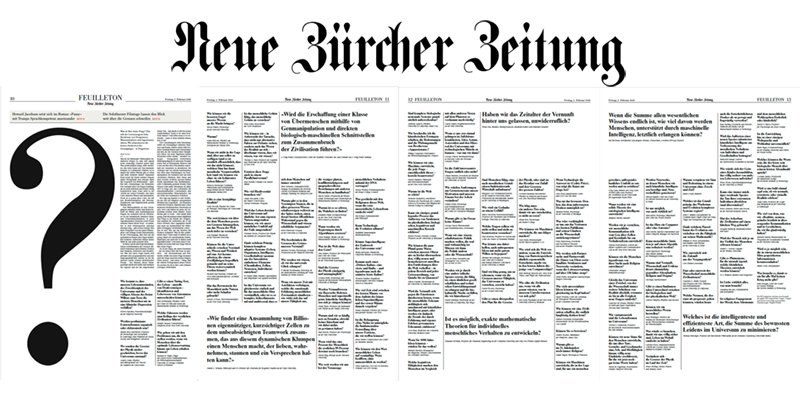
If you were left with the chance of asking only one fundamental question about the future of humanity, which one would it be? That's exactly what legendary American literary agent John Brockman wanted to know of freethinkers, scientists, engineers and entrepreneurs moving at and across the very borders of modern thought. We present their best answers – in question form.
Without a doubt, edge.org is one of the brightest, most stimulating websites today – visitors experience the thinking, actions and lives of modern intellectual adventurers in actu. The pleasure factor is great, as is the gain in knowledge. Every month there is news – but that's not all. Every year John Brockman sends a question out to the "Edgies" and makes the answers accessible on his website; afterward he publishes them in an anthology for bibliophiles. Life – what is it? How is the internet changing the way you think? What is your dangerous idea? Now, after 20 years, the American cultural impresario, who still looks young at the age of 76, has decided that enough is enough. And he asks his community one last question: what's your last question?
It is a question to inspire the individual – to quote Kant one last time – with "admiration and awe." The last question is always a question about last things. These last – and first – things are the true protagonists of the following pages. They will pursue you into your dreams and nightmares. Hopefully.

John Brockman has run out of questions, and it’s a shame. For 20 years, as a sort of homage to his late friend, the conceptual artist James Lee Byars, who in 1968 started “The World Question Center,” Brockman has been posing an “Annual Question” to some of the sharpest minds in the world, many of them scientists. Reviewing what might be a representative sample—“What is the most important invention in the past 2,000 years?”, “What do you believe is true even though you cannot prove it?”, and “What scientific idea is ready for retirement?”—it’s clear what Brockman wanted from his responders: to be intellectually daring, vulnerable, and contentious. Which is fitting, given the motto of Brockman’s website, Edge.org, to which the responses are posted: “To arrive at the edge of the world’s knowledge…”

Since 1998...the editor John Brockman has asked these questions on his Edge page ( www.edge.org ) to a hundred long intellectuals...
Brockman...says he has run out of questions and this year he has launched the last one. The question is, obviously: What is the last question? A chrysanthemum is the flower that Katinka Matson has chosen for her ritual illustration. There are many answers to look for. This is from Ryan Mckay , a psychologist at the University of London: "Will we be one of the last generations to die?" Of Robert Sapolsky, neuroscientist at Stanford: "Given the nature of life, the purposeless indifference of the universe and our absolute lack of free will, how is it possible that most people are not clinically depressed?" But the best last question, of a Leibnizian nature, is that of the MIT physicist Frank Wilczek. Given its monumental size it is understandable that answering it can never be among the obligations that a newspaper has contracted with the news.
Why?

This Idea Is Brilliant stands out by identifying dozens of scientific concepts that deserve more attention, selected with input from leading thinkers such as the evolutionary biologist Richard Dawkins and the technology writer Nicholas Carr. It’s the latest creation of Edge.org, a website that draws attention to ideas on "the frontiers of knowledge in the areas of evolutionary biology, genetics, computer science, neurophysiology, psychology, and physics" and has published other (best-selling) books using a similar expert-crowdsourced model.

Two publishers brought popular scientific books to the market earlier this year, so that the interested layman could simply help to deepen and broaden his knowledge of the current scientific state of affairs. One answers over 100 urgent questions, the other allows nearly 200 scientists to write and explain their most important scientific news item. The questions and the news stories both stem from 2015, but that does not matter. The vast majority has lost nothing to actuality.
Almost daily, newspaper readers get a number of new scientific findings. A remarkable nutritional advice, for example, or a promising medicine, or an ominous event that would point to climate change. For the average newspaper reader, it is impossible to judge whether this is really important, or that the proverbial storm is in a glass of water.
"Scientific pearls" (Know This) wants to offer handles. The composer of the bundle is the American science journalist John Brockman. He is also the administrator of the Edge website, a discussion center for writers, scientists and philosophers. To the most influential scientists and thinkers he has asked the question about what they think is the most interesting and important recent scientific news.

Every year, since 1998, writer and founder of the site edge.org John Brockman asks dozens of top scientists and different personalities one question. The one in 2014 was like this: Which idea deserves to disappear? ... [W]e might add to the idea that we should try for a self-sufficient way of life.
Even today, this idea enjoys great popularity among many people, for various reasons. Some believe that self-sufficiency will help them to more freedom and independence from many external influences. Self-sufficiency allows them to cut off from the system and gain, for example, energy or food independence. For others, the idea of self-sufficiency is linked to the belief that interdependence outside of their nation or group is something that is untenable in the long run. And another reason is the belief that increasing our self-sufficiency will help solve many environmental problems.
Few ideas have been scrutinized by people as self-sufficiency. The results of these efforts clearly show that it is a bad and misguided idea that has far more negatives than positive.

He has brought together scientists and artists from around the world to bring readers' insights, thoughts, and predictions about artificial intelligence: In a book about brainstorming and learning computers, John Brockman summarizes the state of the discussion.
It is one of the topics about which science and now also society have been discussing, researching, and arguing for decades: Artificial Intelligence. But it begins with the concept. Is not it better to call "designed intelligence"? Because unlike intelligence in humans, an "intelligent" program of a computer has been deliberately designed and created in a certain form. This is one of the suggestions that finds itself in a book that is as stimulating as it is entertaining by John Brockman, which is now available in German: "What do we think of artificial intelligence?"

To the annual question of The World Question Center some time ago to the community of intellectuals of Edge.org (online version of Reality Club): "What scientific concept would improve the cognitive toolbox of all?" Writer and thinker Evgeny Morozov answered that "a constant awareness of the Einstellung Effect would be a useful addition."
Morozov recalled that the Einstellung Effect refers to the mental state that predisposes us to solve a new problem by relying on methods that have been effective in the past instead of seeking an optimal solution for that particular problem, sometimes punishing our performance or affecting the result. It is true that we almost always end up solving the problem, but in the process we may have missed the opportunity to do it in a more effective, faster, more efficient way.

This is the urgent context for Know This. Even as it distills humankind’s capacity for knowledge and unveils learnings of the workings of the universe — from billion-year megatrends to infinitesimal quantum mechanics — it juxtaposes this astonishing progress with humankind’s wilful ignorance about how our actions blight the planet.
[Know This] encapsulates a convincing case for mandatory science literacy and it should be prescribed reading for government cabinets, company boards, and teachers — anyone shaping policies, people’s attitudes, or prioritising and allocating funds for research and development.
As we understand more, it becomes ever clearer that we live in an incredible world. Much of this is made possible by science, and Know This proves there are still more miracles to come.

Century after century the number of innovations that modify the human life grows; Companies must learn to deal with extreme uncertainty and have managers of "fast pivoting."
This Will Change Everything, a compilation of more than 125 essays published by Edge editor John Brockman in 2012 (and has an incredible current), thinkers Richard Dawkins, Freeman Dyson, Brian Eno and Steven Pinker speculate about a single event with the potential to completely change the history of humanity in the short or medium term.

This week's roundup of books highlights a diverse and exciting array of nonfiction titles.
Know This: Today's Most Interesting and Important Scientific Ideas, Discoveries, and Developments
With so much news on scientific developments inundating us today, how do we tell which are truly revolutionary? And what makes them so important? To help condense the most significant of the new theories and discoveries, John Brockman asked 198 of the world's finest minds which recent scientific ideas they found most significant. From technology to medical research to neuroscience to genetics, this book addresses a wide range of scientific developments, from the likes of Jared Diamond, Steven Pinker, Rebecca Newberger Goldstein, Carlo Rovelli, and Peter Gabriel.

The Undoing Project: A Friendship That Changed Our Minds
by Michael Lewis
Norton, 362 pp., $28.95
In 2007, and again in 2008, Kahneman gave a masterclass in “Thinking About Thinking” to, among others, Jeff Bezos (the founder of Amazon), Larry Page (Google), Sergey Brin (Google), Nathan Myhrvold (Microsoft), Sean Parker (Facebook), Elon Musk (SpaceX, Tesla), Evan Williams (Twitter), and Jimmy Wales (Wikipedia). At the 2008 meeting, Richard Thaler also spoke about nudges, and in the clips we can view online he describes choice architectures that guide people toward specific behaviors but that can be reversed with one click if the subject doesn’t like the outcome. In Kahneman’s talk, however, he tells his assembled audience of Silicon Valley entrepreneurs that “priming”—picking a suitable atmosphere—is one of the most important areas of psychological research, a technique that involves offering people cues unconsciously (for instance flashing smiley faces on a screen at a speed that makes them undetectable) in order to influence their mood and behavior. He insists that there are predictable and coherent associations that can be exploited by this sort of priming. If subjects are unaware of this unconscious influence, the freedom to resist it begins to look more theoretical than real.
The Silicon Valley executives clearly saw the commercial potential in these behavioral techniques, since they have now become integral to that sector. …

We are in a particularly tribal moment in American politics in which “the enemy of my enemy is my ally” is the most powerful argument around.
John Tooby, the evolutionary psychologist, recently wrote that if he could explain one scientific concept to the public it would be the “coalitional instinct.” In our natural habitat, to be alone was to be vulnerable. If “you had no coalition, you were nakedly at the mercy of everyone else, so the instinct to belong to a coalition has urgency, pre-existing and superseding any policy-driven basis for membership,” Tooby wrote on Edge.org. “This is why group beliefs are free to be so weird.”
We overlook the hypocrisies and shortcomings within our coalition out of a desire to protect ourselves from our enemies.
Today, the right sees the left as enemies — and, I should say, vice versa. ...

. . . AI doomsday scenarios are often predicated on a false analogy between natural intelligence and artificial intelligence. As Harvard University experimental psychologist Steven Pinker elucidated in his answer to the 2015 Edge.org Annual Question “What Do You Think about Machines That Think?”: “AI dystopias project a parochial alpha-male psychology onto the concept of intelligence. They assume that superhumanly intelligent robots would develop goals like deposing their masters or taking over the world.” It is equally possible, Pinker suggests, that “artificial intelligence will naturally develop along female lines: fully capable of solving problems, but with no desire to annihilate innocents or dominate the civilization.”

Three people are standing in front of a painting in the museum, each one taking a picture of it. The art student copies it with brush and paint; The professional photographer bans it on the film in its analog camera; The tourist presses on the button of her smartphone. Which of these images is different from the other two?
The art student has to spend more work on her copy; But in a sense the tourist is with the smartphone of cross-country skiers. Color on canvas, just like the bit of exposed film, is a purely physical representation; A chemical flower on a susceptible medium. The image can not exist independently of this physical embodiment. In contrast, the image stored in the smartphone is essentially numeric. In an approximate way, the camera divides its field of view into a grid of tiny cells in the smartphone and stores a set of numerical values which represent the intensity of the colors in each of these cells; These numbers are the ones that are transmitted - in compressed form - when the picture is sent to friends or placed on the Internet.

Each year, the prestigious journal online Edge.org ( @edge ) requests to dozens of contributors, mostly famous artists, thinkers and scientists, to answer any question. . . .
This January, the question was: "What scientific term or concept should be better known? " On the menu, 206 answers covering both physics and biology or the social sciences. There is no question of mentioning all of them, but many contributions revolve around psychology and the cognitive sciences, exploring in particular the notion of bias.

Each year, the director of the website edge.org, John Brockman, asks a question to a group of intellectual collaborators, many of them belonging to the world of science but also personalities from the world of art, technology and of the music. The question he asked on January 1, 2017 was: Which term or scientific concept should be better known? According to psychologist and linguist Steven Pinker the second law of thermodynamics should be better known.

One of the most quietly unsettling findings in psychology, for my money, is “verbal overshadowing” – a weird fact about memory that’s liable to make you wonder if anything you believe about your life is really true. The finding is this: putting your experiences into words – talking about them with others or writing them down – makes you less likely to recall them accurately.
On closer inspection, this psychological oddity starts to look less strange. Language, as the linguist Nick Enfield points out, pretty much exists in order to categorise things – to sift the chaos of reality into the pigeonholes provided by our pre-agreed words. (He chose verbal overshadowing as his answer to the Edge website’s annual question this year: “What scientific term or concept ought to be more widely known?”) And putting something in a pigeonhole means not putting it into others, by definition. To describe someone as having three dogs is to focus on what the animals share – they’re dogs – and to disregard the fact that they’re a great dane, a sheepdog, and a yorkshire terrier; or old or young, excitable or placid. The research on verbal overshadowing, Enfield writes, suggests this pigeonholing overwrites the previous memory: “When words render experience, specific information is not just left out, it is deleted.” Even the best writer must unavoidably misrepresent the world – we couldn’t communicate otherwise . . .

Try to build a tower by stacking irregularly shaped blocks. That is possible; Sometimes you reach a height of eight, nine, ten stones. Such man-made "Zen-Steintürme" or "Steinmannli" can be found along river banks and mountain peaks. They hold for a while, then the wind blows them over, or a bird lands on it and breaks the stone towers into the knee.
What is the relationship between skill and height? Take some round stones from a river bank. A two-year-old child will be able to build two stones; A three-year with advanced hand-eye coordination creates three. It takes experience to get up to eight rocks. And only with tremendous dexterity and a lot of Trial-and-Error attempts is it to be more than ten. Dexterity, patience, and experience are at times boundaries.

"You can never understand a language—unless you understand at least two languages."
Edge.org also launched the 2017 annual issue—what are the most noteworthy scientific terms or concepts? Dr. Peter Lee, Senior Vice President of Microsoft Worldwide, was invited to give a briefing on the past and present of this scientific term transfer learning.

This week's most important scientific news was enough that NASA and NOAA in the United States confirmed that 2016 was the warmest year.
The European Copernicus program recounted the same already for more than a half week ago, but since it's not exactly the same data set that underlies the two statements, there was still some uncertainty about whether 2016 was actually warmer than in 2015.

Writing recently at edge.org, one of the founding fathers of evolutionary psychology, John Tooby, answered a question which had long baffled me. Why do people on the left get more agitated about transgender bathroom access or hate speech than they do about modern slavery? Tooby explains: ‘Morally wrong-footing rivals is one point of ideology, and once everyone agrees on something (slavery is wrong) it ceases to be a significant moral issue because it no longer shows local rivals in a bad light. Many argue that there are more slaves in the world today than in the 19th century. Yet because one’s political rivals cannot be delegitimised by being on the wrong side of slavery, few care to be active abolitionists any more, compared to being, say, speech police.’ I might also add that many of the practitioners of modern slavery might be a bit foreign–looking, and so in criticising them you run the risk of violating some leftist tribal shibboleth.

Society Needs Reliable Knowledge. Ask Yourself the Right Questions
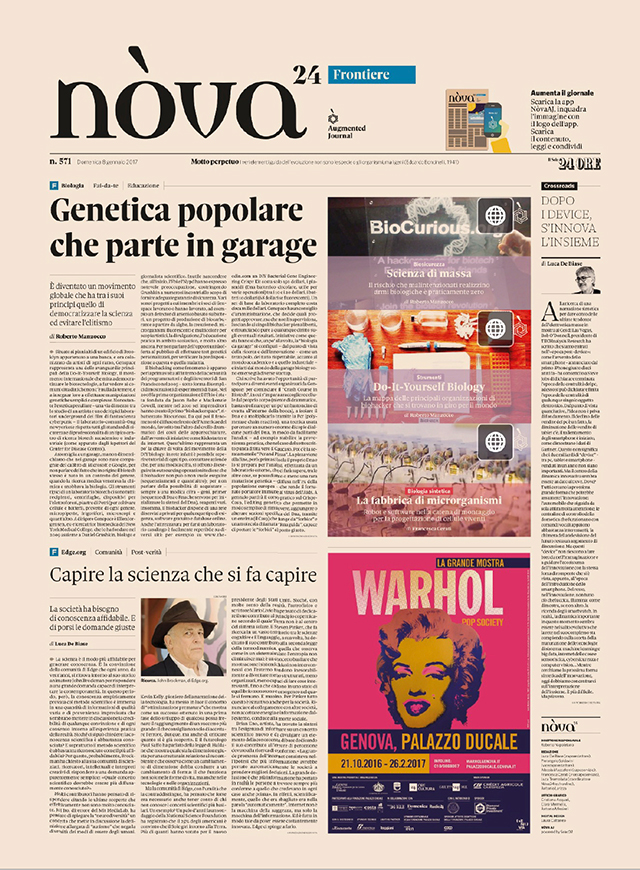
Science is the most reliable way to generate knowledge. This is the conviction of the Edge community which every year, for the past twenty years, has gathered around its long-time driving force John Brockman to answer a big question through which we can supposedly arrive at the edge of knowledge. In this period, however, knowledge empirically derived by the scientific method reveals an amount of information of varying quality and varied provenance which would seem to question the credibility of any belief and any consensus on the practical experience of reality. So one might ask: do we know enough about scientific knowledge? And, above all, can the scientific method be recognized as the most reliable? This is probably why Brockman asked his community of scientists, researchers, intellectuals, and creative interpreters to answer a seemingly simple question: "What scientific term or concept ought to be more widely known?"
Many contributors decided to respond by citing the latest discoveries that are actually not well known. Joi Ito, Director of the MIT Media Lab, described Neurodiversity, a concept that challenges the definition of "autism" and embraces the diversity of ways of being human. Kevin Kelly, a pioneer in the narrative of technology, highlighted the concept of Premature Optimization to show that a success obtained in the first phase of a project’s development can put a brake on a bigger success: which is a recommendation for not only accepting the mistake but also for maintaining a critical attitude regarding what has already been discovered. And the Futurist Paul Saffo wrote about Haldane's Rule of the Right Size, which shows every organism has an optimum size and a change in size inevitably leads to a change in form, which is applicable not only to organisms, but also to technologies and organizations.
But the Edge community, with its distinguishing humility, thought that it was necessary to also take into account those who don’t know the most basic scientific concepts. An example? A couple of years ago a survey from the National Science Foundation reported that 25% of Americans are convinced that the Sun revolves around the Earth, more Americans than those who voted for the new President of the United States. So, with great sense of reality, astrophysicist and author Mario Livio decided to dedicate his contribution to The Copernican Principle, which states that the Earth is not at the center of the solar system. And Steven Pinker, who does research in a vast territory between cognitive science and language, in turn, has devoted his contribution to The Second Law of Thermodynamics, which states that in an isolated system (one that is not taking in energy), entropy never decreases. It is a basic concept that shows how closed systems not interconnected with the outside tend inexorably to become less structured, less organized, less able to do interesting things, until they fall into a monotonous and uniform situation where they stop. And die. For Pinker, this is instructive for society. Giving up the liaison with the other societies, not accepting energy and information from outside, leads to social death.
In writing about Confirmation Bias, the artist Brian Eno has found a balance between the need to provide information about a new scientific concept and to divulge an element of basic knowledge by dedicating his contribution to the error of perception due to the search for confirmation: “The great promise of the Internet was that more information would automatically yield better decisions. The great disappointment is that more information actually yields more possibilities to confirm what you already believed anyway.” In fact, scientifically, what was wrong was the word "automatically." The internet is not the wisdom machine, but only the information machine. But it was conceived in such a way that it is constantly renewed through innovation. This is what Edge pushed us to do.


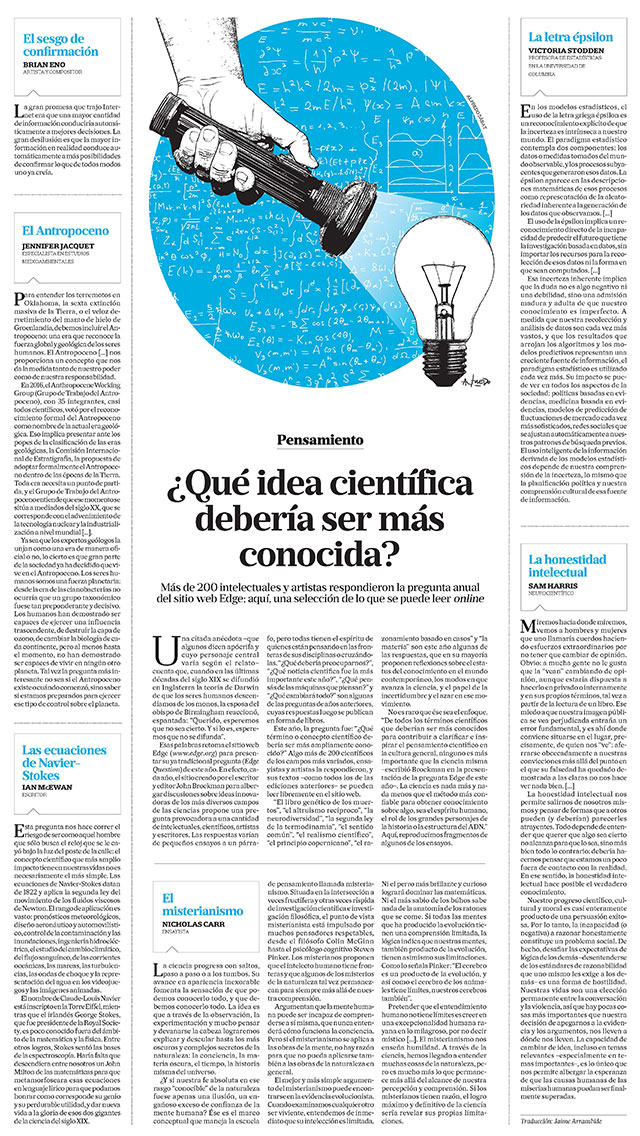
One cited anecdote—which some say is apocryphal and whose central character varies according to the story—tells us that when, in the last decades of the nineteenth century, Darwin's theory that humans descended from monkeys spread in England, the wife of the bishop of Birmingham responded, shocked: "Dear, let's hope it is not true. And if it is, let's hope it does not spread."
Those words take up the Edge website to present its annual question ( Edge Question ) this year. Every year, writer and publisher John Brockman hosts discussions on innovative ideas from the most diverse fields of science and proposes a provocative question to a number of intellectuals, scientists, artists and writers. Answers vary from small essays to a paragraph, but all have the spirit of those who are thinking about the boundaries of their disciplines or crossing them. "What should we care about?" "What scientific news was the most important this year?" "What do you think about the machines you think?" "What will change everything?" These are some of the questions from previous years, whose answers are then published in the form of books.
This year, the question was: "What term or scientific concept should be most widely known?" More than 200 scientists from the most varied fields, essayists and artists responded, and their texts—like all previous editions—can be freely read on the website.
"The Genetic Book of the Dead," "Reciprocal Altruism," "Neurodiversity," "The Second Law of Thermodynamics," "Common Sense," "Scientific Realism," and "The Copernican Principle," are some of the answers this year, which mostly propose reflections on the status of knowledge in the contemporary world, the ways in which science advances, and the role of uncertainty and chance in that movement.
It is not uncommon for that to be the approach. "Of all the scientific terms that should be better known to help clarify and inspire scientific thinking in general culture, none is more important than 'science' itself," Brockman wrote in presenting this year's Edge question. "Science is nothing more nor less than the most reliable way of gaining knowledge about anything, whether it be the human spirit, the role of great figures in history, or the structure of DNA." Here, we reproduce excerpts from some of the essays.
Confirmation Bias (Brian Eno), The Anthropocene (Jennifer Jacquet), Navier-Stokes Equations (Ian McEwan), Mysterianism (Nicholas G. Carr), Epsilon (Victoria Stodden), Intellectual Honesty (Sam Harris)

We generally consider knowledge to be a desirable commodity. But there are situations where people voluntarily forgo information - and those in which ignorance is even practical.

Major thinkers, researchers, and scientists present twelve concepts that everyone should know and which produce fertile new hypotheses.

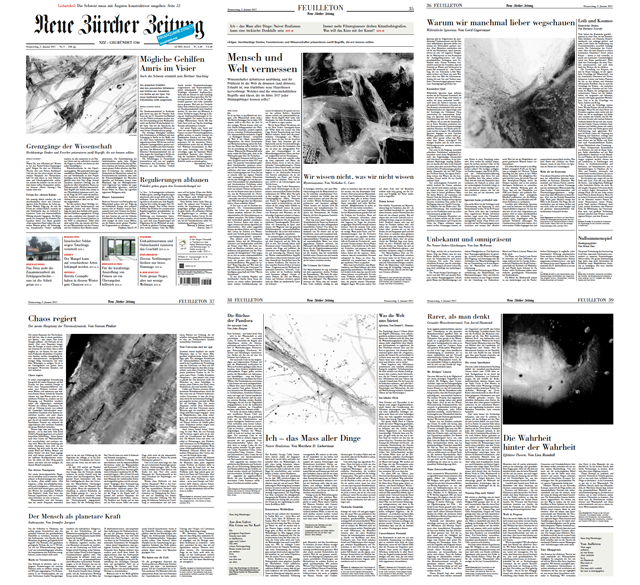
The phrase is as apodictic as it is arrogant: "Science does not think." When Martin Heidegger pronounced it in 1951, he had his finger on the pulse of his time. These few words do not only express a fresh self-assurance of philosophy, but also a newly awakened awareness of problems.
The scientific and technological approach, according to Heidegger's findings, transforms the world into an object of human manipulation which ultimately will threaten the very existence of man through the atomic bomb and human genomics. The tone is unmistakably apocalyptic. While science does not know where it is going, philosophy sees it quite clearly: into ruin.
Heidegger's statement resonates to this day. Even in 2017, it is still de rigeur for a certain kind of intellectual from the humanities department to look down on natural sciences, despite all inter- and transdisciplinary efforts. They don’t usually judge on the basis of their own knowledge or of a presumably higher insight like Heidegger—who was, after all, well acquainted with the most recent findings which physics and biochemistry had brought forth in his time. Rather, they do it ignorantly and from a safe distance, cultivating with considerable fuss what hermeneutics calls a "prejudice": Since our mental life is so rich, what should evolutionary theory or microbiology have to teach us about the human being, this insolvable riddle?
All of our lives are changed fundamentally, and with enormous speed, in the wake of contemporary science and technology
Thus we have been taught in our studies: the humanities want to understand the life of the human spirit, while the natural sciences are trying to explain the phenomena of nature. The two areas are completely different in methodology, and their representatives have nothing to say to each other; there can be nothing but misunderstandings. But even sophisticated hommes de lettres experience today how, in the wake of science and technology, our life is changing fundamentally—and with enormous speed.
This also affects their self-understanding. Do philosophers, literati, and intellectuals continue to regard themselves as interpreters of a world which appears to them only as a black box, and therefore, as it were, specialize in the consolation of their peers? Or do they dare to reconsider the great old questions, not evading the friction with new scientific knowledge: What exactly is life? When did it begin? How does man tick? How deep is the universe? Is the universe a computer? Is there intelligence outside the earth? What is consciousness?
We live in one of the most exciting periods of cognitive activity in the history of mankind —John Brockman
The British physicist and writer Charles Percy Snow had outlined the profile of this new kind of intellectual already half a century ago. He spoke of men of the "third culture", equally well-versed in literature as in science. But Snow's concept remained a dead letter until John Brockman adopted it 25 years ago.
Who is this man? Brockman, who was part of the New York avant-garde scene of the 1970s with people like John Cage, Robert Rauschenberg and Andy Warhol, found his way from the outskirts of experimental art into science, which he regards as a kind of creative practice. The focus of his interest is on cybernetics and evolutionary biology, and his growing certainty that we are "living in one of the most exciting periods of cognitive activity in the history of mankind" compares most closely with the spirit of the Renaissance.
Edge is a cybersalon for extensive scientific debate with a claim to be at the edge of knowledge.
Brockman first saw himself as a homo universalis and man of the third culture, before he set himself up as an "intellectual universal impresario" (David Brooks), putting himself in the service of this culture in order to earn money. In the 1980s, he began to build up a vibrant network of authors working at the interface between natural sciences and humanities. He represents many of them as a literary agent, some of them to this day.
This New York Humanist milieu evokes memories of the productive, adventurous Parisian intellectual scene of the 1960s. Today's thinkers, however, do not see their task in hagiographical interpretation of the texts of founder figures (Marx, Nietzsche, and Freud) in order to prove themselves the only true disciples. Rather, the new authors take up inspiring ideas from Darwin, Neumann, or Maturana, in order to more precisely conceive our living present.
Instead of an exegetic look at the rear-view mirror, then, we find a robustly optimistic will to shape the future. No doubt there is a lot of hubris in the game, but just as much daring and the healthy self-confidence of science-savvy intellectuals who insist on living up to their curiosity.
This is how Edge came into being: a cybersalon designed for wide-ranging and accessible scientific debate with the claim to be at the edge of knowledge. For twenty years, John Brockman has put a question before his community at the end of every year and the responses are published at the stroke of midnight on New Year's Eve on www.edge.org. The 2017 Question is: "What scientific term or concept ought to be more widely known?" You can read a selection of the responses in this Feuilleton. Some of the authors provide science fiction in the best sense of the word—fragments from the workshop of speculative-narrative reason. We intend to cultivate this discipline more consequently in the NZZ Feuilleton. A look into the intellectual laboratory of the future must be an integral part of a discourse oriented towards the true, the good and the beautiful.
Translation of René Scheu's essay from German and articles from English: Angela Schader. Design concept and images (macro shots of the ice on the Lago Bianco): Reto Althaus.
Here the twelve posts:
Mysterianism (Nicholas G. Carr), Deliberate Ignorance (Gerd Gigerenzer), Navier-Stokes Equations (Ian McEwan), Embodied Thinking (Barbara Tversky), The Second Law of Thermodynamics (Steven Pinker), The Anthropocene (Jennifer Jacquet), Naïve Realism (Matthew D. Lieberman), Affordances (Daniel C. Dennett), The Neural Code (John Horgan), Common Sense (Jared Diamond), Effective Theory (Lisa Randall)

Theories that will change our everyday life in the year just begun according to 206 great researchers and intellectuals from around the world

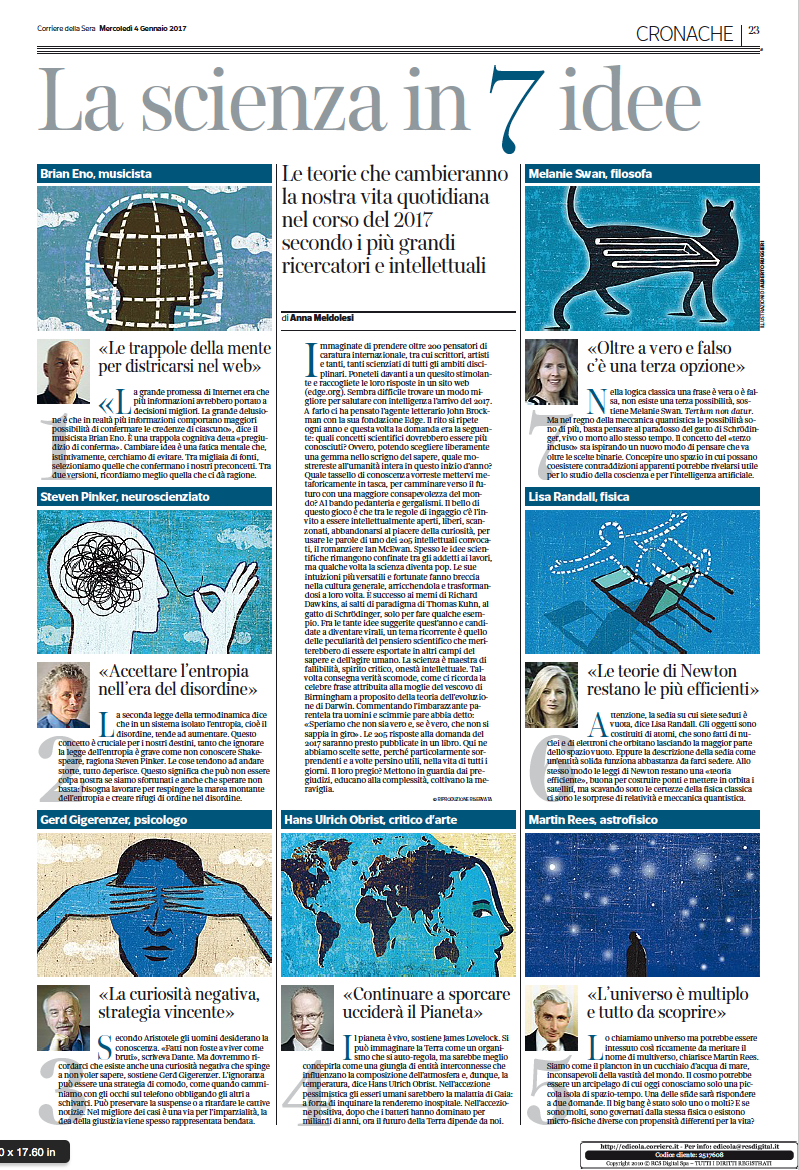
Imagine taking over 200 international thinkers, including writers, artists and many, many scientists of all disciplines. Place them in front of a challenging question and collect their responses on a web site. It seems difficult to find a better way to greet with understanding the arrival of 2017. To do so we thought the literary agent John Brockman with his Edge Foundation. The ritual is repeated every year and this time the question was the following: “What scientific term or concept ought to be more widely known?” That is, being able to choose freely a bud in the casket of knowledge, which you would show humanity at the beginning of this year. What piece of knowledge do you want to put metaphorically in your pocket, to walk toward the future with a greater awareness of the world? And do it with without pedantry and jargon. According to the novelist Ian McEwan, one of the 206 intellectuals invited to participate, the beauty of this game is that among the rules of engagement there is the invitation to be open-minded, free ranging, intellectually playful, to indulge in the unadorned pleasure in curiosity.
Scientific ideas often remain confined among insiders, but sometimes science goes mainstream, and the most versatile and fortunate intuitions breach into the general culture, enriching it, and changing it in turn.
This happened to the memes of Richard Dawkins, to the paradigm jumps of Thomas Kuhn, to Schrödinger’s Cat, just to name some examples. Among the many ideas suggested this year, and candidates to become viral, a recurring theme is that of the peculiarities of scientific thought that would deserve to be exported to other fields of human knowledge and action is that science is a master of failure, critical spirit, intellectual honesty. Sometimes it delivers uncomfortable truths, as it reminds us of the famous phrase attributed to the wife of the Bishop of Birmingham on Darwin’s theory of evolution. Commenting on the embarrassing kinship between men and monkeys she apparently said: "Hopefully it is not true and, if it is true, that you do not know around".
The 206 responses to the 2017 question will eventually be published in a book. Here we have seven contributions, selected because they are particularly surprising and sometimes even useful in everyday life. Their merit? They warn of prejudices, educate complexity, cultivate wonder.
Confirmation Bias (Brian Eno), The Second Law of Thermodynamics (Steven Pinker), Deliberate Ignorance (Gerd Gigerenzer), Included Middle (Melanie Swan), Effective Theory (Lisa Randall), Multiverse (Martin Rees)

What scientific term or concept should be more widely known in the year ahead? Six answers from leading thinkers.
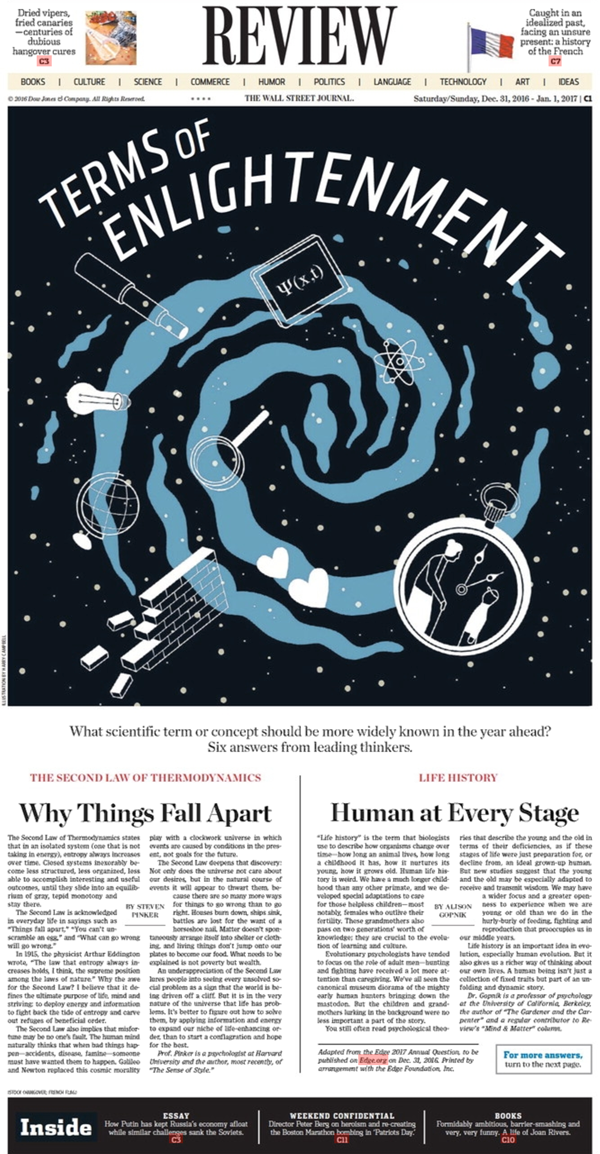
The Second Law of Thermodynamics (Steven Pinker), Life History (Alison Gopnik), Positive Illusions (Helen Fisher), Common Sense (Jared Diamond), The Law of Small Numbers (Adam Alter), Complementarity (Frank Wilczek), The Copernican Principle (Mario Livio), Effective Theory (Lisa Randall)

On the occasion of presenting two facilities in the Kirchner Cultural Center, the legendary musician and producer Brian Eno went through Buenos Aires, in what was his first visit to Argentina. ... In 2012 he published one of 125 essays in the book What is going to change everything?, edited by John Brockman, editor of ... edge.com. Most of the responses, written by authors such as Ian McEwan, Nassim Taleb, Steven Pinker or Ricahrd Dawkins, coming down the side of the artificial intelligence, synthetic biology, physics or astronomy.
Eno, which in the past produced albums by U2, Talking Heads and Coldplay, among others, was on the other side. His answer to What is going to change everything? It was "the feeling that things will get worse." "What will change everything is not a thought but a feeling" ...
For Eno, "the development of mankind so far was driven by the idea that things, with high probability, will be better in the future. The world was rich in relation to its population, there were new lands to conquer, new thoughts to discover and exploit new resources. the great migrations of history was implemented from the projection that there was a better place. But what if this feeling changes?"

"With Big Data we can now begin to actually look at the details of social interaction and how those play out, and are no longer limited to averages like market indices or election results. This is an astounding change."- Professor Sandy Pentland - leading specialist in data science at Massachusetts Institute of Technology, USA - above Edge.org.
Pentland had ambitions to reinvent human society on a large database platform. He believes that with scientific data, one can understand the operating system to generate human society of the future system stable and safe. Thus, the financial system is not disturbed, paralyzed government and the health system will actually work effectively.
"The ability to see the details of the market, of political revolutions, and to be able to predict and control them is definitely a case of Promethean fire—it could be used for good or for ill, and so Big data brings us to interesting times. We're going to end up reinventing what it means to have a human society." - Professor Sand Pentland said.

The world of innovation, entrepreneurial and technological singularity is full of parallels with religion: there are prophets, pilgrimage centers (Silicon Valley, Tel Aviv, Seoul, Shenzhen), tribes of believers, heretics and revealed truths. The commonalities could become a simple curiosity, a thesis topic of a humanistic career, if not because there is a group of technologists and experts on this agenda who believe this cogency of religious values acts as a bias that could lead to wrong projections. And the forecasts of vehicles without human drivers, lives of hundreds of years, end of employment, to travel by virtual reality and other phenomena that are as inexorable from the field of innovation could be saying more about our present, with its molded psychological and cultural patterns in thousands of years, about the future. . . .
In the movie 2001 Space Odyssey, filmed in 1969, Stanley Kubrick imagines a future of space travel, but all women of history are hostesses, assistants or secretaries: the director did not foresee the gender revolution of the 70s. Steven Pinker talks about this in his essay in the book This Will Change Everything, published by the director of the website Edge, John Brockman.
This approach leads to the conclusion that the existence of certain technology is a necessary and sufficient condition for a large-scale social change associated with that progress in a short time. . . .

Speculation comes to mind of a reigning "social mood" in recent days, with a local reality in gray tone that combined corruption scandals, economic recession and defeat in the Copa America, and that in turn matches no less daunting international context, between Brexit, the prospect of Donald Trump winning the election in the United States, terrorist attacks and turbulence in the markets. These were the dominant themes in the media and on social networks in recent days. ...
Six years ago, John Brockman, editor of Edge.org, published a book with 125 short essays written by several of the most influential thinkers in the world, who attempted to answer the question: "What is going to change everything?" The texts were authors like Richard Dawkins, Ian McEwan, Nassim Taleb, Steven Pinker, Freeman Dyson and Jared Diamond, among others.
Most responses came from the field of artificial intelligence, synthetic biology, physics and astronomy (the most repeated response will change what all was the discovery of intelligence beyond Earth).

This month’s Insights column was an attempt to use simple puzzles to highlight the consequences of the infinity assumption in the physical world. The idea was sparked by an article by the physicist Max Tegmark that was written for the book, "This Idea Must Die." Tegmark’s article is excerpted in a blog at Discover magazine under the title, "Infinity Is a Beautiful Concept — and It’s Ruining Physics."

In the past week I seized the opportunity to meet two foreign role models who visited the country.
One is the theoretical physicist Lisa Randall. The other is the artist Brian Eno.
Lisa Randall...spoke to Science & Cocktails in Christiania, which I blogged about here. And she is the person who to me has opened the magic of the laws of physics (and our limited senses to understand it) with books like 'Knocking on Heaven's Door' and her totally humble nature.
Then there's Brian Eno.
...[H]is cooperation with Stewart Brand and The Long Now Foundation and involvement in the anthology This Will Make You Smarter (published by Edge and which each year asks experts in their field an ambitious questions - and to the anthology this year was: "WHAT IS THE MOST INTERESTING RECENT SCIENTIFIC NEWS?"), I found out that Eno is actually deeply ambitious about the world's development while he is a great artist.

...[I]f you’ve been paying attention to the news for the past several years, you’ve almost certainly seen articles from a wide range of news outlets about the looming danger of artificial general intelligence, or “AGI.”
Steven Pinker...for the website Edge.org:
The other problem with AGI dystopias is that they project a parochial alpha-male psychology onto the concept of intelligence. Even if we did have superhumanly intelligent robots, why would they want to depose their masters, massacre bystanders, or take over the world? Intelligence is the ability to deploy novel means to attain a goal, but the goals are extraneous to the intelligence itself: being smart is not the same as wanting something. ...

[Mary Lou Jepsen's] vision is broad and sweeping: it runs from a new generation of extremely high-resolution, affordable MRI machines for early detection of cancer, heart disease, and more, to a far-out time (or maybe not so far-out) when machines can read people’s minds and people can communicate—with each other and maybe even with animals—via thoughts.
The idea “leverages the tools of our times,” Jepsen says, citing advances in everything from physics to optoelectronics to consumer electronics to big data and A.I. that can be combined to shrink the size, improve the functionality, and lower the cost of MRI. “I could no longer wait. I’m still writing up the patents. But I am incredibly excited to strike off on this direction,” she says.
The startup, whose name has not previously been released as far as I can tell, is called Open Water (it could also be OpenWater, “not sure yet…either is OK for now,” she says). “Peter Gabriel gave me the name. He is a great advisor,” Jepsen says. In particular, she was inspired by this article he wrote for Edge.org, called Open Water–The Internet of Visible Thought, in which he credited Jepsen for introducing him “to the potential of brain reading devices.”

Mathematician/economist Eric R Weinstein is managing director of Thiel Capital, but that doesn't mean that he thinks capitalism has a future.
In a short, but wide-ranging essay in Edge's Annual Question series (this year's question is "What do you consider the most interesting recent [scientific] news? What makes it important?"), Weinstein talks about the fundamentally transformative nature of software-based societies and the challenges they put to the nature of work and economics. ...

Like many people nowadays, I do not talk on my iPhone as much as talk to it. That’s because it runs a program called Siri (Speech Interpretation and Recognition Interface) that works as an intelligent personal assistant and knowledge navigator. It’s useful, in a way. If I ask it for “weather in London today”, it’ll present an hour-by-hour weather forecast. Tell it to “phone home” and it’ll make a decent effort to find the relevant number. Ask it to “text James” and it will come back with: “What do you want to say to James?” Not exactly Socratic dialogue, but it has its uses.
Ask Siri: “What’s the meaning of life?”, however, and it loses its nerve. “Life,” it replies, “is a principle or force that is considered to underlie the distinctive quality of animate beings. I guess that includes me.” Ten points for that last sentence. But the question: “What should I do with my life?” really stumps it. “Interesting question” is all it can do, which suggests that we haven’t really moved much beyond Joseph Weizenbaum’s famous Eliza program, which was created in the MIT Artificial Intelligence Laboratory between 1964 and 1966. . . .
. . . [O]ften what really matters to us humans is stuff that we have difficulty articulating.
What’s brought this to mind is an extraordinary interview with Stephen Wolfram that’s just appeared on John Brockman’s Edge.org site. The term “genius” is often overused, but I think it’s merited in Wolfram’s case. Those of us who bear the scars from school and university years spent wrestling with advanced maths are forever in his debt, because he invented Mathematica, a computer program that takes much of the pain out of solving equations, graphing complex functions and other arcane tasks. But he’s also worked in computer science and mathematical physics and is the founder of the WolframAlpha “computational knowledge engine”, which is one of the wonders of the online world. . . .

In the 1960s he was a performance artist, he is now a literary agent in New York, his specialty: bringing ideas of renowned scientists to the people. John Brockman...put out a new book, and writes the question..."What scientific idea is ready for retirement?"
"Only a few really new ideas are developed, without giving up first older. In other words, science progresses through a series of funerals ahead. [But] why wait so long? What established scientific idea is mature enough to be pushed aside, so science can move forward?" ...
[E]nlightening and very entertaining.

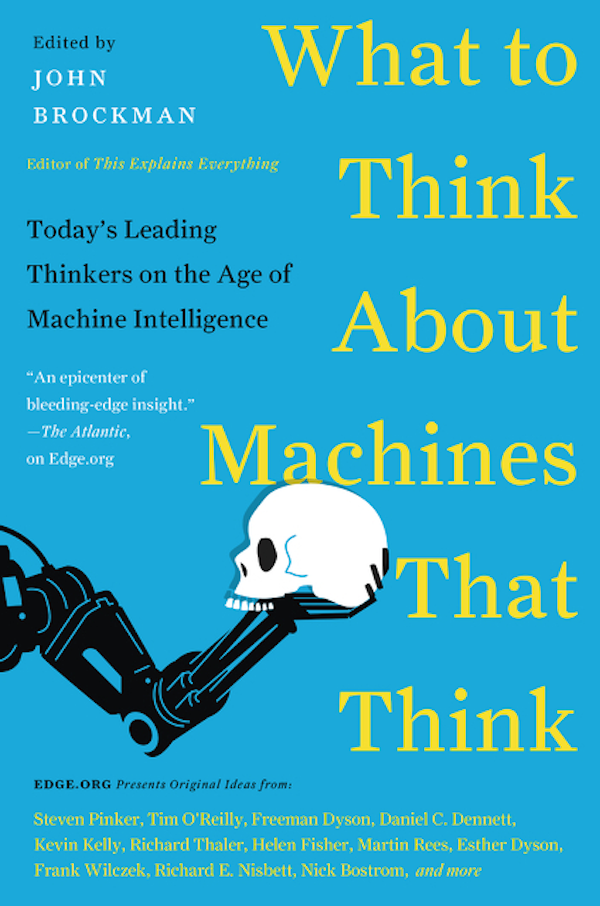 ...[W]ith the culmination of decades of progress in building advanced computing devices and machine learning putting the world on the cusp of true AI, the ground is finally fertile for philosophers, scientists and all manner of other experts and thinkers to jump into the discussion with their own vision of the future of the thinking machine.
What to Think About Machines That Think is a compilation of incredibly short essays on AI, edited by John Brockman ... literary agent to some of the finest minds of our times. ...
Brockman currently runs the ‘online science salon’ edge.org (which The Guardian once called “the world’s smartest website”). The Edge Question, which he poses every year to his extended network of exceedingly intelligent friends and clients, is a simple, direct question that seeks to push the boundaries of understanding on a burning scientific issue.
Year 2015’s question prompts respondents to ruminate on the potential technological, ethical and even emotional issues that will arise when the first machines start to think independently. ...

Every year, the site Edge.org a question to about 200 people at the research frontiers. Among those surveyed are geneticists, physicists, philosophers, people who work with artificial intelligence, plus the odd wild card, as Kai Krause (maybe someone will remember the wayward landscape modeling program Bryce; it was his work). The questions of the type "What have you changed your opinion about?" Or "What a scientific idea, it is time to retire?" The aim is to provoke thoughtful responses. This year was the question "What is the most interesting scientific news?"
The answers are not always intellectually dope, but together they provide a snapshot of what is going on in the various research fields. What will we learn about in the next few years? Bacteria. The realization that man is dependent on the interaction with bacteria and parasites are breaking through.The bacteria on us and in us control gene activity in our bodies, writes bioantropologen Nina Jablonski. A poorer bacterial flora can lead to obesity, allergies, possibly autism. Perhaps we will soon see ads for bacterial smoothies to everything from obesity to depression.

Theoretical physicist Stephen Hawking is on record about the rising class of technology that can perform almost any conceivable task, from driving us to work to babysitting our children. His dour outlook, expressed to the BBC in 2014: “I think the development of full artificial intelligence could spell the end of the human race.”
Hawking says the primitive AI we’ve known to date — the kind that switches on the air-conditioning before you get home from work — is useful enough. But he fears the next stage, when intelligent, thinking machines can independently improve themselves and begin to determine their own destinies. Will that ability exceed humans’ ability to contain it? What then? Where will humans fit into an AI world? Will the robots have any use for us?
These questions are not so farfetched to the nearly 200 scientists, scholars, artists and public intellectuals who contributed essays for the recently released book What to Think About Machines That Think, edited by John Brockman. Few are as pessimistic as Hawking, but most agree humans should be busy thinking through our future coexistence with the new class of being now under construction. Will they serve us? Will we serve them? Or will we somehow merge into a single, super-being? ...

Nature and nurture are twin words essentially associated with the developmental process of human beings. ... In their 2014 survey of scientists, Alison Gopnik and Edge submit that many respondents wrote that the dichotomy of nature versus nurture has outlived its usefulness, and should be retired. The reason is that in many fields of research, close feedback loops have been found in which “nature” and “nurture” influence one another constantly (as in self-domestication), while in other fields, the dividing line between an inherited and an acquired trait becomes unclear (as in the field of epigenetics or in fetal development). (Edge.org and Gopnik).

What made the father of artificial intelligence so unforgettable was his extraordinary real-life mind
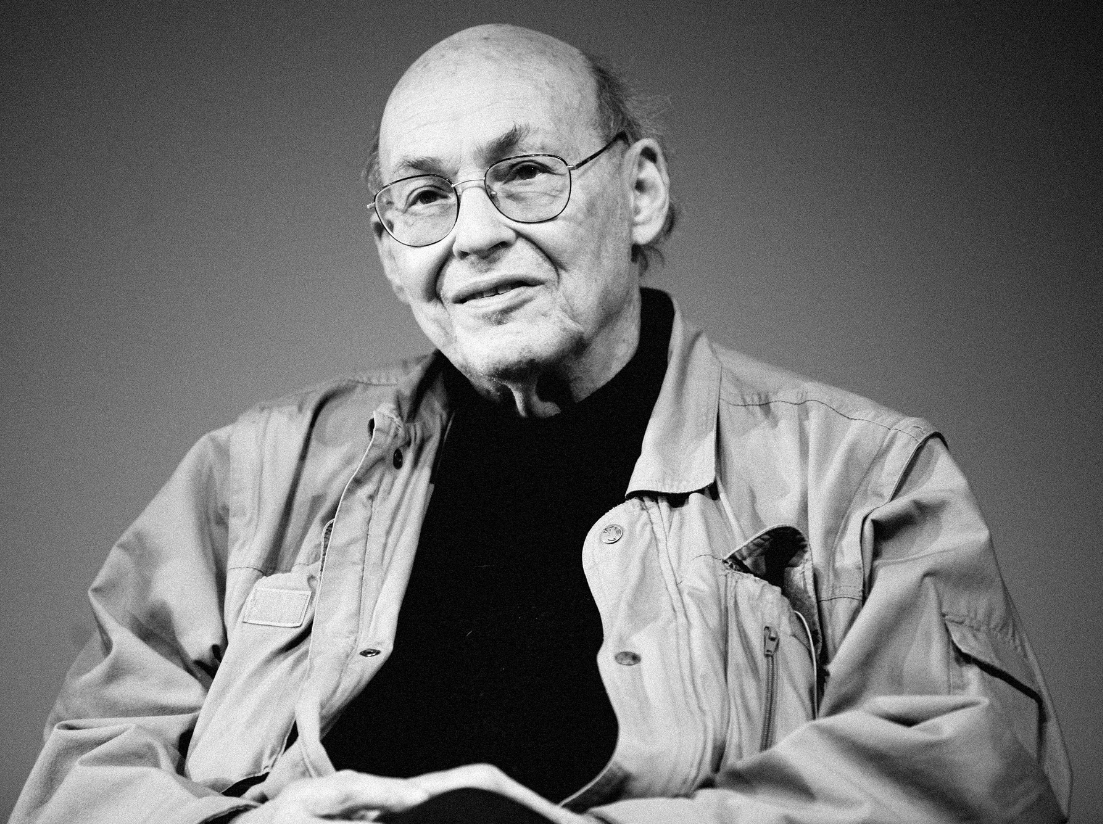
There was a great contradiction about Marvin Minsky. As one of the creators of artificial intelligence (with John McCarthy), he believed as early as the 1950s that computers would have human-like cognition. But Marvin himself was an example of an intelligence so bountiful, unpredictable and sublime that not even a million Singularities could conceivably produce a machine with a mind to match his. At the least, it is beyond my imagination to conceive of that happening.
But maybe Marvin could imagine it. His imagination respected no borders.
Minsky died Sunday night, at 88. His body had been slowing down, but that mind had kept churning. He was more than a pioneering computer scientist — he was a guiding light for what intellect itself could do. He was also our Yoda. The entire computer community, which includes all of us, of course, is going to miss him.
I first met him in 1982 ... I would run into him here and there over the decades. Sometimes, we’d run into each other and talk; other times I’d hear him speak. In 2002, at asummer gathering at the Connecticut farm of Edge.org’s founder John Brockman, a few top scientists were asked to comment on “their universes.” Minsky’s rambling rejoinder was classic:
“To say that the universe exists is silly, because it’s saying that the universe is one of the things in the universe. . . So we have to conclude that it doesn’t make sense to ask about why this world exists. However, there still remain other good questions to ask, about how this particular universe works.” ...
In recent years, whenever Minsky spoke, he would take on a topic and put an astonishing spin to it, whether it was a theory of why people loved musicso much, a stab at determining what made things funny, or a challenging theory of the nature of health. To the last, he was opening minds with his unparalleled meat machine. ...

There is a community called Edge, which publishes non-fiction materials written by scientists. In particular, in recent years it has annually announced "the question of the Year" and the answers to it by leading scientists of the world. The question of 2016 was the following: "What do you think is the most interesting recent scientific news? What makes it important? " In response, 198 scientists participated from different fields ... Each question is carefully thought out ... a sort of voiced firsthand digest of the new learned science ...

From Gene-knives and autistic neurons: The Scholars Association "Edge Foundation" asked well-known researchers, what is revolutionizing the sciences.The result is a fascinating kaleidoscope of new knowledge and methods.
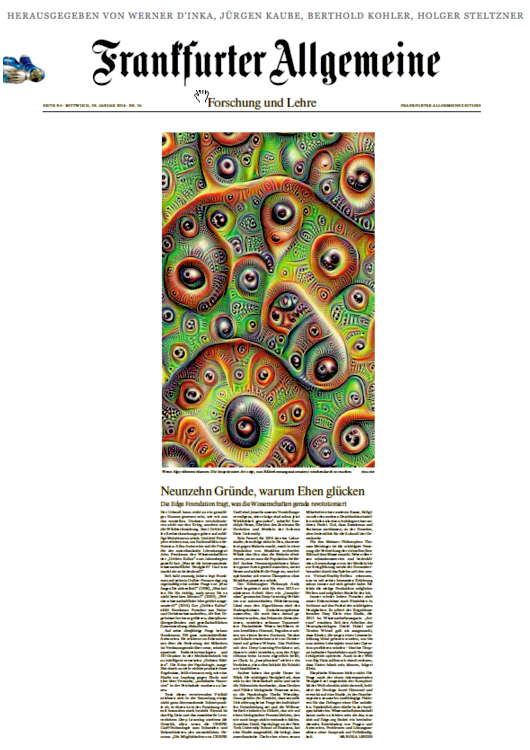
The big bang may not have been such a huge thud, as we imagine. Drones revolutionize not only the war, but also the research on wild animals. Two-thirds of all cancers are due to random mutations. And three principles are sufficient to define rationality. All answers to the question placed before the scientists of the "Third Culture" of American literary agent John Brockman: "What is the most interesting scientific news? And what makes them so important?"
For almost twenty years Brockman puts on his online forum edge.org regularly such a question: "What do you think is right, even if you can not prove it?" (2005), "What do you ask yourself?" (1998), "What is the scientific idea is ready for retirement?" (2014). For "Third Culture" is one of Brockman researchers from natural sciences and humanities, discuss their findings in a larger, multi-disciplinary and social context.
In his this year's question Brockman got 198 very different answers. They range from knowledge about the importance of microbes in the digestive tract of new, resource-saving battery technologies and 3D printers in the medical technology to intelligently networked "green cities". The crisis of psychology, triggered by too many non-reproducible results, just missing a little like a study for vaccination against Ebola and one of the testing, "autistic neurons" to grow in the petri dish. [Continue...]
Read highlighted contributions from: Randolph Nesse, Andy Clark, Thalia Wheatley, Thomas Metzinger, Gary Klein, Jared Diamond.

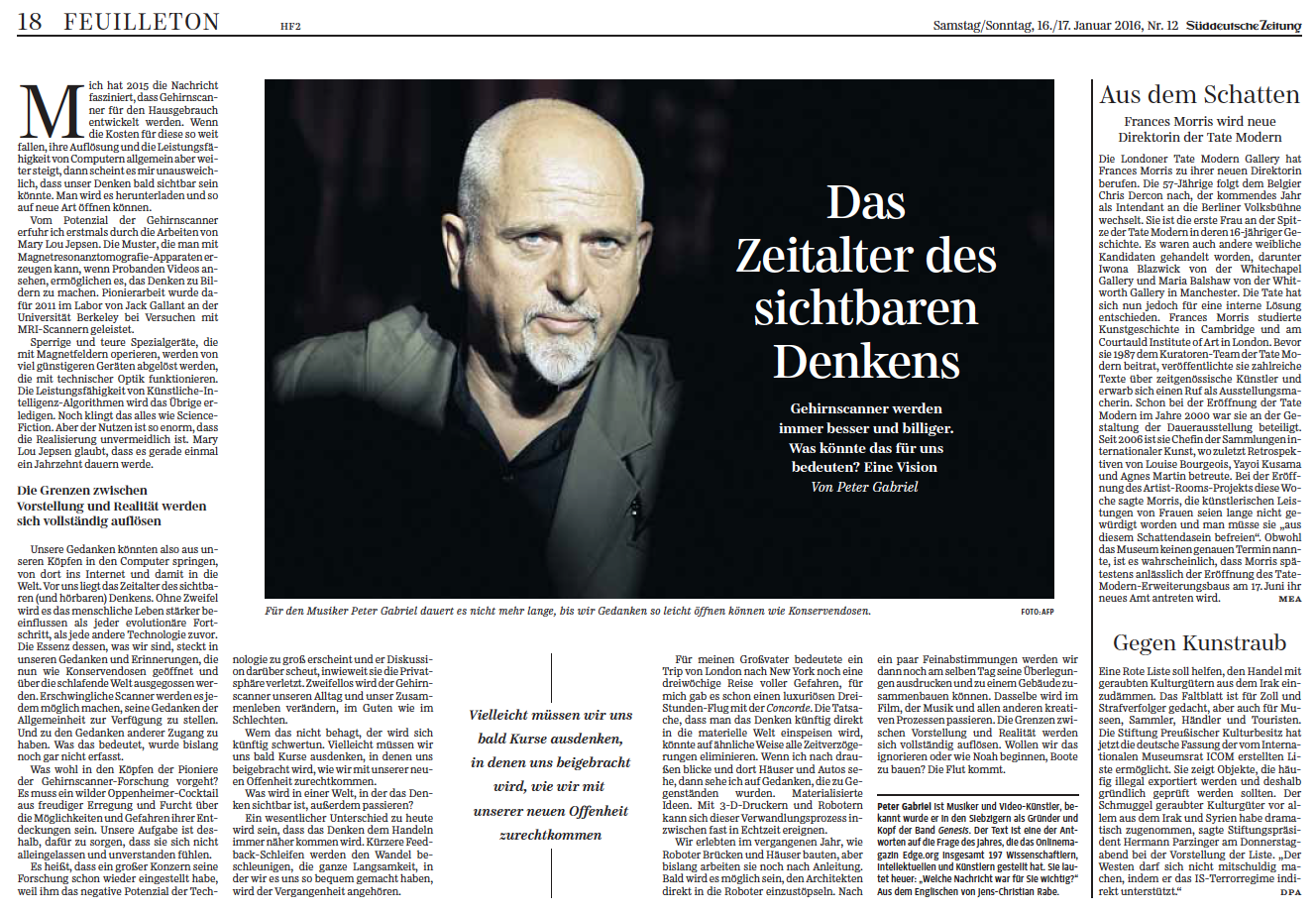
Caption: For musician Peter Gabriel it might not take long until we open our thoughts as easily as a can.
Brain scanners are getting better and cheaper. What could this mean for us? A vision. By Peter Gabriel

Scientists and the media are establishing new ways of looking at who is responsible for anthropogenic climate change. This expanded view of responsibility is some of the most important news of our time because who we see as causing the problem informs who we see as obligated to help fix it. By Jennifer Jacquet

A new study shows that men still hold the power in fields of science and art where supposedly only born geniuses succeed. By Rebecca Newberger Goldstein

Prejudice because of race or religion are no longer the biggest threat to Democracy. In America, nothing divides people so much as the party affiliation. By Jonathan Haidt


What do the United States, Suriname, Papua New Guinea and Tonga have in common?
These countries are among the few worldwide that don't offer paid maternity leave at the federal level for new mothers. ...
In a lovely short essay at Edge.org, psychology professor Linda Wilbrecht, a colleague at UC Berkeley, highlights what we do — and don't — yet know about the impacts of early life experiences on later development. High-quality childcare — whether it comes from mom or other caregivers — and a rich, stable environment could have important downstream consequences for individuals and for society.
Wilbrecht's essay is worth a read...


An answer to the "Edge" question of the year: "What Do You Consider the Most Important News?": It has never been as good for humanity as it is today. But progress can only continue if one understands it. By Steven Pinker
[ English, Edge.org | German Translation ]
Introduction: The Club of Edgy Thinkers
By Andrian Kreye, Feuilleton Editor, Süddeutsche Zeitung
Edge.org’s question of the year. What has existed on the website for the past twenty years, presented under the banner of the "Third Culture," is ultimately a classical salon in the digital space. In its initial form Edge was already a club of “edgy” thinkers.
Between 1981 and 1996, the "Reality Club" met in New York in pubs, clubs and apartments. Forerunner of Reality Clubs were notable developments. First, a series of dinners in 1965 organized in the kitchen of a New York townhouse where composer John Cage cooked mushrooms for a group of young New York avant-garde artists, holding forth on the ideas of Norbert Wiener (cybernetics), Marshall McLuhan (communication theory), Buckminster Fuller (systems theory), and Norman O. Brown (social philosophy), among others.
During that same time period, Brockman was invited to co-organize a seminar on cybernetics at Massachusetts Institute of Technology between a group of New York artists and those scientists (colleagues of Wiener, who had died the year before) who were pioneers in the field of cybernetics. The aim of such events was to consider ideas scientific ideas and also to have the artists and scientists ask each other the questions they were asking themselves.
When asked, Brockman takes the tradition much further back. One of the first of such circles is the "Lunar Society of Birmingham” at the end of the 18th century. The scientists, industrialists and philosophers who gathered for dinner included Charles Darwin's grandfather Erasmus. Another member was Benjamin Franklin, a scientist and later a founding father of the United States.
Last year we published excerpts from the answers to the 2015 Edge Question "What do you think of machines that think?". The Question this year was: "What Do You Consider the Most Interesting Recent [Scientific] News? What Makes It Important?” Because the open formulation of this year’s question brought so many differing and detailed answers, the Feuilleton Section of SZ is publishing one unabridged text every day this week. The first is written by the cognitive scientist Steven Pinker. This is followed by the social scientist Jonathan Haidt, the philosopher Rebecca Newberger Goldstein, the environmental researcher Jennifer Jacquet, the rock singer Peter Gabriel, the psychologist Gerd Gigerenzer and the behaviorist Michael McCullough. All 197 answers are available on Edge.org in the original English.


Each year, Edge.org editor John Brockman poses a provocative question to a select group of thinkers. For this year’s installment, nearly 200 brainy contributors were asked: “What do you consider the most recent scientific news?” Here’s what they had to say.
As Brockman notes, “We now live in a world in which the rate of change is the biggest change.” Science, therefore, has “become a big story, if not the big story: news that will stay news.” But given the insane amount of science-related news that makes the rounds on a daily basis, it’s not immediately clear which sciency tidbits are the ones we should be focused on.
To help him parse through this staggering amount of science—and to provide a 50-foot perspective on where we are right now—Brockman recruited some of the biggest names in science, technology, art, and philosophy. Contributors included Martin Rees, Steven Pinker, Gloria Origgi, Freeman Dyson, Max Tegmark, Judith Rich Harris, Peter Gabriel, Nina Jablonski, Bill Joy, Michael Shermer, Kevin Kelly, Gregory Benford, Sean Carroll, Frank Tipler, Steve Omohundro, and many, many others. ...

Online Thinkers forum frontier (Edge.org) since 1998, has put forward thought-provoking topics every year, such as '98: What questions are you asking yourself?; '99: What is the most important invention in the past 2,000 years?; 2006: What is your dangerous idea?; Last year: What do you think about machines that think? This year, editor John Brockman, got nearly 200 thinkers: What do consider the most interesting recent [science] news? What makes it so important?
As a result, 198 experts from physics, astronomy, psychology, archeology, biology, history, computer science, etc. each wrote an essay, including Steven Pinker, Peter Gabriel, Nina Jablonski, Bill Joy, Michael Shermer, Kevin Kelly, Gregory Benford, George Church. ... Several hot topics ran as expected, including research cancer and other diseases, pollution, genetic research, artificial intelligence, quantum physics and gravity research, to find Earth 2.0 and extraterrestrial life. ...

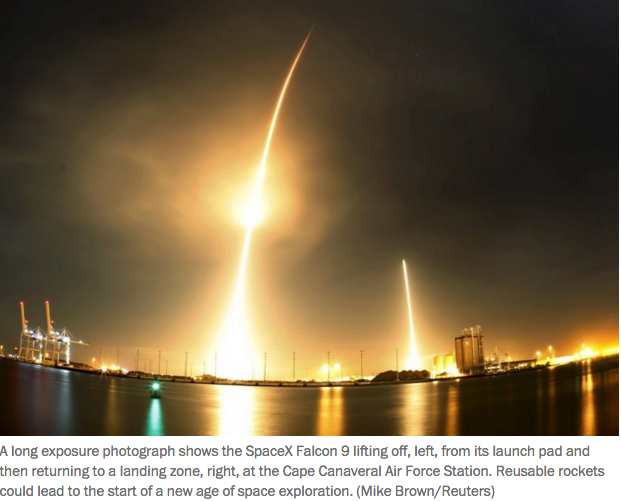
At the end of every year, Edge reaches out to the smartest people on the planet and asks them a single question in an attempt to find the ideas and concepts that are changing the world of science. This year’s two-part question was: “What do you consider the most interesting recent [scientific] news? What makes it important?”
Not surprisingly, this year’s set of 197 responses converged around a few key themes – the human brain, the human genome, space exploration and artificial intelligence. Based on these responses, here are 10 of the edgiest innovation buzzwords that have the greatest potential to change the trajectory of innovation in 2016. ...
Read highlighted contributions from: Max Tegmark, George Dyson, Melanie Swan, Christian Keysers, Abigail Marsh, Kevin Kelly, W. Tecumseh Fitch, Stewart Brand, Thomas Metzinger, and Mark Pagel.


It is time once again for the Edge Annual Question, a mind-bending and boundary-busting online convening of scientists, technologists, and other big thinkers all responding to a single question at the intersection of science and culture. From physicists to artists, cognitive psychologists to journalists, evolutionary biologists to maverick anthropologists, these are people who Edge founder, famed literary agent, and BB pal John Brockman describes as the "third culture (consisting) of those scientists and other thinkers in the empirical world who, through their work and expository writing, are taking the place of the traditional intellectual in rendering visible the deeper meanings of our lives, redefining who and what we are."
This year, John asked: What do you consider the most interesting (scientific) news? What makes it important?" Nearly two hundred really smart people responded, including Steven Pinker, Nina Jablonski, Freeman Dyson, Stewart Brand, Marti Hearst, Philip Tetlock, Kevin Kelly, Lisa Feldman Barrett, Douglas Rushkoff, Lisa Randall, Alan Alda, Jared Diamond, Pamela McCorduck, and on and on.

Big advances in astronomy and genetics
Every year on the website Edge, scientists and other thinkers reply to one question. This year it’s “What do you consider the most interesting recent news” in science? The answers are fascinating. We’re used to thinking of news as the events that happen in a city or country within a few weeks or months. But scientists expand our thinking to the unimaginably large and the infinitesimally small.
Despite this extraordinary range, the answers of the Edge contributors have an underlying theme. The biggest news of all is that a handful of large-brained primates on an insignificant planet have created machines that let them understand the world, at every scale, and let them change it too, for good or ill. ...

Advances in biology and cosmology have dominated the science year
Growing a “brain in a dish”, the prospect of creating designer babies, and the possibility of detecting the first signs of extra-terrestrial intelligence – these are just some of the most important scientific news stories of 2015, according to some of the world’s leading scholars celebrating the year’s achievements.
The question posed to the top thinkers was this: what do you consider the most interesting recent scientific news and what makes it important? Back came a smorgasbord of essay-length answers from more than 100 contributors to Edge.org, the online salon for scientists, philosophers and followers of the “third culture” merging science and the humanities. ...
Read highlighted contributions from: Mark Pagel, George Church, Simon Baron-Cohen, Alison Gopnik, Mario Livio, Martin Rees.

Just about everyone, no matter how tech-enamored or word-weary, appreciates receiving a book as a holiday gift. So, we decided to ask local booksellers which titles have been flying off their shelves — and see whether they had any special recommendations for hidden gems. ...
Jane Stiles at Wellesley Books added that the novels “The Japanese Lover” by Isabel Allende and “Avenue of Mysteries” by John Irving were popular gift choices this year. At Papercuts J.P., one of the area’s newest bookstores, owner Kate Layte said nonfiction has been very popular this year, including many of the titles already mentioned, along with Helen MacDonald’s memoir “H Is for Hawk.”
In addition, Layte said, “there are some great paperback originals I’ve been selling lots of like ‘An Indigenous Peoples’ History of the United States’ by Roxanne Dunbar-Ortiz, ‘The Best American Infographics 2015’ — the editor, Gareth Cook, lives here in JP — and John Brockman’s new collection of essays, ‘What to Think About Machines That Think: Today’s Leading Thinkers on the Age of Machine Intelligence.’ ” A special favorite in fiction is “Katherine Carlyle” by Rupert Thomson. “When folks see the blurbs from James Salter and Phillip Pullman, they can rest assured they’re holding a treasure,” she added. ...

Why should AI scare us? Let’s compare natural vs. artificial intelligence, using Edge’s 2015 big question: What to think about machines that think?
... Alison Gopnik feels machines aren’t nearly “as smart as 3-year-olds.” While AI sometimes outwits Garry Kasparov, it needs millions of pictures (labeled by humans) to learn to recognize cats. Infants need a handful (amazing pattern detectors, + see what babies know, butscientists often ignore). ...

Christmas is coming, and the shopping list is getting fat. So we’re here to give you a hand with at least the ideas stage.
Here at Siliconrepublic.com, we’ve spent the last few weeks creating lists of books that the sci-tech lovers in your life will, well… love.
Our first foray into the world of the must-read saw us pointing you in the right direction on books for those who just can’t get their fill of science knowledge – a serious look at the world of science and technology, if you will.
With this latest list, we look at the other side of that coin. Plenty of knowledge here, too, but with a slightly different flavour.
Compiled by John Brockman, publisher of website Edge.org, This Idea Must Die brings together some of the planet’s leading thinkers and asks them, "What scientific idea is ready for retirement?"
Asking the question of 175 of the world’s leading scientists, artists and philosophers, Brockman elicited answers from a huge range of people. … The most famous book produced from the series is likely This Explains Everything, which was published in 2012, while What To Think About Machines That Think has just been published.
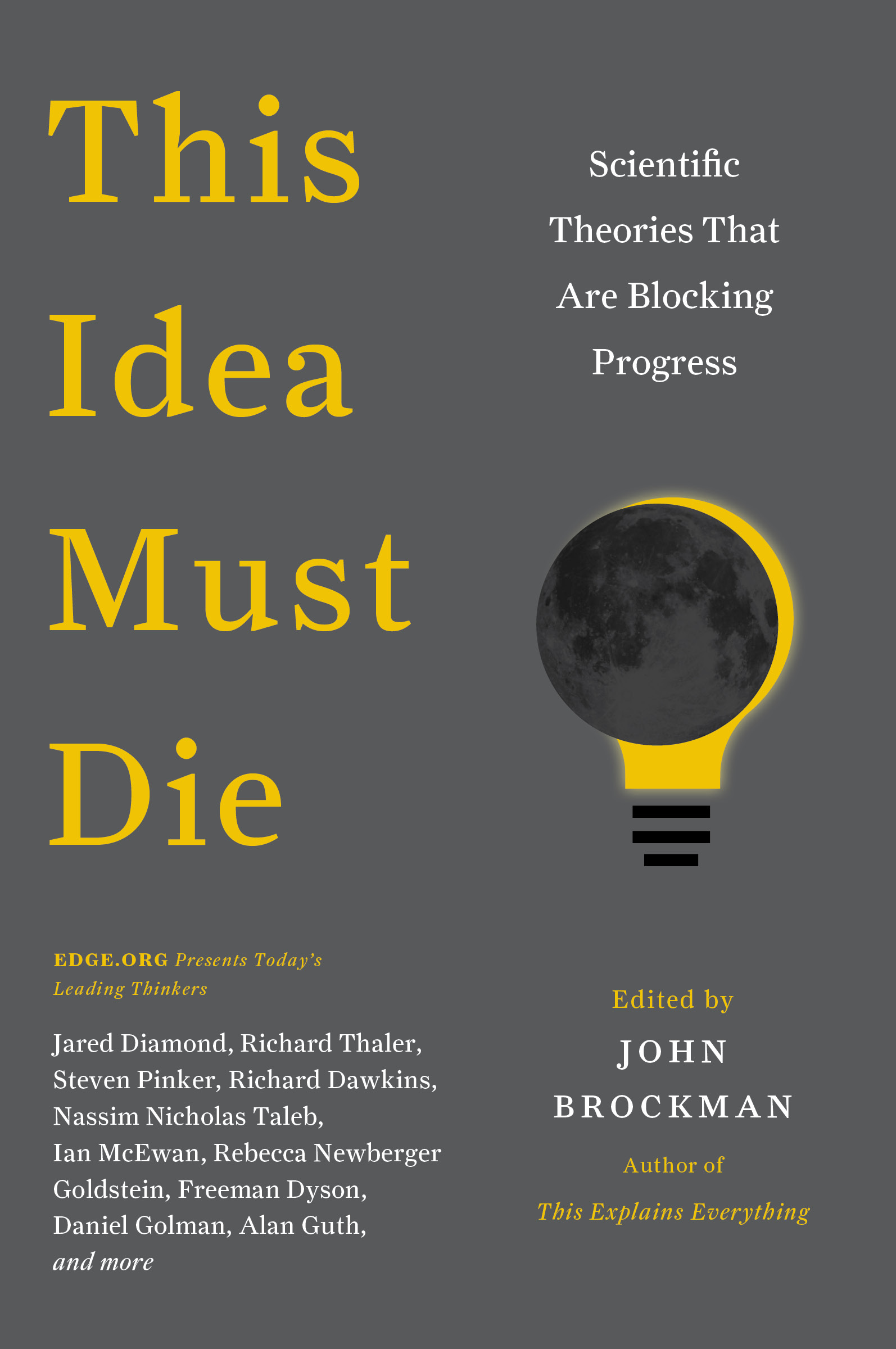


From a blog post, “A Message From Paris,” by British novelist Ian McEwan for edge.org, Nov. 14:
The death cult chose its city well—Paris, secular capital of the world, as hospitable, diverse and charming a metropolis as was ever devised. And the death cult chose its targets in the city with ghoulish, self-damning accuracy—everything they loathed stood plainly before them on a happy Friday evening: men and women in easy association, wine, free-thinking, laughter, tolerance, music—wild and satirical rock and blues. The cultists came armed with savage nihilism and a hatred that lies beyond our understanding. Their protective armour was the suicide belt, their idea of the ultimate hiding place was the virtuous after-life, where the police cannot go. (The jihadist paradise is turning out to be one of humanity’s worst ever ideas; slash and burn in this life, eternal rest among kitsch in the next).
Paris, dazed and subdued, woke this morning to reflect on its new circumstances. ...

On the Web, reputation is a critical currency. But reputation is tricky. The way it's measured changes from platform to platform, network to network. And the way we evaluate the reputation of people, products, companies, information, and even the reputation systems, is affected by our own biases. Big time. Gloria Origgi literally wrote the book on reputation, titled La Reputation. A researcher at the Centre Nationale de la Recherche Scientifique in Paris, Origgi is a philosopher, cognitive scientist, novelist, and journalist. Over at my friend John Brockman's essential site EDGE, Origgi tackles the big question of "What is reputation?"

Wednesday, Oct. 21: The Loyolan is hosting its second annual "60 Second Lectures" event, co-sponsored by the University Honors Program. Professors from various schools at LMU will deliver lectures on ideas in their field that "must die" in the span of one minute, focusing on the central theme of "This Idea Must Die." "60 Second Lectures" will start at 7:15 p.m. in UHALL 1000.

When Ada Lovelace and Charles Babbage invented the world’s first computer, their “Analytical Engine” became the evolutionary progenitor of a new class of human extensions — machines that think. A generation later, Alan Turing picked up where they left off and, in laying the foundations of artificial intelligence with his Turing Test, famously posed the techno-philosophical questionof whether a computer could ever enjoy strawberries and cream or compel you to fall in love with it.
From its very outset, this new branch of human-machine evolution made it clear that any answer to these questions would invariably alter how we answer the most fundamental questions of what it means to be human.
That’s what Edge founder John Brockman explores in the 2015 edition of his annual question, inviting 192 of today’s most prominent thinkers to tussle with these core questions of artificial intelligence and its undergirding human dilemmas. ...
What to Think About Machines That Think is an immeasurably stimulating read in its entirety, exploring the intersection of science, philosophy, technology, ethics, and psychology to unravel some of the most important questions worth asking. ...

We all have worries. But as trained observers, scientists learn things that can affect us all. So what troubles them should also trouble us. From viral pandemics to the limits of empirical knowledge, find out what science scenarios give researchers insomnia.
(Inspiration for this episode comes from the book, What Should We Be Worried About?: Real Scenarios That Keep Scientists Up at Night edited by John Brockman.)

The weekend of July 30, a group of intellectual heavyweights met at a beautiful vineyard in California's Napa Valley. Their agenda was modest: learn how to predict the future. ...The "class," organized by Edge, was led by Philip Tetlock, a University of Pennsylvania psychologist who has made the study of prediction his life's work. For the past several years, Tetlock and his colleagues have been running a project supported by the US intelligence community. Their goal is to find ways to accurately predict major events in world affairs, such as whether Vladimir Putin will lose power in Russia.
Now they're sharing what they've found with the world.The results are astonishing: Tetlock's team found out that some people were "superforecasters" who, when placed in teams, can produce a surprisingly good track record at predicting the future of world affairs. And Tetlock thinks he might know why. ...
Tom Friedman vs. Bill Flack. One is a noted columnist, the other an irrigation specialist. One is world-famous, the other a nobody. Yet Flack is better at forecasting the future...
Big History, since the nineties in the making, if you do not want to go back to Alexander von Humboldt's "Cosmos", operated a popular interest. The Israeli military historian Yuval Noah Harari was with his lectures on the history of mankind an overnight Youtube star. David Christian, the Grand Master of metadiscipline students running down the door, when he offered his standard work "Maps of Time" at the Australian Macquarie University as a lecture. ...
The History Channel is currently running a ten-part series, which is based on Christian concept. From the Third Culture to the publisher John Brockman of Energizers Christian and ascetic Harari were welcomed with open arms. Christian was allowed to perform his mission to an enthusiastic audience of Californian Ted Talks. Here, the circuit closed to world improvement dreams of the Californian Ideology. Big History transported also an ethical and anthropological message. What is man, in what context it moves? Such questions arise as if by magic, if you put him in the cosmic appearance. ...

Daniel Kahneman & Philip Tetlock et al | Edge | 12th August 2015
Expert discussion of forecasting. First case study: The raid which killed Osama Bin Laden. “It’s an interesting fact that in very high stakes national security debates people don’t think it’s possible to make very granular probability estimates. They seem to act as though ‘things are going to happen’, and there’s ‘maybe’ and ‘things aren’t going to happen’. They act as though there will be only three levels of uncertainly”

With This Idea Must Die (2015) barely off the presses, Brockman, editor of the online science salon Edge.org, asked the world's intellectuals for another opinion. They deliver in the latest of the editor's thick compendiums.
Occasionally turgid academic prose rarely mars the nearly 200 lively essays (few of which go beyond five pages) on the future of artificial intelligence. Every contributor—scholars, philosophers, artists, scientists, and journalists, including stars such as Freeman Dyson, Stephen Pinker, Brian Eno, and Daniel Dennett—knows that humans can already make a thinking machine in less than a year. Since the process obeys the laws of nature, a thinking computer is possible and, therefore, inevitable. ...
A satisfying experience for readers looking for thoughtful answers to big questions.

We used to think that the sun revolved around the earth and that the earth was flat. These ideas have been thrown into the trash. But who throws outdated ideas like IQ, free will and essentialism in the bin?
Scientific Weed (***)
The book "Scientific Weed" collects 179 Edge.org persistent ideas that block progress. A book full of interesting observations from top scientists about their field. ...

Edge
Translation: Veronica Puertollano
Machines can imitate perfectly some of the ways humans think all of the time, and can consistently outperform humans on certain thinking tasks all of the time, but computing machines, as usually envisioned, will not get right human thinking all of the time because they actually process information in ways opposite to humans in domains commonly associated with human creativity. ...

Dawkins is mostly unconcerned by the possible damage he has inflicted on his reputation, but he has moments of self-doubt. “I genuinely don’t know whether I’m going about it the right way,” he said, in the half-resigned tone of someone who probably couldn’t go about it any other way. Recently, there have been some signs of reputational management – in a video interview on his “Vision of Life” for the Edge website [https://edge.org/conversation/richard_dawkins-this-is-my-vision-of-life], he discussed Darwinian natural selection without once mentioning his anti-religious campaigning. His memoirs, he pointed out, bypassed his various online wrangles entirely. In conversation, Dawkins seemed concerned that an article about him would draw disproportionately on his Twitter feed – in his eyes, an insignificant late chapter in the context of his whole career. “I’m a scientist,” he said, as if this fact might be forgotten. ...
Perhaps a culture needs someone like Dawkins: his unswerving commitment to a cause, his enormous capacity to inflame and offend. Daniel Dennett, a keen sailor, described Dawkins as his “sacrificial anode” – the hunk of zinc you bolt to the propeller shaft on a boat to protect the propeller from being eroded by seawater. The zinc is gradually worn away while the propeller remains unscathed. “In life you always want somebody out to the left of you to take the heat.”

A response to the 2015 Edge question.
It seems increasingly likely that we will one day build machines that possess superhuman intelligence. We need only continue to produce better computers—which we will, unless we destroy ourselves or meet our end some other way. We already know that it is possible for mere matter to acquire “general intelligence”—the ability to learn new concepts and employ them in unfamiliar contexts—because the 1,200 cc of salty porridge inside our heads has managed it. There is no reason to believe that a suitably advanced digital computer couldn’t do the same. ...

Over at Edge, John Brockman features British historian David Christian on the need to come up with a new origin story that can serve the global community.
Christian, the author of This Fleeting World: A Short History of Humanity, started his career as a professor of Russian history, and over the years as he refined his lectures on the Cold War, he realized…
…I was giving the subliminal message that humans are divided, at a fundamental level, into competing tribes. Having lived through the Cuban Missile Crisis, I remember it vividly. I was a schoolboy in England where this tribalism threatened to blow us all up. That was a very vivid experience for me. I thought, for historians to keep teaching this subliminal message—that we’re divided by tribes—is not a good thing.
So Christian began a program to teach ‘big history’–the story of the whole world, from the Big Bang up to the present day. The goal: to help transcend the tribalisms perpetuated by narrower ethnic and religious histories. ...

We all know that computers can sometimes automate work, taking jobs away from humans. But it can augment human workers as well, making them more effective. In our ongoing research, we’ve found that so far augmentation is far more common, even in the emerging area of “cognitive computing,” in which machines can sense, comprehend, and even act on their own. In this sense, cognitive computing is more about “Person and Machine” than “Person versus Machine.”
But our view grows out of our observations of organizational applications available today. What about in the future?
For well-informed prognostication, it’s helpful to turn to the brain trust at Edge.org. Each year, Edge.org publishes essays from thinkers, scholars, and researchers on a question related to a hot topic in public and academic discourse. This year’s question was, “What do you think about machines that think?” It prompted 186 respondents to write more than 130,000 words total.
While the essays looked at a range of issues, a number of respondents touched on advances in how thinking machines could augment human intelligence. They discussed carefully-considered forms of human-machine interaction, many of which have implications to various businesses and industries including management, health, and creative fields. These answers help us to imagine what the future of computer-augmented work will look like, and what the challenges are to getting there. ...

You've read The News Journal, but have you ever been curious as to what people who put out The News Journal read?
Staffers weigh in with their latest reads
Matt Albright, Education Reporter
What I'm reading: "This Idea Must Die," by John Brockman
Why you should read it: What if you could get some of the world's leading scientists and philosophers in a room and ask them what scientific idea is most inhibiting progress for humanity? This is basically that in book form. I'll admit some of the more highly-technical scientific answers have flown over my head, but this book is really making me think.

Alien Attack
Seriously. Writing in the recently published book What Should We Be Worried About?, senior astronomer Dr Seth Shostak admits this "sounds like shabby science fiction, but even if the probability of disaster is low, the stakes are high." ...

The great discovery that launched the scientific revolution was the insight that humans do not know the answers to their most important questions. It was the discovery of ignorance.
These musings take me back to Edge (www.edge.org), a website founded by John Brockman, a literary agent specializing in serious nonfiction (mostly scientific). Among other endeavors, Edge every year asks a single question of 150-200 leading scientists and researchers. The 2014 question, which particularly titillated me, is best summarized by the title of its published collection of answers (Harper Perennial, 2015):
This Idea Must Die: Scientific Theories That Are Blocking Progress
I find it exhilarating to have so much of our scientific elite capable of questioning the generally accepted wisdom that they have helped create or sustain. To me, this is a typically American phenomenon.
Some years ago, two different Chinese journalists interviewed me and asked the same question, which was very popular at the time: “Do you think China can innovate?” I responded, “If you ask whether Chinese people are capable of innovating, the answer is that we have hundreds or maybe thousands of them innovating every day in Silicon Valley. But to innovate you need a degree of chaos, so the real question is, How much chaos is China willing to accept?”

The world continues its path as technology advances and some futurists have been making bets that seem incredible about what we will achieve in the not too distant future.
Futurist Ray Kurzweil, for example, believes that by 2040 artificial intelligence will be so good that the humans will be completely immersed in the virtual reality that, when technology becomes advanced enough to change the human race irreversibly something will happen called Singularity.
Kevin Kelly, who helped launch Wired in 1993, believes the next 20 years in the field of technology will be radical.Therefore, according to him, technological advances will make the past 20 years "pale" in comparison.
Kelly points out that if you send to the past with a time machine, even if they were only 20 years, and we counted the people we have now and what we'd have time on mobile devices: a free encyclopedia and street maps of most cities in the world, pictures of real-time scores and stock quotes, weather reports, PDF files of all books in the world, etc .; simply call us crazy.
"There is a feeling that everything important has already happened, but relatively speaking, nothing important has happened yet. In 20 years we'll look back and say that not much has happened in the last 20 years. "
How will these amazing changes? Kelly said some of his predictions in an interview with John Brockman on Edge. They are very simple and not so futuristic predictions as they are already quite predictable: robots, big monitoring data ... and something interesting, a human they would then ask intelligent questions. ...

READ: "This Idea Must Die: Scientific Theories that Are Blocking Progress," ed. John Brockman
"This Idea Must Die" is a fascinating collection of mini-essays from 175 scientific luminaries describing which scientific idea they deem most eligible for falling by the wayside, cushy grants and prevailing vogues be damned. The strength of the essays lies both in their disciplined brevity as well as the remarkable ability of these very brilliant thought-leaders to convey their areas of inquiry in a manner general readers can understand. For those who tend to stereotype the planet's empiricists as plodding, observation-driven technicians, the elasticity of thought and imaginative excursions on display here easily dispel that notion. Surely recognizing and articulating the sacred cows in our midst, as happens here, is one step towards constructing newer, better models.

If New Good Science can’t be trusted to hack away the detritus of Bad Old Science, perhaps we need to exit fully-appointed laboratories altogether for unfunded but informed speculation. That’s where Editor John Brockman’s This Idea Must Die fits the bill nicely.
This Idea Must Die is a fascinating collection of mini-essays from 175 scientific luminaries describing which scientific idea they deem most eligible for falling by the wayside, cushy grants and prevailing vogues be damned. In that sense this book puts speculative self-correction back in the driver’s seat. Think of a Pruner’s Digest that argues for clearing away old brush to make room for the green shoots of tomorrow. ...
This review barely scrapes the surface of what lies in store for the intrepid reader. The strength of the essays lies both in their disciplined brevity as well as the remarkable ability of these very brilliant thought-leaders to convey their areas of inquiry in a manner general readers can understand. ...

...Our innovative journey toward change involves inquiry, curiosity and doubt. Much of this we do the same way the Wright’s did – by letting the world know of our thoughts and views. Any proponent of change has to proclaim his/her thoughts. Galileo, one of the greatest astronomers and scientists of all time, defended his views on heliocentrism in Dialogue Concerning the Two Chief World Systems. Philosophers such as Plato, Kant and Nietzsche, and many others, published their thoughts that changed the world in outlook and philosophy. A new innovative book This Idea Must Die edited by John Brockman takes us through scientific theories and practices that are blocking our progress. At a recent interview, Brockman said: "Daniel Kahneman has studied human rationality and found out that characteristics we thought we had as humans aren’t necessarily the case. We are not HOMO ECONOMICUS, we’re not the rational human beings we thought we were. A lot of what we do is pre-conscious and without acknowledgement."...

Are there scientific ideas that have become too old and are actually blocking progress instead of enabling it? According to John Brockman - publisher of the world's smartest website Edge.org - there are. So he challenged the greatest scientists, artists and philosophers to answer the question: "What scientific idea needs to be retired in order to make room for new ideas to advance?" The answers he put into a book of 175 essays that he called "This Idea must die". Lawrence Pollard has been speaking to John Brockman.
It all started with a young scientist named Laurie Santos at a conference that I ran saying, “How do we get rid of some of these ideas that are just standing in front of us? Just blocking everybody?” A lot of these ideas have to do with being promulgated by elderly, white males still alive whose names are attached to them. It comes down to is science advertising or is it argument?

On his website Edge.org, John Brockman—an idea guru—interviews and opens dialogues with the century’s brightest minds (many of which he represents as their agent). Every year, he publishes a book that poses an unsettling question to philosophers, scientists, and other kinds of big thinkers. This is how he’s come up with his 'question books,' such as WHAT SHOULD WE BE WORRIED ABOUT?, WHAT HAVE YOU CHANGED YOUR MIND ABOUT?, WHAT IS YOUR FAVORITE DEEP, ELEGANT, OR BEAUTIFUL EXPLANATION?, and WHAT IS YOUR DANGEROUS IDEA? Reading through the answers (both on the website and in these annual question books) would be an excellent way for extraterrestrials to figure out what’s going on in the minds of those crazy humans.

Few will dispute the fact that this world we live in is built on ideas. They encompass anything between the ideals of democracy to the relatively more recent technological conveniences such as the Internet. ...
Some of these have been discussed in a new book titled, "This Idea Must Die: Scientific Theories That Are Blocking Progress." This is the latest in a series of annual books posing a question every year to some of the best minds.
The brainchild of John Brockman, the founder of the intellectually stimulating edge.org, the current book is a compendium of answers to the question, "What scientific idea is ready for retirement?" posed to 175 of the world's greatest scientists, philosophers, and writers.
As Brockman explains it, few truly new ideas are developed without abandoning old ones first. And, as theoretical physicist Max Planck (1858-1947) noted, "A new scientific truth does not triumph by convincing its opponents and making them see the light, but rather because its opponents eventually die, and a new generation grows up that is familiar with it." ...

Can the Apple Watch become a must-have accessory for the Bitcoin generation that views currency, forget a watch, as a quaint has-been? ...
Author and historian Yuval Noah Harari brutally likens computer games to a drug-addled brain in a conversation with Nobel prize winner Daniel Kahneman, titled “Death Is optional”, for Edge.org. As robots and technology make us humans redundant, we will have no meaning in life, he says cheerily. We will solve our inner problems by clicking on digital gadgets. Many of us do that already, witness the slew of passengers who attack their anxiety by babbling into phones the minute the plane lands. What will happen with an always-on watch? I shudder to think. ...

Daniel Dennett wants to convince Tom Stoppard that there is no Hard Problem.
Dennett, on the other hand, thinks that we may have already solved the problem of consciousness with a coterie of small-scale, rather banal explanations. The non-mysterious ways in which the brain creates our sensory experience might be the only ingredients we need to explain how it is that we are aware of feeling something.
He expands on this possibility in his contribution to a new collection of essays at edge.org that asks the question: “What scientific idea is ready for retirement?” He chooses the Hard Problem (even though, he says, it isn’t actually a scientific idea) and suggests we should approach all of its difficulties in the same way as scientists approach extrasensory perception and telekinesis: as “figments of the imagination”. ...

Recommendations of recent books from the staffs of a rotating list of Bay Area independent bookstores. This week’s list is from Copperfields Books, Santa Rosa
Nonfiction
A KIM JONG-IL PRODUCTION: THE EXTRAORDINARY TRUE STORY OF A KIDNAPPED FILMMAKER, HIS STAR ACTRESS, AND A YOUNG DICTATOR'S RISE TO POWER, by Paul Fischer: A jaw-dropping book about the former North Korean leader’s atttempt to boost the reputation of his country’s filmmaking industry.
THIS IDEA MUST DIE: SCIENTIFIC THEORIES THAT ARE BLOCKING PROGRESS, by John Brockman: Want a dinner party guaranteed to produce intense and lively conversation? Introduce Brockman’s book!
BETWEEN YOU AND ME: CONFESSIONS OF A COMMA QUEEN, by Mary Norris: This is a fabulous meandering ride through language, the pursuit of a good pencil and how best to say what you mean, from the New Yorker’s copy editor.
UNEXPECTED ART: SERENDIPITOUS INSTALLATIONS, SITE SPECIFIC WORKS AND SURPRISING INTERVENTIONS, by Jenny Moussa Spring: Imagine turning the corner toward the harbor in Auckland, New Zealand, to discover a 60-foot bright yellow rubber duck quietly floating there. This modest art book is full of astonishing, inventive and delightful art installations around the world.

#19—This Idea Must Die: Scientific Theories That Are Blocking Progress (HarperPerennial) edited by John Brockman.
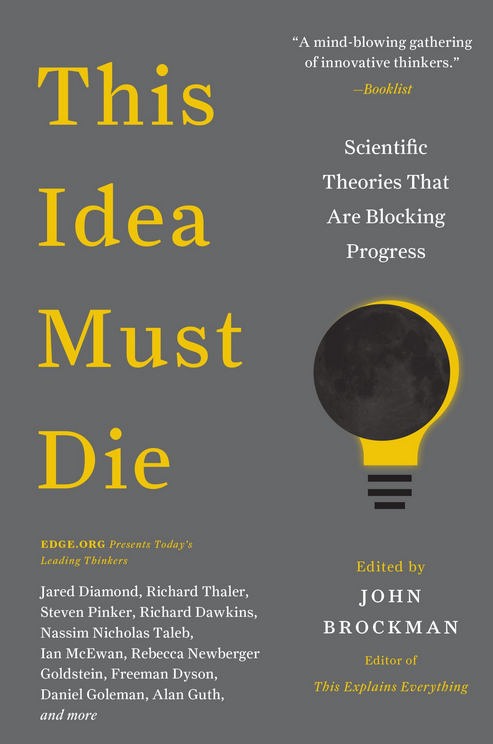

NONFICTION Bay Area
The Edge Question Book, This Idea Must Die is #6 on the San Francisco Chronicle's Best-Seller List, March 22nd.

The Edge Question Book, This Idea Must Die is #15 on the National Indie Bestseller List, Week Ending March 15th.

Brain plasticity, godlessness, Malthusian notions - all should go according to the responses to John Brockman's latest question
THE physicist Max Planck had a bleak view of scientific progress. "A new scientific truth does not triumph by convincing its opponents..." he wrote, "but rather because its opponents eventually die."
This is the assumption behind This Idea Must Die, the latest collection of replies to the annual question posed by impresario John Brockman on his stimulating and by now venerable online forum, Edge. The question is: which bits of science do we want to bury? Which ideas hold us back, trip us up or send us off in a futile direction? ...
This Idea Must Die is garrulous and argumentative. I expected no less: Brockman's formula is tried and tested. Better still, it shows no sign of getting old.

The Edge Question Book, This Idea Must Die is #4 on the Northern California Indie Best-Seller List, Week Ending March 1st. Back to press for 3rd printing, bringing total to date to 24,500 copies.

There’s something ironic about seeing a promotion for John Brockman’s latest collection of science musings, This Idea Must Die, right under his Edge site’s featured conversation, Death is Optional.
Because a lot of ideas don’t die. They recede for a while–like Lamarck’s notion of the inheritance of acquired traits–and then insinuate their way back into scientific consciousness.
But that’s a minor complaint. Brockman’s new anthology, in which he asks a host of leading intellectuals what ideas should be consigned to the dustbin, is engaging. ...


Are you an idea junkie? Of course you are! It’s exciting to hear about ideas, especially new ones. There’s a progression that happens when you hear a new idea – you run it through your brain, try to envision where it might lead. Who will benefit from this new idea? Who will it hurt? Will it be worth the cost? Is it legal; is it morally defensible? Is it, in fact, a good idea?
In our latest episode of Freakonomics Radio, we run that progression in reverse. Rather than asking if a new idea is a good one, we ask whether it’d be better if some of the ideas we cling to were killed off. The episode is called “This Idea Must Die.” ...
The episode is drawn from a fascinating book of the same name: This Idea Must Die: Scientific Theories That Are Blocking Progress (Edge Question Series)

John Brockman has collected his “angels”: all of the many scientists, philosophers, psychologists, techno-geeks, and mathematicians that he either is an agent for or whom he simply knows, and posed to them a provocative question: “What scientific idea is ready for retirement?” The results, in the form of 1-4 page mini-essays, are compiled in a new book,This Idea Must Die: Scientific Theories that are Blocking Progress. You can buy it for only $11.81 on Amazon.
Although I’m not a fan of “idea anthologies” in general, this one is good, and well worth reading. For one thing, you’ll be surprised at the ideas that people say must be deep-sixed, including “Theories of everything” (Geoffrey West), “Entropy” (Bruce Parker), “Falsifiablity” (Sean Caroll, and I disagree with him), “Humans are by nature social animals” (Adam Waytz), “Mind versus matter” (Frank Wilczek), “Culture” (Pascal Boyer), and “The illusion of scientific progress” (Paul Saffo, whose essay I again disagree with). You can see the entire list of contributors, which number about 150) at the Amazon page, simply by clicking on the bookcover link here.
...For a mini-education in contrarian thinking in science, this book is essential.

This was quite a week. Settle into to your favorite easy chair, pour yourself some freshly brewed Sumatra coffee and enjoy these longer-form weekend reads:
- What Do You Think About Machines That Think? (Edge)


Whether it’s the four bodily humors, the geocentric universe, or the steady state theory, sometimes an old idea has to die before new science can flourish. (Just ask Copernicus.) A new anthology edited by Edge.org’s John Brockman aims to speed that process along by asking scientists and big thinkers which scientific concepts they’d target for extinction. Ira talks with two contributors to This Idea Must Die—theoretical physicist Sean Carroll and quantum mechanic Seth Lloyd— about the ideas they’d like to give a good shove out the door. Read an excerpt from the book here, and vote for which ideas you think should die.

Once again, the online magazine Edge has returned to stimulate an exciting intellectual debate of great height, with the annual question that launches on these dates to some of the brightest minds of our time. On this occasion, its brilliant editor John Brockman has raised the challenge of dissecting the lights and shadows of the artificial intelligence (AI): "Do you think about the machines that think?" The responses reflect a wide range of views among some of the great scientists and thinkers of the world today, showing that there is no consensus clear when assessing to what point should celebrate or fear the emergence of thinking machines.
At one end are the great American philosopher Daniel C. Dennett, who mocks with much scorn of the "urban legend" according to which "the robots we will dominate" in the near future. On the other are scientists of the stature of the astrophysicist's NASA and Nobel prize winner John C. Mather, who is convinced that the artificial intelligence "will become a reality, and quite soon", taking into account the massive amount of money that is already being invested in this field, and the enormous potential benefits awaiting entrepreneurs who built the first computers with human (or superhuman) intelligence.
However, although experts are not based on the time of predict whether much or little time for the era of AI, there is a very broad consensus on the unstoppable advent, sooner or later, this revolution. The reason explains it very well the physicist and Nobel Prize Frank Wilczek, citing the famous "astonishing hypothesis" of the co-discoverer of DNA, Francis Crick: the human mind is nothing more than "an emergent property of matter" and therefore "all intelligence is intelligence produced by a machine" (either a brain formed by neurons or a robot manufactured with silicon chips).
As I said in a memorable interview the great Spanish neuroscientist Rafael Yuste: "inside the skull there is no magic, the human mind and all our thoughts, our memories and our personality, everything is based on shots of groups of neurons. There is nothing more, there is a spirit in the ether... There is a great lack of knowledge on how to operate this machine. But I am sure that consciousness arises from the physical substrate which we have on the brain."
And so, as the biologist George Church says in his own answer to the question of Edge, "I am a thinking machine, made of atoms." If this is true, the appearance of another type of machine that can also think is only a matter of time.

From the self to left brain vs. right brain to romantic love, a catalog of broken theories that hold us back from the conquest of Truth.
“To kill an error is as good a service as, and sometimes even better than, the establishing of a new truth or fact,” asserted Charles Darwin in one of the eleven rules for critical thinking known as Prospero’s Precepts. If science and human knowledge progress in leaps and bounds of ignorance, then the recognition of error and the transcendence of falsehood are the springboard for the leaps of progress. That’s the premise behind This Idea Must Die: Scientific Theories That Are Blocking Progress (public library) — a compendium of answers Edge founder John Brockman collected by posing his annual question — “What scientific idea is ready for retirement?” — to 175 of the world’s greatest scientists, philosophers, and writers. Among them are Nobel laureates, MacArthur geniuses, and celebrated minds like theoretical physicist and mathematician Freeman Dyson, biological anthropologist Helen Fisher, cognitive scientist and linguist Steven Pinker, media theorist Douglas Rushkoff, philosopher Rebecca Newberger Goldstein, psychologist Howard Gardner, social scientist and technology scholar Sherry Turkle, actor and author Alan Alda, futurist and Wired founding editor Kevin Kelly, and novelist, essayist, and screenwriter Ian McEwan.
Brockman paints the backdrop for the inquiry:
Science advances by discovering new things and developing new ideas. Few truly new ideas are developed without abandoning old ones first. As theoretical physicist Max Planck (1858–1947) noted, “A new scientific truth does not triumph by convincing its opponents and making them see the light, but rather because its opponents eventually die, and a new generation grows up that is familiar with it.” In other words, science advances by a series of funerals.
Many of the answers are redundant — but this is a glorious feature rather than a bug of Brockman’s series, for its chief reward is precisely this cumulative effect of discerning the zeitgeist of ideas with which some of our era’s greatest minds are tussling in synchronicity. They point to such retirement-ready ideas as IQ, the self, race, the left brain vs. right brain divide, human nature and essentialism, free will, and even science itself. What emerges is the very thing Carl Sagan deemed vital to truth in his Baloney Detection Kit — a “substantive debate on the evidence by knowledgeable proponents of all points of view.” ...
Complement This Idea Must Die, the entirety of which weaves a mind-stretching mesh of complementary and contradictory perspectives on our relationship with knowledge, with some stimulating answers to previous editions of Brockman’s annual question, exploring the only thing worth worrying about (2013), the single most elegant theory of how the world works (2012), and the best way to make ourselves smarter (2011).

We live in a reformatory whose message is that the future is already determined. It awaits us are robots, artificial life and superior artificial intelligence. No choice, we have not: do not think that any other future is possible. The only thing we can do is to bite the bullet and accept this future technology and the dilemmas that come with it, whether we like it or not. The sooner we accept it, the more able we are: the prepackaged cyber future are sold with so much gloomy moralizing is akin to entering into a marriage in the bad old days. I would like to put a spotlight on the strange, retroactive destiny that characterizes the debate about the future: we are asked to accept the whole package in advance, long before any of this is reality, so that it eventually becomes just as inevitable as it actually is not. ...

"Science advances by a series of funerals," writes John Brockman, founder of the online discussion forum Edge.org. Sometimes, he says, old ideas have to be put to bed before new ones can flourish. With that in mind, he asked researchers, journalists and other science enthusiasts to weigh in on which established theories need to go. From the replies, Brockman compiled This Idea Must Die, a fascinating smorgasbord of 175 short essays about every field and facet of research. ...
A few of the arguments are bound to be controversial. For example, a journalist asserts that the information gleaned from massive particle accelerators isn’t worth their equally massive price tags. And while Brockman’s question inspired some thought-provoking responses, the short essays can provide only a brief overview of complex problems. Readers will want to do some research of their own before deciding which, if any, of these ideas really requires a funeral.

I was seduced by infinity at an early age. Georg Cantor’s diagonality proof that some infinities are bigger than others mesmerized me, and his infinite hierarchy of infinities blew my mind. The assumption that something truly infinite exists in nature underlies every physics course I’ve ever taught at MIT—and, indeed, all of modern physics. But it’s an untested assumption, which begs the question: Is it actually true? ...
Excerpted from This Idea Must Die, edited by John Brockman. Used with permission.




...[T]he most controversial topics in the field of advanced technologies will be 'artificial intelligence [AI]' of power to be machined...the exponential increase in computing power, represented by Moore's Law, Google, Facebook, Twitter, etc. The emergence of Web services-based (really) big data and machine learning with the Big Data, especially Deep learning techniques environmental changes that seem to apply again sparked a boom in artificial intelligence. ...
What super artificial intelligence will bring the 'existential risk' destruction of the human race? ...[C]omputer scientist Jaron Lanier has an Edge.org comment titled 'The Myth of AI'. Eminent scholars such as Stephen Pinker caused a hot response to the comments. ...[E]dge annual Distinguished members of the cast to one topic comments recipients in 2015 the theme of the event 'What do you think about that machine think?' That decided, and thus the physics In response, psychology, cognitive science, neuroscience, computer science, journalism, art, artificial intelligence, directly or indirectly, related to the field of oneself and others Certified Professional 186...answers have come up. ...

Love is… at root, biology. A host of endocrine-system-regulated hormones relay chemical messages around the body and brain. Complex loops of physiological feedback between endocrine, nervous, and reproductive systems regulate our sexual responses and maintain homeostasis via hormone-producing glands such as the pituitary and thyroid. We feel the effects of ‘love’ throughout our bodies; even with the reproductive system completely excised our hormones would continue their thrilling course. And we feel it in our brains, in our minds. Modulated by hormones such as oxytocin, neurotransmitting chemicals at synapses lead to inhibition or firing of networks of neurons (baby, you flood my synaptic clefts like no other). Firing or inhibition consolidates or weakens these networks – thus do we fall in, or out of, love.
According to Steven Pinker, ‘Love is not all you need, and does not make the world go round.’[1] That is true. However, this fluke of natural selection can come to be our everything. Sometimes, the end of love can be the end of meaningful life (and for an unhappy few, literally the end of life). The neurochemical, neurostructural resonances within close relationships – couples, families, tribes – can gift members a sense of shared purpose. When we draw significance from these bonds, from their apparent strength and continuity, we are often driven to try to shape our environments to uphold and sanctify them. This drive has myriad positive effects, but it can also be perilously narrow. If we are to avoid relationship conservatism – and exclusion of those who do not identify with the love paradigm – we must allow the flourishing of love in the widest possible sense. ...
[1] Steven Pinker, “Evolutionary Genetics and the Conflicts of Human Social Life,” in This Explains Everything: Deep, Beautiful, and Elegant Theories of How the World Works, ed. John Brockman, 1st ed (New York: Harper Perennial, 2013), 45.

"If at first the idea is not absurd, then there is no hope for it," Albert Einstein reportedly said. I’d like to broaden the definition of addiction—and also retire the scientific idea that all addictions are pathological and harmful.
...Scientists have now shown that food, sex, and gambling compulsions employ many of the same brain pathways activated by substance abuse. Indeed, the 2013 edition of the Diagnostic and Statistical Manual of Mental Disorders (the DSM) has finally acknowledged that at least one form of non-substance abuse—gambling—can be regarded as an addiction. The abuse of sex and food have not yet been included. Neither has romantic love.
I shall propose that love addiction is just as real as any other addiction, in terms of its behavior patterns and brain mechanisms. Moreover, it’s often a positive addiction. ...
Excerpted from This Idea Must Die, edited by John Brockman. Used with permission.

There are few more damning responses to a new study or book or proposal than to say that it relies on “anecdotal” evidence — implying not just that the underlying idea lacks seriousness and objectivity, but that the author is lazy or even untrustworthy. Editors also tend to recoil from anecdotal openings for news stories (in part because most anecdotal ledes are awful), and book critics love to display their smartypants-ness by dissing some new volume as anecdotal.
Nicholas Carr, author of “The Shallows: What the Internet is Doing to Our Brains” (2010), wants to rehabilitate the anecdote. So when Edge.org asked him and other thinkers to answer the question “What scientific idea is ready for retirement?” he had his answer. In “This Idea Must Die: Scientific Theories That Are Blocking Progress,” a collection of 175 short essays from top thinkers, Carr makes his case against anti-anecdotalism in two sharp paragraphs: ...
“This Idea Must Die,” edited by John Brockman, is forthcoming from Harper Perennial on Feb. 17.



Stephen Hawking famously warned in 2010 that based on the history of humankind, an alien, more-advanced civilization would probably destroy us. "We only have to look at ourselves to see how intelligent life might develop into something we wouldn't want to meet," he said. Hawking expressed a similar fear of advanced artificial intelligence (AI) machines. In 2014 he pronounced, "The development of full artificial intelligence could spell the end of the human race." Taken seriously, these two statements could even imply that we should neither search for extrasolar advanced civilizations nor strive for superior AI machines.
I was contemplating these issues when I received the annual EDGE question from "intellectual impresario" John Brockman. Every year Brockman sends to about 200 thinkers a single question, and he posts all the answers on his website, edge.org. The question for 2015 was "What do you think about machines that think?"... I strongly recommend reading all the answers, since they are quite fascinating. ...

It’s difficult to deny that humans began as Homo sapiens, an evolutionary offshoot of the primates. Nevertheless, for most of what is properly called "human history" (that is, the history starting with the invention of writing), most of Homo sapiens have not qualified as "human"—and not simply because they were too young or too disabled.
In sociology, we routinely invoke a trinity of shame—race, class, and gender—to characterize the gap that remains between the normal existence of Homo sapiens and the normative ideal of full humanity. Much of the history of social science can be understood as either directly or indirectly aimed at extending the attribution of humanity to as much of Homo sapiens as possible. It’s for this reason that the welfare state is reasonably touted as social science’s great contribution to politics in the modern era. But perhaps membership in Homo sapiens is neither sufficient nor even necessary to qualify a being as "human." What happens then? ...
Excerpted from This Idea Must Die, edited by John Brockman. Used with permission.


This year’s Edge question is "What do you think about machines that think?" My response is less about their likelihood and more about how we should respond, as a society, if this ever comes to pass. Specifically, it involves naches, the Yiddish term for pride and joy...
Read the rest here.

UVM robotics expert contributes essay to world-famous Edge conversation
John Brockman's Edge Question is a major event in the intellectual calendar each year—its roots go back to talks he had with Isaac Asimov and others in 1980. This year's question, "What do you think about machines that think?" drew essays from Daniel C. Dennett, Nicholas Carr, Steven Pinker, Freeman Dyson, George Church and nearly two hundred other luminaries and Nobel Prize winners.
UVM computer scientist and robotics expert Joshua Bongard was asked to weigh in, too. ...
...[R]ead the whole essay. It’s online now and will appear in a printed book as each of the Edge questions—like “What will change everything?” (2009) and “What is your dangerous idea?” (2006)—has for the last decade.


Every January the intellectual impresario and literary agent John Brockman (who represents me, I should disclose) asks a large group of thinkers a single question on his website, edge.org. This year it is: “What do you think about machines that think?” There are lots of interesting answers, ranging from the skeptical to the apocalyptic.
I’m not sure that asking whether machines can think is the right question, though. As someone once said, it’s like asking whether submarines can swim. But we can ask whether machines can learn, and especially, whether they can learn as well as 3-year-olds. ...

180 intellectuals responded to this Edge annual question - "What do you think about computers that think?" Soon this question may become an issue for all of us
"What do you think about computers that think?" The question for 2015 on the prestigious Edge.org site. Each year the site gives the same question to more than 180 intellectuals and publishes their answers in one sequence, later published as a thick book. Respondents ranged from columnists in The New York Times, Nobel Prize winners, best-selling authors, and heroes of the technology world, many of them close friends of the site's colorful editor, literary agent John Brockman. Previously published questions: "What scientific concept has to retire?", "What tools will improve everyone's thinking?" and "What should we be worried about? ". This year, as mentioned, Brockman called 180 intellectuals to express an opinion on the question Hawking has been talking about. And Disclosure: I was delighted to receive an invitation to participate this year in most of this dialogue, and my response, ordered to be short - even short of this column - for the annual anthology published.
Several respondents, including the writer Pamela McCorduck, Italian physicist Carlo Rovelli, Professor Margaret Levi of Stanford University and the Israel Prize laureate and former president of the Weizmann Institute Haim Harari, refer to machines that think as inevitable, and in large measure daily. Interest in human responsibility and proper management like any other field, and material nightmares. More than the machines thinking like people, I am concerned about people who think like machines, writes Harari.
Others relate to the very dismissive forecast: Vice President for Research of the George Washington University, Neurobiologist, Leo Chalupa doubts machines will be capable of abstract thought. Science fiction writer Bruce Sterling writes that computers may be major players in the future, but the script will never write people. They further emphasize emotion and will remain forever confined to human beings.

 Over at BB pal John Brockman's Edge.org, nearly 200 very smart people, like Daniel C. Dennett, Brian Eno, Alison Gopnik, Nina Jablonski, Peter Norvig, and Rodney Brooks, ponder the EDGE Annual Question of 2015: What do you think about machines that think?


This week's Nova magazine features contributions from
Frank Tipler, Paul Saffo, Tomaso Poggio, Nicholas Carr, Kevin Kelly,
Juan Enriquez, Peter Norvig, Jochi Ito, Julio Boccaletti, Carlo Rovelli,
Douglas Coupland, and Haim Harari
"Another year, and some of the most important thinkers and scientists of the world have accepted the intellectual challenge." —El Mundo

EL MUNDO. DOMINGO 18 DE ENERO DE 2015
"What do you think about machines think?" This is the annual question that the digital magazine Edge launches every year around this time, and which it presents to some of the brightest minds on the planet. Just over a month ago, in early December, Stephen Hawking warned of the potentially apocalyptic consequences of artificial intelligence, which in his opinion could eventually lead to "the end of the human species". But really, should we fear the danger of a future army of humanoids out of control? Or rather we should celebrate the extraordinary opportunities that could give us the development of thinking machines, and even sentient beings? Do such beings along with ourselves pose new ethical dilemmas? Would they be part of our "society"? Should we grant them civil rights? Would we feel empathy for them? Another year, and some of the most important thinkers and scientists of the world have accepted the intellectual challenge posed by the editor of Edge, John Brockman. This is just a selection of some of the most interesting responses.
Nick Bostrom, Daniel C. Dennett, Frank Wilczek, Steven Pinker
EDGE / EL MUNDO MADRID
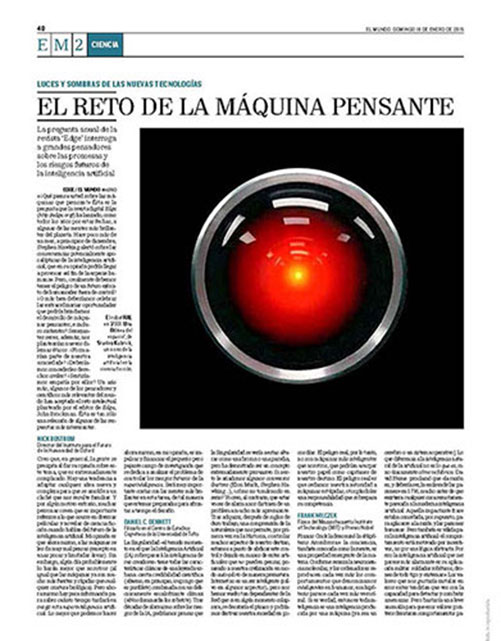

SÜDDEUTSCHE ZEITUNG
FEUILLETON
Was denken Sie über Maschinen, die denken?
Nr. 12, Freitag, 16. Januar 2015
Once a year, the literary agent John Brockman presents a question to scientists on the website edge.org.. This year it's about artificial intelligence. Here is a selection of responses [three parts on Süddeutsche.de online):
Responses by David Gelernter, Peter Norvig and Douglas Coupland, Alison Gopnik, Brian Eno and Daniel L. Everett, Seth Lloyd, Thomas Metsinger, Susan Blackmore
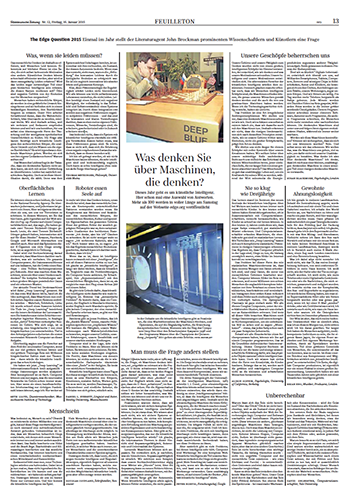
Part I: David Gelernter, Peter Norvig and Douglas Coupland Jan 16
Part II: Alison Gopnik, Brian Eno and Daniel L. Everett Jan 17
Part III: Seth Lloyd, Thomas Metzinger, Susan Blackmore Jan 18

During the year just ended, Edge.org put to discussion the question What scientific idea is ready for retirement? Jerry Coyne pointed out in response to the idea of free will: "When pressed, Nearly all scientists and philosophers most admit this. Determinism and materialism, They agree, win the day. But they're remarkably quiet about it. Instead of spreading the important scientific message que our behaviors are the deterministic results of a physical process, they'd rather invent new "compatibilist" versions of free will: versions que comport with determinism. "Well, When We order strawberry ice cream we really Could Not have ordered vanilla, "They Say," but we still have free will in another sense. And it's the sense only that's important. "" * Essayist, core member of Studies of Science, Technology and Society (ICPD). Writes under the new orthographic agreement...
...2014 Edge Annual Question Video by Jesse Dylan from Edge Foundation on Vimeo.

...In 1996 Egde.org website was made that was designed to put on a virtual room known scientists and philosophers and to ask each other the questions dangerous ideas-or rather the questions that each strives to respond to science.
Since then every year Egde.org publishes a book with the question of the year. For example this year's question is "What scientific concept is ready for retirement." The 2006 question was "What is your own dangerous idea." Will glean some ideas so dangerous for the good of the year 2015. Let me note that the word does not mean dangerous and necessary bad ideas. It means that we will change our lives. ...

Every year, BB pal, legendary book agent, and Edge.org founder John Brockman asks very smart people like Daniel C. Dennett, David Gelernter, Alison Gopnik, Rebecca Newberger Goldstein, and Kevin Kelly a big question at the intersection of science and culture. Here's filmmaker Jesse Dylan's impressionistic documentary on last year's Edge Question, "What Scientific Idea Is Ready for Retirement?"

Each year, Edge Foundation founder John Brockman poses an interesting question to thinkers in a wide range of fields: psychology, theoretical physics, evolution, cognitive science, and more. This year's question was "What scientific idea is ready for retirement?" And here are some of the answers.
Jesse Dylan put together this video, featuring answers from Jerry Coyne, Daniel C. Dennett, George Dyson, David Gelernter, Rebecca Newberger Goldstein, Alison Gopnik, Kevin Kelly, Alex Pentland, Irene Pepperberg, Steven Pinker, Lee Smolin, Paul Steinhardt, and Frank Wilczek. Brockman also collects the answers to his Edge Foundation questions in an annual book. This year's book, This Idea Must Die: Scientific Theories That Are Blocking Progress, will be available in February 2015.
The folks in this video come up with a variety of answers, and they don't all agree, but it's interesting to hear what outdated or misunderstood ideas these individuals want to see retired for the sake of moving forward.

This Idea Must Die: Scientific Theories that Are Blocking Progress
Edited by John Brockman
Brockman (What Should We Be Worried About?), founder of the Edge Foundation, has compiled a series of humorous and thought-provoking short essays from a wide array of scientists, science writers, and assorted academics. Several essays deal with concepts that aren’t fully understood, even by experts; string theory, for instance, is addressed in several sections, each from a slightly different angle. More philosophical topics receive consideration as well, such as free will, nature vs. nurture, and the difference between the brain and the mind (if there is one). Even economics is included. Some topics, like the lament over the term rocket scientist or the problem with artificial intelligence, are arguments about definitions, while other discussions contemplate the morality of certain practices in science. One fascinating result of having several authors address the same topic is seeing firsthand the ways experts disagree with one another. A common thread throughout is the reminder that science and its practitioners do not exist in a vacuum: those who work in areas that many consider esoteric still fight traffic and worry about what their work will do to make the world better. Brockman succeeds in presenting scientific work that will appeal to a variety of readers, no matter their background.

Brockman, John (Editor)
Feb 2015. 592 p.
 One detects no small Edge.org anthology. Each year, Brockman, the founder of the online science salon, poses a provocative question––last time, it was What Should We Be Worried About? (2014)—and invites leading scientists, philosophers, and artists to respond in concise and lucid essays. This time, he really struck a chord, inviting contributors to kill off scientific ideas that are outdated to the point of obstructing new advances. One hundred and seventy-five intellectual assassins eagerly stepped forward. ... Physics, statistics, robotics, linguistics, medicine—all are zestfully scrutinized in this exuberant, mind-blowing gathering of innovative thinkers, which includes even novelist Ian McEwan, who tries to try put the kibosh on the entire murderous exercise, declaring, "Every last serious and systematic speculation about the world deserves to be preserved."

News & Events
 Penn State Brandywine Common Read "kickoff" event set for Sept. 11
9/5/2014 —Penn State Brandywine will host its first Common Read event of the academic year—a panel discussion titled, "What Is Brandywine Worried About"—on Thursday, Sept. 11, at 11:30 a.m. in the Vairo Library Amphitheatre. Students, faculty and staff are invited to this thought-provoking dialogue, which mirrors the theme of this year’s Common Read book, "What Should We Be Worried About?"
The event will feature six panelists, including Brandywine faculty, staff and students, who will discuss topics that concern each of them in today's world. Topics will range from educational issues to scientific reasoning and beyond.
"What Should We Be Worried About?," edited by John Brockman, is a collection of short essays revealing the planet’s most hidden threats. The essays are written by some of the world’s most influential scientists who were asked to disclose unknown situations that worry them. The result was a book that changes the way people view biology, economics, neuroscience, philosophy, physics, psychology, war, technology and much more.
The campus Common Read was created to provide an opportunity for the entire Brandywine community to participate in knowledgeable conversation about a shared text, allowing the campus to develop a dialogue focused on one central idea or question.
In the event of inclement weather, the panel discussion will be held in the Tomezsko Building, room 103. For more information about this year’s Common Read selection, visit Penn State Brandywine’s Common Read webpage.

How pocket supercomputers warp our perception of time.
I'm kind of a worrier, so naturally I picked up this book called What Should We Be Worried About? Editor John Brockman, the curator of Edge.org, asked a bunch of really smart people—scientists, writers, journalists, tech gurus, folks like that—to write essays about what keeps them up at night. It's that simple.
My wife commented that perhaps this wasn't the sort of book I should be reading, but as a curmudgeon, I had to disagree. It's actually sort of validating to read about all these other people's worries. Plus, the writers keep 'em short—too short, in the case of Terry Gilliam—and the breadth of the worriers clues you in to a wide range of worries you never even knew you needed to worry about. How awesome is that?
-----
THE PATIENCE DEFICIT
By Nicholas G. Carr
I'm concerned about time—the way we're warping it and it's warping us. Human beings, like other animals, seem to have remarkably accurate internal clocks. Take away our wristwatches and our cell phones and we can still make pretty good estimates about time intervals. But that faculty can also be easily distorted. Our perception of time is subjective; it changes with our circumstances and our experiences. When things are happening quickly all around us, delays that would otherwise seem brief begin to seem interminable. Seconds stretch out. Minutes go on forever. "Our sense of time," observed William James in his 1890 masterworkThe Principles of Psychology, "seems subject to the law of contrast." ...
... It's not clear whether a technology-induced loss of patience persists even when we're not using the technology. But I would hypothesize (based on what I see in myself and others) that our sense of time is indeed changing in a lasting way. Digital technologies are training us to be more conscious of and more antagonistic toward delays of all sorts—and perhaps more intolerant of moments of time that pass without the arrival of new stimuli. Because our experience of time is so important to our experience of life, it strikes me that these kinds of technology-induced changes in our perceptions can have broad consequences.

I was fascinated by this book from the moment I picked it up at Barnes & Noble. I had heard of a few of the writers Brockman tapped for this volume, but I was unfamiliar with most of the names listed in the table of contents. Moreover, I could not find any rhyme or reason to the authors selected to present their various perspectives on what should, in fact, be on our radar screens when it comes to what we should be distressing about. Although everyone arguably has some connection to science, I found it impossible to identify a common thread characterizing all of the contributors.
Most of the selections run only two to three pages, which made the book particularly easy to digest in a series of short sittings. Over the week it took me to get through all of the vignettes, I probably spent no more than an hour reading the book at any one time. Still, many of the ideas resonated with me on several levels. I found myself thinking about what I had read as I was involved in other activities throughout the day. For example, I spent my entire run one afternoon reflecting on the chapter by Martin Rees, “We are in denial about catastrophic risks.” Rees is an emeritus professor of cosmology and astrophysics at the University of Cambridge.

We all have worries. But as trained observers, scientists learn things that can affect us all. So what troubles them, should also trouble us. From viral pandemics to the limits of empirical knowledge, find out what science scenarios give researchers insomnia.
But also, we discover which scary scenarios that preoccupy the public don’t worry the scientists at all. Despite the rumors, you needn’t fear that the Large Hadron Collider will produce black holes that could swallow the Earth.
It’s Skeptic Check, our monthly look at critical thinking … but don’t take our word for it!
Guests:
-
David Quammen – Science journalist, contributing writer for National Geographic Magazine, author of Spillover: Animal Infections and the Next Human Pandemic
- Sandra Faber – Astronomer at the University of California, Santa Cruz
- Paul Saffo – Technology forecaster based in the Silicon Valley
- Seth Shostak – Senior astronomer, SETI Institute, host,Big Picture Science
- Elisa Quintana – Research scientist, SETI Institute
- Lawrence Krauss – Theoretical physicist, Director of the Origins Project at Arizona State University

Inspiration for this episode comes from the book, What Should We Be Worried About?: Real Scenarios That Keep Scientists Up at Night

This Will Change Everything
...provides more than 100 specialists in various fields to answer the question" What will change everything?"... Sometimes frightening, but very scenic professors, books, authors, public figures, insights and predictions reflect the innovative new ways of thinking and perception of the surrounding environment options. Intellectuals considerations, covering areas from genetics to computer science, points to the inevitable changes that will determine both the public and the rebuilding of the universe. Any thoughts expressed declares a new idea that appears small, but important piece of the future map.

Not a perfect mechanism, but fear remains a useful sense: without such a system, our life would have been a complete disaster. Where does this mania to underestimate the fear, prudence or caution if they have their positive side?
Fear is no longer fashionable. Self-help books are populated with tips so that we finish with our fears and go out of the comfort zone. The feeling that is promoted in today's society is that of the omnipresence of the internal control: the location should not matter to us, the crucial point is the attitude. And therefore it is that nothing and no one believes us apprehension. It seems that trying to feel secure and avoiding events that we assume vulnerable was a bad psychological strategy. But is it true that the caution is a tactic that we cancel? . . .
. . .Amid this discrediting of prudence and caution, the question that the stimulating publication Edge recently launched the brightest minds on the planet is striking. Every year, this digital magazine poses the question that respond dozens of influential intellectuals. The 2013 question was: "What should we be worried about?" ("Why should we be concerned?"). Most striking was not the demand for scientists and communicators identified social concerns, but the fact that you asked for them with that resounding "must". Because none of the respondents answered "no worry about nothing", so we can assume that, for these brilliant minds, harboring fears it is not nonsense.
In fact, a review by answers shows us, updated, the entire spectrum of disappointments that have proven many humans Adaptive throughout history. It is, of course, the apprehension that makes us the loneliness: the psychologist David M. Buss, for example, causes the alarm that the shortage of desirable couples increased in the future human brutality. There is also who points out the fear by the loss of vital sense. Dave Winer, the pioneer in the world of blogs, worried that we no longer have desire to survive and the anthropologist Christine Finn that we finish to completely lose touch with the physical world. …

A popular Washington Post article by my colleague Michael S. Rosenwald said that researchers were finding that the habit of scanning and skinning material online was changing the human brain and hindering people’s” ability to read long, complex and dense material. Cognitive scientist Daniel Willingham, a professor at the University of Virginia, is highly skeptical. ...
… "The truth is, probably, that the brain is simply not adaptable enough for such a radical change. Yes, the brain changes as a consequence of experience, but there are likely limits to this change, a point made by both Steve Pinker and Roger Schank when commenting on this issue. If our ability to deploy attention or to comprehend language processes were to undergo substantial change, the consequences would cascade through the entire cognitive system, and so the brain is probably too conservative for large-scale change."
Pinker and Schank were among a group of people who responded in 2010 to Edge.org’s question: How is the Internet changing the way you think? Pinker, a renowned experimental psychologist and cognitive scientist at Harvard University, gave this answer: Not at all. He wrote in part: …

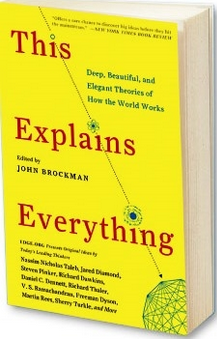
In 1997, the Reality Club, which was formed in 1981 to explore themes of the post-Industrial Age, went on-line and was rebranded as "Edge." Those involved with Edge brainstorm to ask an annual question and challenge brilliant people to answer it. The 2012 question, "What is your favorite deep, elegant, or beautiful explanation?" which sought to gather people’s opinions about their favorite scientific theory or explanation, led to more than 200 answers. This book includes edited forms of 148 of those answers it its 411 pages, making the average chapter less than 3 pages long. A common theme in the published answers is the proposal of "a simple and nonobvious idea … as the explanation for a diverse and complicated set of phenomena." ...
...I enjoyed reading this book immensely and spent more time on it, per page, than on any other book. Each of the 148 bite-size chapters is a delight, and trying to summarize the content would lead to a book-length review.

"What Should We Be Worried About?" is the title of a new 2014 book edited by John Brockman, in which 153 scientists, professors and leading thinkers write two- and three-page essays in response to the book title.
One essay highlights an issue that will worry governments increasingly in the future. The issue is the current unsustainable expectation of infinite economic growth.
The essay title is a question: "A World Without Growth?" by financial risk expert Satyajit Das. To paraphrase, all modern societies, whether capitalist, socialist or communist, depend on continuing economic growth as a universal solution for all political, social and economic problems, which includes improving living standards and reducing poverty.
Also, growth is now expected to solve the problems over overindebted individuals, businesses and nations.
Over the past 30 years, globalization and debt-driven consumption across the planet became the tool of generating economic growth. That planetwide growth is destroying the Earth's environment and using up finite resources, especially water.
Those factors, plus unsustainable debt levels rising in all nations, threatens to end an unprecedented 200 years of growth and expansion. ...

Bring together two hundred of the most powerful minds in one place and let them inspire each other, confront and learn—it's a great recipe to accelerate scientific progress in the world and a quite interesting way to spend time. But how to do it? Even 30 years ago, such a project would not have a chance. The Internet radically changed this situation. In 1996, a New York literary agent John Brockman established the website Edge.org. It's an extraordinary cul-de-sac in the global network, which sooner or later gets everyone fascinated by the most advanced content on science, technology and society.
For website Edge.org publishes the writings and record videos of absolutely exquisite people, primarily leading American and British scientists, including Nobel Prize winners, as Frank Wilczek, Eric Kandel, Daniel Kahneman and George Smoot. A significant contribution by the science popularizors: writers, journalists and the golden children of Silicon Valley, who introduce the rest of the world to new technologies.
All this, the incredible group and its works, are managed by John Brockman—the man whose biography complies with the idea of the American dream. . . .

They say a fool and his money are never as much time together in this blog are very concerned about your money going to help make it ready and so the little money they have always be with you.
Editors of Edge.org asked some of the most influential thinkers of the world, including neuroscientists, physicists and mathematicians, what they considered the most important scientific concepts of the modern age. The result is the book This Will Make You Smarter: New Scientific Concepts To Improve Your Thinking...a collection of 200 essays exploring all kinds of concepts. ...

Insomniacs will have plenty of fodder to fuel their sleeplessness after reading What Should We Be Worried About? Real Scenarios That Keep Scientists Up at Night.
...Fifty years ago, nuclear annihilation might have topped the list. War is a bit player here, with a cheery nod from Steven Pinker, who basically tells us there’s not much to worry about (but offers prescient speculation about an aging Putin bent on regaining a former Soviet republic or two).
No, what we should be worrying about is superstition, fundamentalism, anti-scientific bias, the dumbing-down of just about everything–including ourselves–and the pervasive, addictive presence of the Internet.
But I found comfort in the 21-word, haiku-like entry from screenwriter and former Monty Python troupe member Terry Gilliam: "I’ve given up worrying. I merely float on a tsunami of acceptance of anything life throws at me...and marvel stupidly." And probably sleeps at night.

Any political ideology involves some idea of the state of fiscal spending and tax scheme. And the practical tools of public policy (whether laws, regulations, taxes, or government subsidy programs) are directly influenced by the ideology of officials who create the advisers they hire, and the voters who elected to the first.
....And since we have an ideology formed, it acts as a "filter" that we use to make sense of the reality around us. As explained Gerald Smallberg...(see "Bias is the Nose for the Story" on "This Will Make You Smarter", 2012), humans do not appreciate the objective reality to filter the incredible amount of data they receive... Bias says Smallberg "is an intuition-a sensitivity, receptivity, which acts as a lens or filter our perceptions [...] These biases mediate between our intellect and our emotions to create, from perceptions, opinions, judgments, categories, metaphors, analogies, theories and ideologies through which we frame the way we see the world." This notion...is related to the argument of Daniel Kahneman (a psychologist and Nobel Prize in Economics in 2002, see "Thinking, Fast and Slow", 2011) in the sense that our brain cohabiting two systems, one operating biases..."automatically and quickly, with little or no effort, and without feeling voluntary control" and another that "directs attention to activities that require mental effort, including complex calculations [...] and are associated with the subjective experience of agency, choice and concentration".

Why scientists need to stop worrying about whether or not everything in biology serves a purpose.
John Brockman, the publisher and science impresario who runs the online science and culture salon Edge.org, has asked his provocative, annual Edge question: What scientific idea is ready for retirement? "Few truly new ideas are developed without abandoning old ones first," Brockman writes. "What established scientific idea is ready to be moved aside so that science can advance?"
Here’s my candidate for forced retirement: The idea that we need to distinguish between things in biology that are there for a purpose and those that aren’t.

A man would not be human if he did not care would reveal himself.But what if scientists worried?
Annually John Brockman, founder of the famous discussion platform allows Edge.org , a question for a selection of the most interesting scientists, authors and artists in the world. The responses are then collected and published in book form. This time, Brockman asked the question: "Where should we should be worried about?"
The result can be read in the book recently published 153 x caffeine for your mind. Include Nicholas Carr (The shallow), Daniel Dennett, Steven Pinker (The Blank Slate), Brian Eno (musician and producer of U2), Nassim Nicholas Taleb (Black Swan) and 148 others to answer question posed by John Brockman. They talk briefly and powerfully about the concerns that keep them busy, such as more and more people are becoming increasingly stress the consequences of a major Internet outage, and that we have ceased to explore the space ...

The darkest fears of the leading lights and rising stars of science, brought together by the Edge's John Brockman, could keep us all awake at night
WARNING: read the subtitle of this book first. Its editor, cultural impresario John Brockman, may well have you struggling to get your shut-eye as he sets out to keep us on our toes.
The trick this time lies in the tone of a book of answers to questions that Brockman poses annually to science's great and good on his Edge website. It's really not all good news.
In 2007, Edge asked what we were optimistic about. Six years later, the tone sounds like a pessimistic rejoinder: what shouldwe be worried about? But with Brockman it's rarely simple. He invited people to share a scientific worry that might not be on the popular radar, or one they think should drop off the radar. ...
At the end of the exercise, Brockman's crew has left us with a net balance of new fears. But they also introduce us to some big ideas. As psychologist Daniel Goleman puts it: "Effective worrying focuses our attention on a genuine threat and leads to anticipating solutions." Or perhaps biologist Craig Venter is onto something when he writes, hopefully tongue in cheek: "As a scientist, an optimist, an atheist, and an alpha male, I don't worry."

Cosmologist Sean Carroll is one of many who have recently answered the annual question posed by Edge.org, which this year was: What scientific idea is ready for retirement? Sean, whom I’ve met at the Naturalism workshop he organized not long ago, and for whom I have the highest respect both as a scientist and as a writer, picked “falsifiability.”
Which is odd, since the concept — as Sean knows very well — is not a scientific, but rather a philosophical one.
Now, contra some other skeptics of my acquaintance, at least one of whom was present at the above mentioned workshop, Sean is actually somewhat knowledgable and definitely respectful of philosophy of science, as is evident even in the Edge piece. Which means that what follows isn’t going to be yet another diatribe about scientism or borderline anti-intellectualism (phew!). ...

We care about the Third World War, aging, drug use but also about himself - zabrinjavanja. In the book "What Should We Be Worried About 'series of celebrity scientist reveals his greatest concerns and answers the question of how to prevent them.
What should we be worried? That's the question John Brockman, founder Edge.org ('smartest' global sites, according to a review in The Guardian) set by the world's most influential scientists including Steven Pinker, Mihaly Csikszentmihalyi, Frank Wilczek, Seth Lloyd, Alison Gopnik, Nassim Nicholas Taleb Helen Fisher, Lawrence Krauss, Susan Blackmore and many others.
He asked them to discover what they are most concerned, with special emphasis on scenarios that have not yet appeared on the global radar.
The greatest minds of our time in the field of neuroscience, economics, philosophy, physics, psychology, biology and many other areas of its proposed 150 ideas that will bring a revolution in the understanding of the modern world.

The book also focuses on lesser-known ideas, such as the modular mind. These sections are the ones who make the work fun and interesting.
One or the other essay is difficult to understand for the layman, most texts but present themselves as easily digestible and entertaining. No contribution is longer than four pages. The shortest essay is even only three words: "Keep it short." He brings an idea from philosophy to the point - that of Occam's Razor. It says that one should be frugal in the formation of scientific theories: If you have the choice between several possible explanations of the same facts is to bring forward the simplest theory - that is the one that gets by with as few hypotheses. The tightness of the contributions makes the book even to the profitable reading if you just only has ten minutes time to read.
...The compilation of the brilliant, sometimes even stunning ideas can be recommended to all who are interested in science.

WHAT SHOULD WE BE WORRIED ABOUT?
John Brockman
I've really come to look forward to these annual collections from contributors to Edge.org, the multi-disciplinary science website. Every year editor John Brockman throws out a question to scientists of any discipline to address. The responses are short essays you can snack on like brain-stretching popcorn.
This year the responses are ones that may keep you up at night, so be warned. All of the contributors address the question of what the real threats to our planet and way of life are, as opposed to the false fears that distract us too easily. The topics range all over the scientific map; the likelihood of war, advances in medicine and health care, population growth and distribution, the advance of the virtual, global economics...you get the idea.

The telescope, that allows us to see far in space and thus back in time, giving us an unprecedented understanding of our own existence, is a far superior tool
Reese regards the internet as the greatest human invention of all time. In barely two decades, it has become so essential to our lives and work that one cannot imagine doing almost anything without it. Indeed, in a book that comes out this week, a collection of essays titled What Should We Be Worried About? by a hundred or so prime thinkers of the world, philosopher Daniel Dennett and historian of science and technology George Dyson consider the possible breakdown of the internet as the issue that they are most worried about. ...

What should we be worried about? Real Scenarios that keep scientists up at night. This is the title of the new book edited by the literary agent John Brockman, founder of the website Edge.org, a discussion forum that includes novelist Ian McEwan, musician Brian Eno, physicists Frank Wilczek and Freeman Dyson, as well as yours truly, 13.7's Tania Lombrozo, and a couple of hundred of other academics and intellectuals. Every year, Brockman asks this group a "question." Answers in the form of short essays are compiled in paperback volumes with the intention of providing food for thought, as well as showcasing some of the cutting-edge ideas in science and technology and how they shape our culture. This is year, nothing less than 150 answers were published, of which I provide a meager sample here.
A cross-disciplinary kaleidoscope of intelligent concerns for the self and the species.
In his famous and wonderfully heartening letter of fatherly advice, F. Scott Fitzgerald gave his young daughter Scottie a list of things to worry and not worry about in life. Among the unworriables, he named popular opinion, the past, the future, triumph, and failure "unless it comes through your own fault." Among the worry-worthy, courage, cleanliness, and efficiency. What Fitzgerald touched on, of course, is the quintessential anxiety of the human condition, which drives us to worry about things big and small, mundane and monumental, often confusing the two classes. It was this "worryability" that young Italo Calvino resolved to shake from his life. A wonderful 1934 book classified all of our worries in five general categories that endure with astounding prescience and precision, but we still struggle to identify the things truly worth worrying about — and, implicitly, working to resolve — versus those that only strain our psychoemotional capacity with thedeathly grip of anxiety.
In What Should We Be Worried About? (public library), intellectual jockey and Edge founder John Brockman tackles this issue with his annual question — which has previously answered such conundrums as the single most elegant theory of how the world works (2012) and the best way to make ourselves smarter (2011) — and asks some of our era’s greatest thinkers in science, psychology, technology, philosophy, and more to each contribute one valid "worry" about our shared future. Rather than alarmist anxiety-slinging, however, the ethos of the project is quite the opposite — to put in perspective the things we worry about but shouldn’t, whether by our own volition or thanks to ample media manipulation, and contrast them with issues of actual concern, at which we ought to aim our collective attention and efforts in order to ensure humanity’s progress and survival. . . .
. . .What Should We Be Worried About? is an awakening read in its entirety. For more of Brockman’s editorial-curatorial mastery, revisit the Edge Questions compendiums from 2013 and 2012, and see Nobel-winning behavioral economist Daniel Kahneman on the marvels and flaws of our intuition.

LES COULISSES DE LA PAILLASSE. Quelles sont les théories scientifiques qui devraient être mises au placard ? C'est la question qu'a posée dans son "défi" annuel le site Edge (Edge.org), un forum de discussion sur la science : le but est d'accélérer le progrès de nos connaissances.
Le débat scientifique peut en effet donner lieu à des situations de blocage, comme celle décrite par Max Planck, un des pères de la mécanique quantique. Il expliquait qu'il avait été incapable de persuader le chimiste germano-balte Wilhelm Ostwald que la deuxième loi de la thermodynamique (augmentation de l'entropie) ne pouvait pas être déduite de la première (la conservation de l'énergie). "Cette expérience me donnait aussi l'occasion d'apprendre un fait remarquable : une nouvelle vérité scientifique ne triomphe pas en convainquant ses opposants et en leur faisant voir la lumière, mais plutôt parce que ses opposants finissent par mourir, et arrive une nouvelle génération qui est familière avec la nouvelle idée."

These scientific ideas will drive you crazy
Much has been made of this year's question at John Brockman's Edge, generally described as an online salon. Brockman asked for recommendations about which scientific ideas should be retired, and some 170 salonists replied. Dennis Overbye plucked up a few proposed discards for consideration at Out There, concluding, "No matter who you are, you are bound to find something that will drive you crazy."

The 2014 Edge Annual Question (EAQ) is out. This year, the question posed to the contributors is: What scientific idea is ready for retirement?
As usual with the EAQ, it provokes thought and promotes discussion. I have only read through a fraction of the responses so far, but I think it is important to highlight a few Edge contributors who answered with a common, and in my opinion a very important and timely, theme. The responses that initially caught my attention came from Laurence Smith (UCLA), Gavin Schmidt (NASA), Guilio Boccaletti (The Nature Conservancy) and Danny Hillis (Applied Minds). If I were to have been asked this question, my contribution for idea retirement would likely align most closely with these four responses: Smith and Boccaletti want to see same idea disappear — stationarity; Schmidt’s response focused on the abolition of simple answers; and Hillis wants to do away with cause-and-effect.

WEIZENKORNLEGENDE DES INTERNETS
[1.20.14]
SÜDDEUTSCHE ZEITUNG
FEUILLETON
Von Andrian Kreye
No. 15, Montag, 20. Januar 2014
Once a year, the New York literary agent John Brockman on his online forum for science and culture edge.org, asks one question. He gets answers from his network of scientists, intellectuals and artists. For 2014 was the question was "What Scientific Ideas Should We Retire?" Among the 174 responses received to date by the evolutionary biologist Richard Dawkins ("Essentialism"), the science historian George Dyson ("Science and Technology"), the neuro-scientist Sarah-Jayne Blakemore ("Left Brain/Right Brain"), as well as the response of the SZ-Feuilleton Editor, Andrian Kreye" Moore's Law.)

Kate Clancy, John Horgan and Ashutosh Jogalekar offered interesting replies to the annual Big Question from Edge’s John Brockman: What scientific idea is ready for retirement?

The latest assault on our uniqueness comes from Edge.org, which asked the world’s supposedly most “brilliant minds” to come up with ideas that should be retired in science.

WHAT SCIENTIFIC IDEA IS READY FOR RETIREMENT?
[1.19.14]
Domingo, 19 2014
PAGE 5
DEBATES
From culture to altruism, to the left and right hemispheres of the brain, to universal grammar, to the very notion of scientific progress: for some of the brightest minds in the world, these concepts deserve to retired from the scientific conversation.
This is the result provocateur who this year had the question which, like all the years, proposed Edge - a web site associated with a Publisher that promotes thought and discussion of cutting-edge science, arts and literature - partners usual and invited, to those invited to think "what scientific idea is ready to retire?". About 170 scientists, philosophers, academics and writers responded with brief essays, that they can be read online (www.edge.org) and that, like other years, they will probably soon its publication on paper. Here, a selection of some of the responses.
This is this year's provocative result of the question, which is proposed every year, by Edge, a website associated with a literary agent that promotes thinking and discussion of cutting-edge science, arts and literature, who invited his usual collaborators and guests , to think about "What scientific idea is ready to retire?". Some 170 scientists, philosophers, scholars, and writers responded with short essays that can be read online (www.edge.org) and, as has happened in previous years, will surely soon be published as a book. Here, a selection of some of the answers.
Simple Answers
Gavin Schmidt
Climatologist, NASAs Goddard Institute
Information Overload
Jay Rosen
Associate Professor of Journalism, New York University
Markets Are Bad; Markets Are Good
Michael I. Norton
Associate Professor of Marketing, Harvard Business School
The Illusion of Scientific Progress
Paul Saffo
Technology Forecaster
Certainty. Absolute Truth. Exactitude.
Richard Saul Wurman
Founder, TED Conference; eg Conference; TEDMED Conferences
Anti-anecdotalism
Nicholas G. Carr
Author, The Shallows and The Big Switch
Retire nothing!
Ian McEwan
Novelist; Author, Sweet Tooth; Solar; On Chesil Beach

We must accelerate the pace at which science corrects itself. Because science can remain reliable. For this is as the strategic question that arises Edge this year, the community of researchers led by John Brockman: what scientific theories are ripe for retirement? Over 130 scholars - including Mihaly Csikszentmihalyi, Aubrey de Grey, Sherry Turkle, Nassim Nicholas Taleb, Stewart Brand, Richard Dawkins, Matt Ridley, Steven Pinker, George Dyson, Kevin Kelly - responded. Surprises abound. The findings are published edge.org .

What scientific idea is ready for retirement? Read responses to that inquiry from the likes of Jared Diamond, Richard Dawkins, Alison Gopnik, Max Tegmark, Freeman Dyson, June Gruber, and many other brilliant people over at Edge.org, legendary book agent John Brockman's hub for really smart scientists and other big thinkers to share ideas with each other and the public. From the intro:
Science advances by discovering new things and developing new ideas. Few truly new ideas are developed without abandoning old ones first. As theoretical physicist Max Planck (1858-1947) noted, "A new scientific truth does not triumph by convincing its opponents and making them see the light, but rather because its opponents eventually die, and a new generation grows up that is familiar with it." In other words, science advances by a series of funerals. Why wait that long?

Yesterday, I discussed some of this year's "Annual Question" answers at Edge.org, which was:
What scientific idea is ready for retirement?
The responses were a diverse set of scientific ideas from scientists and thinkers across a wide range of disciplines.

"Take a look. No matter who you are, you are bound to find something that will drive you crazy."
...Here are some concepts you might consider tossing out with the Christmas wrappings as you get started on the new year: human nature, cause and effect, the theory of everything, free will and evidence-based medicine.
Those are only a few of the shibboleths, pillars of modern thought or delusions — take your choice — that appear in a new compendium of essays by 166 (and counting) deep thinkers, scientists, writers, blowhards (again, take your choice) as answers to the question: What scientific idea is ready for retirement?
The discussion is posted at edge.org. Take a look. No matter who you are, you are bound to find something that will drive you crazy. ...
...The whole thing runs more than 120,000 words. You can dip into it anywhere and be maddened, confused or stirred. If there is an overall point, it is that there is no such thing as a stupid question. ...

This year, I was invited to contribute to the Edge Foundation’s Annual Question. Other contributor include Helen Fisher, Irene Pepperberg, Alan Alda, Nina Jablonski, Jay Rosen, and, well 150 others: http://www.edge.org/responses/what-scientific-idea-is-ready-for-retirement
The question was, “What scientific idea is ready for retirement?”
My contribution: The Way We Produce And Advance Science

It's the start of the new year, and that means it's time for the Edge's annual Big Question — and as always, it's a provocative one. Nearly 170 prominent thinkers were asked: "What scientific idea is ready for retirement?" Here's what they said.
"Science advances by a series of funerals," writes Edge.org editor John Brockman. "Ideas change, and the times we live in change. Perhaps the biggest change today is the rate of change. What established scientific idea is ready to be moved aside so that science can advance?"

Unlike rock stars, scientific ideas do not usually burn out. They fade away and outlast their usefulness.
This is what motivated a new survey of 166 scientists and intellectuals, asking which ideas ought to be “retired” from science, not quite because they are wrong, but because they are old and ineffective, like nature versus nurture, left-brain versus right-brain, or carbon footprints.
As with Newton’s law of gravity, which gave way to Einstein’s, many of these ideas were once on the cutting edge, but have since been revealed as incomplete, outdated and bland. So the survey, released Tuesday by U.S. literary agent John Brockman, founder of the web salon Edge.org, is like spring cleaning for science. The point is to clear away junk, but sometimes you rediscover something useful under the couch.

Each year, the magazine Edge.org poses a question to the brightest minds on the planet. On this occasion, the editor John Brockman and his team has raised the following question: What scientific idea is time to retire? In the prestigious intellectual survey involved scientists from the likes of British biologist Richard Dawkins and the novelist Ian McEwan.
As explained in the Brockman own The Observer , Edge.org was founded in 1996 as the online version of The Reality Club, an informal meeting of intellectuals between 1981 and this year were cited in Chinese restaurants, artist studios , investment banks, dance halls, museums, halls and other places. "
Although events have moved into cyberspace, the spirit of Reality Club remains in the lively discussions back and forth on topical today pivots on intellectual debate issues, "says Brockman.
"The online salon Edge.org is hosted on a living document of the millions of words he produced conversation Edge in the last 15 years. Available for free to all Internet users."
To summarize the vision that inspires the draft annual Edge question, Brockman quotes a sentence of James Lee Byars: "To achieve great things, you have to look for extraordinary people."
"Through the years, Edge.org has had a very simple criterion for choosing their partners. Sought people whose creative work has expanded our understanding of what and who we are. Some are best selling authors and celebrities of mass culture. Most do not. preferstimulate work on the cutting edge of culture and research ideas that are not usually exposed. interested in us' think smart ', not the topics of' received wisdom, "Brockman says.
Here are some of the best answers to the Edge.org annual question, assigned to the online edition of THE WORLD through an agreement with the digital magazine. The responses of all participants in this project can be read in English here .

It is unrealistic to believe that everything science believes today will continue to be believed into the future ... and I frankly know of no scientist (except perhaps Sheldon Cooper) who believes such a thing. New evidence will cause scientists to revise the thinking and models, and the understanding of reality will shift accordingly. This is as it should be.
But which current assumptions or theories are, here and now, most ready to be retired?
That's the question posed by this year's "annual question" over at Edge.org. You can find the responses from the 176 respondents - amazing intellects from all over science and academia - over at the website, and they are all extremely fascinating.

JOHN BROCKMAN: A PORTRAIT OF THE WORLD MIND THAT CAME IN FROM THE COUNTER CULTURE
[1.10.14]
Be imaginative, exciting, compelling, inspiring: That's what John Brockman expects of himself and others. Arguably, the planet's most important literary agent, Brockman brings its cyber elite together in his Internet salon "Edge." We paid a visit to the man from the Third Culture.

At the age of three John Brockman announced: "I want to go to New York!" For decades he has been a leading light behind the scenes in the city's intellectual life. Foto wowe
...Like the idea of the Internet—which was slowly acquiring contours during these rambling 1960s discussions—the idea of Edge, the Internet salon around which Brockman's life now revolves, was also taking shape. Edge is the meeting place for the cyber elite, the most illustrious minds who are shaping the emergence of the latest developments in the natural and social sciences, whether they be digital, genetic, psychological, cosmological or neurological. Digerati from the computer universe of Silicon Valley aren't alone in giving voice to their ideas in Brockman's salon. They are joined in equal measure by other eminent experts, including the evolutionary biologists Richard Dawkins and Steven Pinker, the philosopher Daniel Dennett, the cosmologist Martin Rees, the biological anthropologist Helen Fisher, the economist, psychologist and Nobel Prize winner Daniel Kahneman, the quantum physicist David Deutsch, the computer scientist Marvin Minsky, and the social theorist Anthony Giddens. Ranging from the co-founder of Apple Steve Wozniak to the decoder of genomes Craig Venter, his guest list is almost unparalleled even in the boundless realm of the Internet. Even the actor Alan Alda and writer Ian McEwan can be found in his forum.
The bridge of the third culture
A question is sent out to all salon members at the start of every year. This year it is: "What scientific idea ready to be retired?" The "editorial marching orders," written by Brockman, reveal the heart of Edge: "Go deeper than the news. Tell me something I don't know. You are writing for your fellow Edgies, a sophisticated bunch, and not the general public. Stick to ideas, theories, systems of thought, disciplines, not people. Come up with something new, be exciting, inspiring, compelling. Tell us a great story. Amaze, delight, surprise us!" ...
[Continue using Safari/Firefox/Internet Explorer] [Continue using Chrome][
NOTE: Chrome auto-translate re-translates the English version on the FAZ webstie into a machine language translation.]

Pre-Publication Serialization
"The online salon at edge.org is a living document of millions of words charting the Edge conversation over the past 15 years. It is available, gratis, to the general public.
"As the late artist James Lee Byars and I once wrote: 'To accomplish the extraordinary, you must seek extraordinary people.' At the centre of every Edge project are remarkable people and remarkable minds—scientists, artists, philosophers, technologists and entrepreneurs."

Pre-Publication Serialization:

Every year, the American literary agent John Brockman asks the Cyber-Elite year the Edge question. Read a selection of the most exciting and surprising answers.

But they do like to talk about beauty, a lot, at least when mass media are listening. Edge.org, a gathering point for celebrity scientists and public intellectuals, spent the whole of 2012 mulling over a question proposed by Canadian psychologist Steven Pinker: “What is your favourite elegant, deep or beautiful explanation?” The 194 submissions, which included quantum theory and Einstein’s explanation of gravity, were recently published by Harper Perennial under the title This Explains Everything.

In 2006, Philip E. Tetlock published a landmark book called "Expert Political Judgment." While his findings obviously don't apply to me, Tetlock demonstrated that pundits and experts are terrible at making predictions. …
… Tetlock is now recruiting for Year 3. (You can match wits against the world by visiting http:www.goodjudgmentproject.com.) He believes that this kind of process may help depolarize politics. If you take Republicans and Democrats and ask them to make a series of narrow predictions, they'll have to put aside their grand notions and think clearly about the imminently falsifiable.
[ED NOTE: See: "How To Win At Forecasting: A Conversation with Philip Tetlock" on Edge http://bit.ly/14aZrqQ]

However, Tetlock found two distinguishable groups of thinkers among the experts: hedgehogs and foxes.
...These findings taught Tetlock, the author of Expert Political Judgment, a few lessons about pundits. They "were hard pressed to do better than chance, were overconfident, and were reluctant to change their minds in response to new evidence. That combination doesn't exactly make for a flattering portrait of the punditocracy," he recently told Edge.org.

We sometimes tend to think of ideas and feelings that our intuition shooting, intrinsically superior to feelings that are based on reason and logic. Intuition - the 'underbelly' - is deified as the noble savage of mind, those intrepid short shrift to the pedantry of reason.
Especially artists, who often operate intuitively, are prone to this belief. By a number of experiences I have become skeptical.
This piece is taken from the book "This explains everything. John Brockman, founder of the website edge.org , prepares an annual demand of a selection of the most interesting scientists and artists in the world.

Question: "What should worry us in the future?" Answered 150 of the most respected people for their research or their remarkable intelligence. And how many people, so many answers about what people should pursue in the future.
List of people interviewed includes winners of Nobel prize, authors of science fiction and a lot of scholars in psychology, physics or biology. Below is a short list of the most interesting answers ...

Edge.org, the online soapbox for scientists and other intellectuals, has published the answers to its latest annual question - What should we be worried about? …
At the Institute of Cognitive Neuroscience, University College London, Sarah-Jayne Blakemore believes we should be concerned about the effect of environmental factors on the development of the adolescent brain, something she says we know little about. She highlighted the possible adverse effects of excessive gaming and social networking, and the UNICEF estimate that 40 per cent of teenagers worldwide lack access to secondary education. 'Adolescence represents a time of brain development when teaching and training should be particularly beneficial. I worry about the lost opportunity of denying the world's teenagers access to education,' she said.

Computer scientist David Gelernter answering the 2013 annual question of Edge.org, "What should we be worried about?"
If we have a million photos, we tend to value each one less than if we only had ten. The internet forces a general devaluation of the written word: a global deflation in the average word's value on many axes. As each word tends to get less reading-time and attention and to be worth less money at the consumer end, it naturally tends to absorb less writing-time and editorial attention on the production side. Gradually, as the time invested by the average writer and the average reader in the average sentence falls, society's ability to communicate in writing decays. ...

10. THIS EXPLAINS EVERYHING: Deep, Beautiful, and Elegant Theories of How the World Works John Brockman (Harper Perennial; $15.99)

Each December for the past 15 years, John Brockman, a literary agent, search among business cards to invite the best scientists and writers discuss what occasion of scientific concepts can improve the cognitive ability of humanity. The topic we discussed in December last year is "What do we have to worry about in 2013?" ...
The crisis of the Internet
Does not need to fear that any young person is inventing nuclear weapons in some neighborhood low, because this work needs a lot of financial resources and it is difficult to do it without being noticed by people. However, if this young man has a laptop with access to the Internet, you can devote a few hours every day to take advantage of electronic defects in the world, and hardly anyone notices. In addition, the cost is very low, also the risk of being punished after being caught.

In a review published early last year in The Observer, the cultural entrepreneur John Brockman had his friend artist James Lee Byars had shared with him a sort of epiphany that changed his life. Byars believed that "to achieve a satisfactory level of knowledge would be crazy to go to Widener Library at Harvard and read six million books. Instead, they should be locked up in a room at the 100 brightest minds in the world and have them ask each other the things we were wondering themselves. "
The experiment did not work exactly as I imagined Byars, but that room Brockman built virtually in 1996 to create Edge.org, a site that brings together more than 600 scientists, artists, philosophers, entrepreneurs, and other intellectuals who share their knowledge free with the world, in order to "reach the boundaries (edge) of knowledge." One of the most interesting ways to share in this forum is through the question posed annually. In 2010, the question was "how the Internet is changing the way you think? ". In 2011, the question was "What scientific concept would improve your thinking?". And the most recent question was "what is your explanation profound, beautiful or elegant favorite?". ... If you review some of the more than 190 answers posted online find, among others, a physicist who explains why his favorite is "why we live in a world understandable" and a psychologist who vote for the "sexual conflict theory "along with many others, from the most general to the most specialized. Certainly, reading material for several months.

Anxiety is not only the most common mental problem in the United States, it verges on a national obsession. Last year, New York Magazine declared it the signature diagnosis of our time with Xanax as its pharmacological mascot, taking over from depression and Prozac in the 1990s. The New York Times devotes an entire ongoing series to probing the anxious mind. And the online forum the Edge asks as its key question for 2013: "what should we be worried about?" All this worrying represents our own apocalyptic myopia. Before we know it, we're not just worrying about love, death, sickness, children, money—we're worrying about the worrying itself.

The biologist and paleontologist Scott D. Sampson was the only one to get the scoop on natural disasters and man's aggression in the environment, and only Giulio Boccaletti drew attention to the alarming decrease of water resources of the planet. Jonathan Gottschall cited violence in fiction. No more than two participants proved worried about economic growth tied to financial speculation. Detail: one, Satyajit Das, is a financier. ...
The population explosion never forgotten gained new contours with eugenics (less and better children) practiced in post-Mao China as part of its hegemonic ambitions. China, insists psychologist Geoffrey Miller, not only wants to become the greatest military power, economic, industrial, commercial and cultural 21st century, but also the most biopoderosa with beings healthier and intellectually gifted Earth. Miller, however, confesses to be less concerned with dreams of grandeur of the Chinese than with a Western reaction fueled by ideological prejudices, xenophobia and panic bioethics.

Stanford professor and neuroscientist Robert Sapolsky chooses to discuss swarm intelligence.
"Observe a single ant," he notes, "and it doesn't make much sense – walking in one direction, suddenly careening in another for no obvious reason, doubling back on itself. Thoroughly unpredictable. The same happens with two ants, with a handful of ants.
"But a colony of ants makes fantastic sense. Specialized jobs, efficient means of exploiting new food sources, complex underground nests with temperature regulated within a few degrees."
What's fascinating about all this, Sapolsky goes on to say, is that "there's no blueprint or central source of command." Rather than "the wisdom of the crowd," the complexity of an ant colony depends on simple behavior algorithms "that consist of a few simple rules for interacting with the local environment and local ants."

This inspired idea was begun by Brockman on the Edge website, as his annual forum for experts to answer one given question using layman's language. It has led to this fabulous book – a mine of accessible science that is food for mind and soul, in three-page essays apiece.
The question: "What scientific concept would improve everybody's cognitive toolkit?" Answers from a roster of 160 big brains (Matt Ridley, Brian Eno, Richard Dawkins, et al) traverse across the cosmos, deep time and the unconscious. A real must-read.

Around the same time, I was checking out responses to a question that science-book agent John Brockman just posted Edge.org: “What should we be worried about?” Brockman has been posing questions like this to his stable of professional eggheads, or Edgeheads, annually since 1998. Reading over responses to Brockman’s question, I was struck by how many Edgeheads are fretting over the future of particle physics in particular and pure science in general. Here are edited excerpts from Edge.org: ...

... presents a very interesting hypothesis as to how the brain works: the brain, it explains, makes decisions through iterative event synthesis based upon experience exceeding a judgmental threshold. In addition, the author shows how species with limited frames of reference concentrate and populate in areas away from the largest numbers of species.
An important treatise on how the world works in real terms. Its explanations are not tautologies; however, the examples cited comport with classic problem areas in the natural sciences and engineering. The contents of this book could provide for some very interesting scientific and philosophical debates on the nature of how things operate.

If you, without any reference, enter Edge inadvertently, you might think that you have come upon a useful digital magazine. It will be a mistake. Edge is not a magazine but a conversation, probably the most useful space at the moment for anyone who wants to peer into the flowering of the most advanced human thought. In Edge, there is no stable of contributors who write eye-catching articles on different topics that have come to be called culture; There is a surprising territory where one finds, in rigorous disarray, the vanguard of scientific knowledge, at this technological and humanistic moment.
That which has come to be called the third culture.
....Edge is the opposite of Twitter: there is only room for those who have something to say, things that say they are solidly argued and, of course, there is no way to synthesize anything in 140 characters.
Stop by there....Edge is an online salon that has preserved millions of words that trace the most fascinating cultural conversation of the last fifteen years. Cultural, of course, in the best sense of the word. The seventeen Edge Questions formulated as of today have resulted in a total of over two thousand responses, and provide one of the most complete ready-to-wear knowledge bases, ideal for incorporation into the wardrobe of our particular wisdom.
It's not useful nor does it make sense to summarize. You have to go and read it daily, to have intellectual food for a few months because each of these reflections is a micro-essay on a specific topic that opens doors to reflection and study in all fields of human knowledge.

...for the polemical technology author Evgeny Morozov, the best answer was the word "smart" itself. ... All this smart awesomeness will make our environment more plastic and more programmable," Morozov argued. ... In this, Morozov’s critique overlaps with a second significant contemporary word: "fragility." As Black Swan author Nassim Nicholas Taleb explains in his 2012 book Antifragile, a "fragile" system is easily broken by unexpected shocks or irregularities. Global finance was one such system at the time of the 2008 crisis, with its locked-in assumptions about risk and cascading series of bad debts. Antifragility ... describes a system that is able to thrive on uncertainty, and that will not be brought crashing down by circumstances its designers did not anticipate.

Edge.org is a website that is definitely worth reading, and rightly enjoys being known as "The world's smartest website." It has a great form of online debate in which world experts, the most meritorious scientists, philosophers, entrepreneurs, are invited to answer a question. The get the year off to a good start, Edge asked the question: "What *Should* We Be Worried About". The answers are often quite abstract, drifting in the direction of loose discussion of broader, long-term problems. Some, however, relate to current problem that sooner or later will catch up to us.
…A long, but extremely nutritious and useful reading, which I recommend to all.

Two eerie story collections and two comic novels are part of this month’s crop, along with an anthology that has science writers aiming to explain, well, everything.
THIS EXPLAINS EVERYTHING
Edited by John Brockman
411 pages. Harper Perennial. $15.99.
Mr. Brockman, the editor and publisher of Edge.org, asked the thinkers in his online science community to share their favorite “deep, elegant or beautiful” explanation. . . . a handy collection of 150 shortcuts to understanding how the world works. Elegance in this context means, as the evolutionary biologist Richard Dawkins writes, the “power to explain much while assuming little.” . . . Among the things this book will teach you? How much you don’t know.
 ,
, 
"A COLLECTION of essays by big thinkers answering big questions may never be a page-turner, but should still be deeply satisfying. And This Explains Everything delivers."

EDITORIAL
What should we worry about? Scan the headlines, and the answers seem obvious. We should worry about Congress and the debt ceiling, about gun violence and climate change, about terrorism, the euro, schools, taxes, entitlement programs and Kim Kardashian's sunburn.
But how confident are we that we're worried about the right things? History shows that our concerns are often misguided or conditioned on outdated assumptions. Ask 100 motorists the colors of a "yield" sign, and most will say yellow and black, even though they've been red and white since 1971. But if we still believe in yellow and black despite all evidence to the contrary, what other assumptions will lead us astray? Our endless fretting over Y2K didn't stop terrorists armed with box cutters.
So, what really should we worry about? It's the official question John Brockman posed this year to his jury of top intellectuals. Brockman isthe über literary agent, cultural impresario and best friend to the world's smartest people. He runs edge.org, a science/arts salon with lofty ambitions: "To arrive at the edge of the world's knowledge, seek out the most complex and sophisticated minds, put them in a room together; and have them ask each other the questions they are asking themselves."
These are people who, presumably, don't sweat the small stuff. Brockman's question drew 150 short essays from among the salon's 660 vetted contributors. Concerns about runaway viruses and Chinese eugenics made the cut, as did a handful of glib commentaries about the perils of worrying. But the overarching theme was easy to spot:
We should worry about the interplay between humans and technology. ...

Every year John Brockman, editor of the online salon Edge, puts forth a question that he hopes will inspire fascinating answers from leading scientists and thinkers, such as Steven Pinker, Jared Diamond, and Sherry Turkle. He has done it again. This time he asked, "What is your favorite deep, elegant, or beautiful explanation?" A multiplicity of answers are offered in the compact, accessible essays that form "This Explains Everything: Deep, Beautiful, and Elegant Theories of How the World Works" (Harper), edited by Brockman. If you want to increase the intellectual heft of your reading while keeping it entertaining, "This Explains Everything" will do nicely.

Edge.org is a website where really smart people write about subjects that make most people's heads hurt. I check it out whenever I need to feel particularly stupid.
...This year's subject was suggested by the technology historian George Dyson: "What should we be worried about?"
Dyson's premise: "[P]eople tend to worry too much about things that it doesn't do any good to worry about, and not to worry enough about things we should be worrying about." This sounded good to me. My hobbies include worrying, moping and brooding. As I previously have confessed, I spend way too much time obsessing about grizzly bear attacks. ... I figured the Edge.org piece could help me spend my leisure hours more effectively.... I figured wrong. ... First off, some 150 really smart people contributed things to worry about. Their essays ran to 168 printed pages. I got through maybe 50 of them before going catatonic. ...

Science salon Edge.org is permeated with a sense of wonder. Maybe that's what lured in the many brainy contributors (Steven Pinker, Brian Eno) to This Explains Everything: Deep, Beautiful, and Elegant Theories of How the World Works, edited by John Brockman ($18, Harper Perennial).

This is what editor John Brockman asked some of the world's foremost thinkers. He shares their answers with Veronica Rueckert — representing 150 of the most fascinating theories of how the world works.

All these kinds of pedestrian worries are horrible enough, but the Edge list makes it clear that we haven't considered all the delicious possibilities out there.
I had no idea, for example, that I needed to be worried about "data disenfranchisement," as David Rowen, the editor of Wired UK, suggests, or the end of what Adam Alter calls "hardship inoculation."
I was amazed at how many smart people (psychologist Susan Blackmore, MIT researcher David Dalrymple, roboticist Rodney A. Brooks) were worried about robotics. While I have wasted far too much time worrying about "men," just as biological anthropologist Helen Fisher did in the survey, and "stress," as aggregator Arianna Huffington responded, I don't think we are talking about the same things.

"The most stimulating English-language reading to be had from anywhere in the world."
Every year the Edge resulting collection of answers/ideas (previous questions tackled have included What Is Your Dangerous Idea? What Are You Optimistic About? and What Have You Changed Your Mind About, And Why?) seems the most stimulating English-language reading to be had from anywhere in the world. ... I mention all this because what's so refreshing about the essays of the Magnificent 155 is that their worries are, mostly, very big worries. ... I commend them as role models for those Canberrans who waste their Letters to the Editor on their teeny-weeny, First World, bourgeois NIMBY worries. What if Summernats makes some noise? What if a new floodlight pylon alters the view we've grown used to? What if we have to pay for plastic shopping bags? What if arrogant cyclists stray, outrageously into our driving lanes? What if the government leaves the grass unmown and untidy? ... Here, at edge.org, entertainingly discussed, are the sorts of worries that really matter, worries about the whole planet, our whole species, about the wider world beyond our suburbs and our narcissistic suburban selves.

As is the case every year, Edge.org, the prestigious site disclosure and debate, throws down the gauntlet to his question of the year: what should we care? From his website, whose identity definition reads: "To reach the bank of knowledge of the world, look for more complex and sophisticated minds, reúnalas in a room, and have to question each other the questions that are being raised" - the aristocracy of thought, science, philosophy or art takes stock of the concerns of our time, presenting an assortment of Gordian knots. And there is more shade than is pinched inside the question: we care about the concern. community today lives with the feeling that his days are no longer a blank canvas to fill, not even moral competition coup and epistemological. ...

...We are serious fans of his work. And if his recent comments about the potential risks of greater-than-human artificial intelligence—or lack thereof—are any indication, he's itching to start a giant fight among futurists. ... Sterling made his remarks in the current manifestation of the Edge's annual Big Question. This year, editor John Brockman asked his coterie of experts to tell us what we should be most worried about. In response, Sterling penned a four paragraph article saying that we shouldn't fear the onset of super AI because a "Singularity has no business model."

For 15 years, the literary agent John Brockman has been posing open-ended questions on his Web site Edge.org. Last year’s question — “What is your favorite deep, elegant or beautiful explanation?” — drew responses from more than 150 scientists and creative thinkers. The geographer Jared Diamond wonders at the 1950s experiments that revealed how plants and animals generate electricity; the anthropologist Helen Fisher thinks we can transcend the old nature-nurture debates by studying how the environment can turn genes on and off. But the meta-award goes to the philosopher Rebecca Newberger Goldstein for answering one question with another: “Where do we get the idea that the beauty of an explanation has anything to do with the likelihood of its being true?

The musician Brian Eno looks with fear to the fact that intelligent people increasingly distance themselves from politics: "The most intelligent people I know do not want anything to do with politics. ... Avoid politics like the plague [...] We expect you handle it when other people and these people make mistakes we complain. We believe that our responsibility to stop at the ballot box and there are people who come to us even the ballot box." ... Kate Jeffrey, a professor of behavioral neuroscience is concerned that more and more people die in the years ahead: "The extension of the duration of human life is often claimed in the media and is never questioned." ... The tax and astronomer Gregory Benford afraid that human beings become like "mice blocked on the spherical surface of our world, where we will be even more trapped."

... Kevin Kelly thinks we should worry about the "underpopulation bomb" - the first time in human history to experience a diminishing number of young people combined with an increasing number of robots. ... Paul Saffo worries about a coming fight between two extreme classes he calls "engineers" and "druids", basically optimists and pessimists respectively who either want to use technology or ban technology. "Druids fear that robot cars are unsafe; Engineers wonder why humans are allowed to drive at all." Andy Clark says we don't need to worry about Super-AIs ruling the world, unless they get culture first. That's just a sampling of the many references to robots, robotics, and machine intelligence. As it has been in past years, the full set of responses is well worth a read for anyone with an interest in the future of the world.

John Brockman’s Edge question for 2013 asks more than 150 intellectuals, “What should we be worried about?”... more»

China at home
-- Outrageously bad “Chinese Eugenics” article published on Edge.org ...it wouldn’t surprise me at all if there is / was eugenics research going on in China, even on a large scale (as there was in many countries in the 20th century, including the USA), but it’s nothing like how Miller tries to claim.

"Those of us fortunate enough to live in the developed world fret too much about minor hazards of everyday life: improbable air crashes, carcinogens in food, and so forth. But we are less secure than we think. We should worry far more about scenarios that have thankfully not yet happened – but which, if they occurred, could cause such world-wide devastation that even once would be too often.
"Much has been written about possible ecological shocks triggered by the collective impact of a growing and more demanding world population on the biosphere, and about the social and political tensions stemming from scarcity of resources or climate change. But even more worrying are the downsides of powerful new technologies: cyber-, bio-, and nano-. We're entering an era when a few individuals could, via error or terror, trigger a societal breakdown with such extreme suddenness that palliative government actions would be overwhelmed....
From "2013: What should we be worried about?" at edge.org

This week's question came Annual Edge . The suggested science historian George Dyson: "What should concern us?". The answers make up an interesting catalog of contemporary concerns ...

The Edge Question again is not any question, but the question asked annually since 1998 by the bustling New York literary agent John Brockman to a circle of the most prestigious researchers and intellectuals in the world (who are mostly from English-speaking countries). A year ago, the Question was: "What is your favorite deep, elegant, or beautiful explanation?" ...
...There perhaps seems to be a little too much science fiction in the game and too little politics. It is then, in one of the surprises that make Edge, that the pop star Brian Eno presents a response that is one of the shortest and most elegant, but perhaps the most disturbing: "Most of the smart people I know want nothing to do with politics. We avoid it like the plague—like Edge avoids it, in fact. ...We expect other people to do it for us, and grumble when they get it wrong. We feel that our responsibility stops at the ballot box, if we even get that far. After that we're as laissez-faire as we can get away with. ... What worries me is that while we're laissez-ing, someone else is faire-ing."

"...fun and inspirational collection of brief essays...that present wonderful explanations of the world around us. The result is 150 brief essays that present wonderful explanations of the world around us. The authors include Richard Dawkins, Eric Kandel, Alan Alda, and Brian Eno; all have something worthwhile to contribute. VERDICT This engaging collection can be read from cover to cover or browsed as interest dictates, but all inquisitive readers will enjoy it. Highly recommended."

This time the Question is: What should concern us? began 2013. It's hot. The economic situation is not easy for most. Is this what disturbs us or ... what may happen to future generations with the world we are creating? Are there concerns concerns? For the unemployed, their situation. For the debtor's account arrives, hungry for what and when is your next course, for some the last iPhone or fashionable shoe. Ultimately, what should concern us? Do you immediately or ... the farthest? Did staff or the collective? What worries the rich, how poor, one country or another?

... This year, that query was "What Should We Be Worried About?", and the idea was to identify new problems arising in science, tech, and culture that haven't yet been widely recognized.
This year's respondents include former presidents of the Royal Society, Nobel prize-winners, famous sci-fi authors, Nassem Nicholas Taleb, Brian Eno, and a bunch of top theoretical physicists, psychologists, and biologists. And the list is long. Like, book-length long. There are some 150 different things that worry 151 of the planet's biggest brains. And I read about them all, so you don't have to: here's the Buzzfeedized version, with the money quote, title, or summary of the fear pulled out of each essay. Obviously, go read the rest if any of the below get you fretting too.
What keeps the smartest folks in the world awake at night? Here goes:
1. The proliferation of Chinese eugenics. – Geoffrey Miller, evolutionary psychologist.
2. Black swan events, and the fact that we continue to rely on models that have been proven fraudulent. – Nassem Nicholas Taleb
3. That we will be unable to defeat viruses by learning to push them beyond the error catastrophe threshold. – William McEwan, molecular biology researcher
4. That pseudoscience will gain ground. – Helena Cronin, author, philospher
5. That the age of accelerating technology will overwhelm us with opportunities to be worried. – Dan Sperber, social and cognitive scientist ...
 ,
, 
In his regular weekly column, Hungary's Minister of Economics Gyorgy Matolcsy has put the spotlight on one of the annual questions posed to the best minds of the planet by literary uber-agent and big idea wrangler John Brockman of Edge.org. "What Scientific Concept Would Improve Everybody's Cognitive Toolkit?" was the original question. Matolcsy has made a list of measures by which Hungary could win, including the co-operation between the government and the central bank's foreign currency debtors and rescuing all from their trap. Also He said, "nobody would lose if the state re-gains the domestic monopolies whose privatisation was a mistake."

A spat has broken out between Hungary's Economy Ministry and Roubini Global Economics about who is to blame for the downward spiral of the national currency, the forint, after Roubini's firm Roubini Global Economics (RGE) recommended shorting the currency. ... Hungary's Ministry for National Economy said in a statement that the forint began to depreciate after economist Nouriel Roubini - dubbed Dr Doom for his pessimistic forecasts - said in a newsletter that failure to secure a deal with the International Monetary Fund was bad news for the currency. ... But Roubini economists cited comments made by Economy Minister Gyorgy Matolcsy in a newspaper column [ED. NOTE: A review of This Will Make You Smarter, the 2011 Edge Question book], in which he seemed to favor the country adopting more unorthodox economic policies as the reason for the currency's weakness.

...This year, Brockman’s panelists (myself included) agreed to take on the subject of what we should fear. There’s the fiscal cliff, the continued European economic crisis, the perpetual tensions in the Middle East. But what about the things that may happen in twenty, fifty, or a hundred years? The premise, as the science historian George Dyson put it, is that “people tend to worry too much about things that it doesn’t do any good to worry about, and not to worry enough about things we should be worrying about.” A hundred fifty contributors wrote essays for the project. The result is a recently published collection, “What *Should* We Be Worried About?” available without charge at John Brockman’s edge.org. ...\

The discussion is seeded with contributions from dozens of philosophers, futurists, academics, writers, artists and scientists. They don't warn of topical issues of the day — such as gun control or government debt or whatever is in the headlines right now.
They are thinking a little ahead. ... Such as this from biologist and author Colin Tudge: Science, in short, is in danger of losing its integrity and its intellectual independence—of becoming the handmaiden of big business and the most powerful governments. ... And this from journalist and author David Berreby: What worries me is the ongoing "greying" of the world population, which is uneven globally but widespread. It is not "on the radar" (except for occasional gee-whiz news stories and narrow discussions about particular problems for this or that trade).

Each year, literary über-agent and big idea wrangler John Brockman of Edge.orgposes a new question to an assortment of scientists, writers, and creative minds, and publishes a selection of the responding essays. This year's question, which came fromGeorge Dyson, is "What *Should* We Be Worried About?"
We worry because we are built to anticipate the future. Nothing can stop us from worrying, but science can teach us how to worry better, and when to stop worrying.
Many people more interesting than me responded—here are the 2013 contributors, and the list includes some amazing minds: Brian Eno, Daniel Dennett, Esther Dyson, George Dyson, David Gelernter, Danny Hillis, Arianna Huffington, Kevin Kelly, Tim O'Reilly, Martin Rees, Bruce Schneier, Bruce Sterling, Sherry Turkle, and Craig Venter, to name just some. And here's an index of all the essays this year.
Following is the full text of my contribution, "Science Has Not Brought Us Closer To Understanding Cancer."

Among the other responses, I noticed a number with the post-rational theme that we ought to worry about the ways we worry—because of the way our minds are organized, these writers think, we can't fret about the right things, even as we wear ourselves into a frazzle about the wrong ones.
For instance, Dan Sperber worries that we generally worry in ways that are futile but wasteful of our limited time and energy.
Another "meta" theme this year is the unexamined consequences of the human race's process of taming itself. For instance, Scott Atran worries that the rich variety of human experience is turning into one homogenized global beige, the way that the planet's rich diversity of edible plants has been crowded out by a few monocultures. And Nicholas Humphrey worries about the ease with which people now access any knowledge they seek.
I was also struck by Alison Gopnik's worry about our misplaced notions of childrearing, which causes people to worry about inconsequential things (which way the stroller faces, which form of "sleep training" to use) while missing the consequential ones (like the fact that so many American children grow up in poverty, thus missing out on the "long, protected, stable childhood" that best serves a developing human being). That one ties together the threads of misplaced anxiety, reliance on technology, and the effects of today's experiences on tomorrow's people. It also is one of those mind-altering posts which causes you wonder "how could I have not seen that?"
All in all, it's a stimulating collection. Well worth a look.
 ,
, 
Just when we were patting ourselves on the back for eluding the end of the world and avoiding the fiscal cliff, the folks at The Edge have let loose a flood of new things to worry about. ... Every year Edge.org poses an Annual Question to dozens of scholars, scientists, writers, artists and thinkers. The respondents this year include the reasonably famous, such as Arianna Huffington, Steven Pinker, Brian Eno, Daniel Dennett, Sam Harris and 13.7's own Stuart Kauffman, as well as the not so famous (like me). ... The 2013 question is: "What should we be worried about?" Respondents were urged to raise worries that aren't already on the public radar, or to dispel those that are....

A (ambitious) recipe practiced by Brockman since 1996, after a period of contacts, meetings and dialogues with the guru of the "new knowledge", the most advanced frontiers of science, technology, philosophy, when brought together in a virtual room a hundred the likes of Murray Gell-Mann, Freeman Dyson, Martin Rees, Niles Eldredge, Paul Davies, John Barrow, Jared Diamond — to name but a few - asking them the question: "What questions are you asking youirself?".
This led to edge.org and soon the "room" has become an apartment and then a palace from which pass the best brains that Brockman is able to intercept and willingly agree to talk to each other and to the public the content of these dialogues . Cornerstone of the initiative - and that is the common thread of what would otherwise be (and in part) only a juxtaposition of extravagant opinions - are precisely the questions that initial took the form of "annual question," which launches Brockman beginning of each year and that over the months you will find answers, more or less agree, the new intellectuals of the third culture.
Just yesterday, on time in advance via Twitter, has been entrusted to the web application of 2013: "What should we be worried about?", Pointing out that the answers must indicate the "scientific reasons" concerns and confirming our impression that the type and the tone of these questions would be discussed.
The Edge web-site annual question feature is out today, with this year’s question What *Should* We Be Worried About?. I wrote something about the “Nightmare Scenario” that HEP is facing if the LHC finds a Standard Model Higgs and nothing else. ... Others addressed the same issue, with Lisa Randall writing: "In my specific field of particle physics, everyone is worried. I don’t say that lightly. I’ve been to two conferences within the last week where the future was a major topic of discussion and I’m at another one where it’s on the agenda." ... Amanda Gefter sees no reason to worry. Particle theorists will just move to making progress without experiment, through studying paradoxes of the current theory, with her final example for optimism the recent debate over the “firewall paradox”. ... Carlo Rovelli’s contribution explains one problem with this: humans are very good at convincing themselves they have found some wonderful explanation of something (e.g. some resolution of a paradox, like the supposed SUSY solution to the hierarchy problem), when reality actually involves something quite a bit more subtle and unexpected . . . [58 comments]

The website for years Edge.org meets many of the best scientists, artists, thinkers and technologists, all attentive to think the changes in knowledge and how to understand the world and life. As every year, the site invites them to answer a single question. The nearly 200 responses are an incredible display of wit, knowledge and sensitivity. And like every year, Radar read them and reproduced the 10 most remarkable and original to the question that opened in 2012: What's your favorite explanation deeper, beautiful or elegant? ...

I was told some years ago that the reason why some species of sea turtles migrate all the way across the South Atlantic to lay their eggs on the east coast of South America after mating on the west coast of Africa is that when the behavior started, Gondwanaland was just beginning to break apart (that would be between 130 and 110 million years ago), and these turtles were just swimming across the narrow strait to lay their eggs. Each year the swim was a little longer—maybe an inch or so—but who could notice that? Eventually they were crossing the ocean to lay their eggs, having no idea, of course, why they would do such an extravagant thing.

And the answers do not disappoint. In fact, reinforce, if proof were still needed the deep sense of cultural path Edge: breaking the walls that traditionally separate scientific specialties and interdisciplinary approach to research in this time of great change, not only preference intellectual or fashionable slogan, but real preconditions for an exploration of the very sources of innovative knowledge.

... Science theories that explain puzzling human behavior or the inner workings of the universe were also particular favorites of the Edge contributors: Psychologist Alison Gopnik of the University of California, Berkeley, is partial to one that accounts for why teenagers are so restless, reckless and emotional. Two brain systems, an emotional motivational system and a cognitive control system, have fallen out of sync, she explains. ...

Every January, John Brockman, the impresario and literary agent who presides over the online salon Edge.org, asks his circle of scientists, digerati and humanities scholars to tackle one question. ... The responses, released at midnight on Sunday, provide a crash course in science both well known and far out-of-the-box, as admired by the likes of Astronomer Royal Martin Rees, physicist Freeman Dyson and evolutionary biologist Richard Dawkins.

... many nominated ideas were not from those found in science courses taught in school or college. Neuroscientist Robert Sapolsky of Stanford University thinks the most beautiful idea to him would be emergence, in which complex phenomena almost magically comes into being from extremely simple components. For example, a human being arises from a few thousand genes. The intelligence of an ant colony - labor specialization, intricate underground nests comes from the seemingly senseless behavior of thousands of individual ants. He says that "Critically, there's no blueprint or central source of command and out of this emerges a highly efficient colony."

Darwin's theory of evolution by natural selection, Einstein's reinterpretation of the cosmos through general relativity and the idea that we live in one of an infinity of universes are some of the most elegant and beautiful human ideas, according to a group of the world's leading thinkers.

The concept of collective intelligence proposed by the science writer Matt Ridley goes in this direction: we live in a society centered on the cult of 'individual intelligence, the charisma and meritocracy, but the development of the human species was gregarious but guaranteed the ability to operate complex systems "networking", through the division of labor and the sharing of objectives.

A sort of scientific-cultural online salon, Edge poses its annual big question to a select group of thinkers and publishes their responses. This year's essayists include biologist Richard Dawkins, geographer Jared Diamond and computer scientist David Gelernter. It all goes online at 12:01 a.m. Sunday morning. edge.org.


The Opinion Pages
More Tools for Thinking
David Brooks, March 29, 2011
In Tuesday’s column I describe a symposium over at Edge.org on what scientific concepts everyone’s cognitive toolbox should hold. There were many superb entries in that symposium, and I only had space to highlight a few, so I’d like to mention a few more here.
Before I do, let me just recommend that symposium for the following reasons. First, it will give you a good survey of what many leading scientists, especially those who study the mind and society, are thinking about right now. You’ll also be struck by the tone. There is an acute awareness, in entry after entry, of how little we know and how complicated things are. You’ll come away with a favorable impression of the epistemological climate in this subculture.
Here though, are a few more concepts worth using in everyday life:
Clay Shirky nominates the Pareto Principle. We have the idea in our heads that most distributions fall along a bell curve (most people are in the middle). But this is not how the world is organized in sphere after sphere. The top 1 percent of the population control 35 percent of the wealth. The top two percent of Twitter users send 60 percent of the messages. The top 20 percent of workers in any company will produce a disproportionate share of the value. Shirkey points out that these distributions are regarded as anomalies. They are not.
Jonathan Haidt writes that “humans are the giraffes of altruism.” We think of evolution as a contest for survival among the fittest. Too often, “any human or animal act that appears altruistic has been explained away as selfishness in disguise.” But evolution operates on multiple levels. We survive because we struggle to be the fittest and also because we are really good at cooperation.
A few of the physicists mention the concept of duality, the idea that it is possible to describe the same phenomenon truthfully from two different perspectives. The most famous duality in physics is the wave-particle duality. This one states that matter has both wave-like and particle-like properties. Stephon Alexander of Haverford says that these sorts of dualities are more common than you think, beyond, say the world of quantum physics.
Douglas T. Kenrick nominates “subselves.” This is the idea that we are not just one personality, but we have many subselves that get aroused by different cues. We use very different mental processes to learn different things and, I’d add, we have many different learning styles that change minute by minute.
Helen Fisher, the great researcher into love and romance, has a provocative entry on “temperament dimensions.” She writes that we have four broad temperament constellations. One, built around the dopamine system, regulates enthusiasm for risk. A second, structured around the serotonin system, regulates sociability. A third, organized around the prenatal testosterone system, regulates attention to detail and aggressiveness. A fourth, organized around the estrogen and oxytocin systems, regulates empathy and verbal fluency.
This is an interesting schema to explain temperament. It would be interesting to see others in the field evaluate whether this is the best way to organize our thinking about our permanent natures.
Finally, Paul Kedrosky of the Kauffman Foundation nominates “Shifting Baseline Syndrome.” This one hit home for me because I was just at a McDonald’s and guiltily ordered a Quarter Pounder With Cheese. I remember when these sandwiches were first introduced and they looked huge at the time. A quarter pound of meat on one sandwich seemed gargantuan. But when my burger arrived and I opened the box, the thing looked puny. That’s because all the other sandwiches on the menu were things like double quarter pounders. My baseline of a normal burger had shifted. Kedrosky shows how these shifts distort our perceptions in all sorts of spheres.
There are interesting stray sentences throughout the Edge symposium. For example, one writer notes, “Who would be crazy enough to forecast in 2000 that by 2010 almost twice as many people in India would have access to cell phones than latrines?”
[Originally published March 29, 2011 in The New York Times.]

Opinion | OP-ED Columnist
Tools for Thinking

David Brooks, March 28, 2011
A few months ago, Steven Pinker of Harvard asked a smart question: What scientific concept would improve everybody’s cognitive toolkit?
The good folks at Edge.org organized a symposium, and 164 thinkers contributed suggestions. John McWhorter, a linguist at Columbia University, wrote that people should be more aware of path dependence. This refers to the notion that often “something that seems normal or inevitable today began with a choice that made sense at a particular time in the past, but survived despite the eclipse of the justification for that choice.”
For instance, typewriters used to jam if people typed too fast, so the manufacturers designed a keyboard that would slow typists. We no longer have typewriters, but we are stuck with the letter arrangements of the qwerty keyboard.
Path dependence explains many linguistic patterns and mental categories, McWhorter continues. Many people worry about the way e-mail seems to degrade writing skills. But there is nothing about e-mail that forbids people from using the literary style of 19th-century letter writers. In the 1960s, language became less formal, and now anybody who uses the old manner is regarded as an eccentric.
Evgeny Morozov, the author of “The Net Delusion,” nominated the Einstellung Effect, the idea that we often try to solve problems by using solutions that worked in the past instead of looking at each situation on its own terms. This effect is especially powerful in foreign affairs, where each new conflict is viewed through the prism of Vietnam or Munich or the cold war or Iraq.
Daniel Kahneman of Princeton University writes about the Focusing Illusion, which holds that “nothing in life is as important as you think it is while you are thinking about it.” He continues: “Education is an important determinant of income — one of the most important — but it is less important than most people think. If everyone had the same education, the inequality of income would be reduced by less than 10 percent. When you focus on education you neglect the myriad of other factors that determine income. The differences of income among people who have the same education are huge.”
Joshua Greene, a philosopher and neuroscientist at Harvard University, has a brilliant entry on Supervenience. Imagine a picture on a computer screen of a dog sitting in a rowboat. It can be described as a picture of a dog, but at a different level it can be described as an arrangement of pixels and colors. The relationship between the two levels is asymmetric. The same image can be displayed at different sizes with different pixels. The high-level properties (dogness) supervene the low-level properties (pixels).
Supervenience, Greene continues, helps explain things like the relationship between science and the humanities. Humanists fear that scientists are taking over their territory and trying to explain everything. But new discoveries about the brain don’t explain Macbeth. The products of the mind supervene the mechanisms of the brain. The humanities can be informed by the cognitive sciences even as they supervene them.
If I were presumptuous enough to nominate a few entries, I’d suggest the Fundamental Attribution Error: Don’t try to explain by character traits behavior that is better explained by context.
I’d also nominate the distinction between emotion and arousal. There’s a general assumption that emotional people are always flying off the handle. That’s not true. We would also say that Emily Dickinson was emotionally astute. As far as I know, she did not go around screaming all the time. It would be useful if we could distinguish between the emotionality of Dickinson and the arousal of the talk-show jock.
Public life would be vastly improved if people relied more on the concept of emergence. Many contributors to the Edge symposium hit on this point.
We often try to understand problems by taking apart and studying their constituent parts. But emergent problems can’t be understood this way. Emergent systems are ones in which many different elements interact. The pattern of interaction then produces a new element that is greater than the sum of the parts, which then exercises a top-down influence on the constituent elements.
Culture is an emergent system. A group of people establishes a pattern of interaction. And once that culture exists, it influences how the individuals in it behave. An economy is an emergent system. So is political polarization, rising health care costs and a bad marriage.
Emergent systems are bottom-up and top-down simultaneously. They have to be studied differently, as wholes and as nested networks of relationships. We still try to address problems like poverty and Islamic extremism by trying to tease out individual causes. We might make more headway if we thought emergently.
We’d certainly be better off if everyone sampled the fabulous Edge symposium, which, like the best in science, is modest and daring all at once.
[Originally published March 28, 2011 in The New York Times.]

SAN ANTONIO — Some of the world’s pre-eminent experts on bias discovered an unexpected form of it at their annual meeting.
Discrimination is always high on the agenda at the Society for Personality and Social Psychology’s conference, where psychologists discuss their research on racial prejudice, homophobia, sexism, stereotype threat and unconscious bias against minorities. But the most talked-about speech at this year’s meeting, which ended Jan. 30, involved a new “outgroup.”
It was identified by Jonathan Haidt, a social psychologist at the University of Virginia who studies the intuitive foundations of morality and ideology. He polled his audience at the San Antonio Convention Center, starting by asking how many considered themselves politically liberal. A sea of hands appeared, and Dr. Haidt estimated that liberals made up 80 percent of the 1,000 psychologists in the ballroom. When he asked for centrists and libertarians, he spotted fewer than three dozen hands. And then, when he asked for conservatives, he counted a grand total of three.


[Google translation:] As every year since 1998, the online magazine Edge (www.edge.org) has once again raised a great question to the best minds on the planet. And once again, this virtual forum of debate offers us all a wonderful opportunity to savor the thoughts of many top scientists and thinkers of the world.
This year, the question posed by Edge was: "What scientific concept improve our cognitive tools?". I ask readers of Eureka to take away everything they can from the 164 replies received. They will find many pearls of wisdom in this ocean of knowledge.
Among the illustrious figures who have participated in this high caliber survey, which has increased in prestige every year, the highlight is the biggest superstar of modern science, Craig Venter. ...
... Your response, like almost everything the father of the human genome and artificial life, says and does, not leave anyone indifferent: "We are not alone in the Universe." Venter believes that any discovery would have greater impact on mankind than the discovery of life outside our Solar System: "If we find that there are many, perhaps millions of origins of life, and therefore that life is present throughout the universe This will profoundly affect all humans." ...
...Edge has again shown that there is nothing like a asking a good question to the best brains.

Human psychology can work against investors trying to make the best financial decisions, notes Nicholas Colas, chief market strategist at ConvergEx.
In a commentary this morning, he suggests that clients consider ways to "sharpen the rational part" of their investment psychology. Colas writes:
"Human nature, as it turns out, is a veritable minefield of biases and distortions that push rational thought through emotional screens to the point where clearheaded thinking can mutate into irrational outcomes."
One of the most cited mantras of investing is to "think and think differently," the piece adds. Along those lines, Colas points to early investors who were insightful enough to put money into such companies as IBM (IBM) and Apple (AAPL) before they became giants of technology.
He believes investors should ask themselves: What scientific concept would improve everyone's cognitive toolkit?
Colas notes that's a question which has also been raised by the Edge Foundation, a think-tank run by John Brockman. Members of the foundation range from music producer Brian Eno to Nobel Prize winner Daniel Kahneman and Nicholas Taleb, author of the "The Black Swan."

We all know the world of Professional Wrestling is low brow and can appeal to the lowest common denominator. Each time Wrasslin' gets brought up in discussing MMA I can almost hear Luke Thomas doing his best mocking yokel impression while chastising people for making continual connections between the two before feeling the need to inform us of his penchant for The Classics as his preferred means of recreational entertainment. Something like that.
So it may come as some surprise that a clear cut example of Pro Wrestling terminology finds itself the centre of a recently published scientific essay. In this instance I'm referring to the term 'Kayfabe' which coincidentally enough I used in the headline of a recent article. ....
...With that out of the way, here's the Science part. Edge Foundation, Inc. is a non-profit virtual think tank and claims its informal membership to include "some of the most interesting minds of the world" and has been featured and referenced by the likes of American Scientist, New Scientist, The BBC, The Times, The New York Times, The Boston Globe and Wired. Each year Edge poses a question in an attempt to get various thinkers from various backgrounds around the world to chime in with their own answers and interpretations. Questions have varied from philosophical ("What do you believe is true even though you cannot prove it?" 2005), technological ("What is the most important invention in the last two thousand years ... and why?" - 1999) and cultural ("How is the Internet changing the way you think?" - 2010).
This year's question is psychological with "What Scientific Concept would improve everybody's cognitive toolkit?"....
...And as I alluded to, 'Kayfabe' formed the basis of one of the responses.
Eric Weinstein - Mathematician and Economist (PhD Mathematics at Harvard) and Principal of the Natron Group in Manhattan - writes:
The sophisticated "scientific concept" with the greatest potential to enhance human understanding may be argued to come not from the halls of academe, but rather from the unlikely research environment of professional wrestling. ...
[Continue]

Each year, the Edge Foundation asks dozens of big-picture thinkers to answer a single question, in a short essay. This year’s question, proposed by the Harvard psychologist Steven Pinker, is: “What scientific concept would improve everybody’s cognitive toolkit?” Or, to paraphrase, how might people alter the way they interpret the information they take in about the world, to better comprehend it?
A great question, as usual. But interestingly ambiguous: Who, exactly, is is the “everybody” in the phrase “everybody’s toolkit”?

[Google translation]..."Truth is only a model", writes Neil Gershenfeld, an MIT physicist. He finds that you should write down all the behind the ears, and lay people. In everyday life are shaped too much controversy about politics or lifestyle of the conviction to be right. Since one wishes for the humility of the researcher who knows he does not produce truth, but only models of reality that can quickly be back passé. "What scientific concept is in everyone's mental tool box?", had asked the thinker Club Edge.org. As suggested before Gershenfeld skepticism about truth.

Every January the cognoscenti know to look out for the annual question posed by literary agent and self-styled intellectual impresario John Brockman on his Edge "salon" website. The trick, of course, is to get the question just right so that the great and good - and the wannabes - feel compelled to play what is often the smartest game in town.
One of my favourites was the deceptively simple tease: "What do you believe is true even though you cannot prove it?" (2005), which provided diverse snapshots of individual intellectuals at work and of emerging trends.
With this year's question, though, Brockman gets really tricksy: "What scientific concept would improve everyone's cognitive toolkit?"
[Continue]

The term 'scientific"is to be understood in a broad sense as the most reliable way of gaining knowledge about anything, whether it be the human spirit, the role of great people in history, or the structure of DNA. A "scientific concept" may come from philosophy, logic, economics, jurisprudence, or other analytic enterprises, as long as it is a rigorous conceptual tool that may be summed up succinctly (or "in a phrase") but has broad application to understanding the world.

e dial up researchers investigating climate change in Antarctica; plus, internet guru Clay Shirky explains his answer to this year's Edge Question
Presented by Alok Jha and produced by Andy Duckworth
Robin McKie and Nell Boase are in the studio to discuss this year's Edge Question: What scientific concept would improve everybody's cognitive toolkit?
The founder of edge.org John Brockman tells us how they dreamed up the idea of picking the brains of the world's leading thinkers, and one of the brains, social media expert Clay Shirky, explains his answer to this year's question.
The founder of edge.org John Brockman tells us how they dreamed up the idea of picking the brains of the world's leading thinkers, and one of the brains. ...

This year, Brockman asked: "What scientific concept would improve everybody's cognitive toolkit?" He took as his starting point James Flynn's notion of "shorthand abstractions" -- "concepts drawn from science that have become part of the language and make people smarter by providing widely applicable templates ('market', 'placebo', 'random sample', 'naturalistic fallacy', are a few of his examples)". If we have a shorthand linguistic means of expressing the notion, Flynn suggested, we can use it as an element in thinking and debate. "This is the most challenging question we've put forth to date," Brockman said. Daniel Kahneman, the father of behavioural economics, said: "It is my favourite question ever. You will get great responses and actually move the culture forward."
On Saturday Brockman published this year's submissions, more than 150 answers from the likes of Craig Venter, Brian Eno and Steven Pinker (mostly men, it has to be said, with contributors such as Alison Gopnik and Lisa Randall making up a small female minority). A number of Wired contributors have sent in answers this year, writers such as Jonah Lehrer, David Eagleman and Matt Ridley. Some journalists and editors were also invited to add their thoughts, which is how I submitted a proposal for "personal data mining" as part of the symposium.
So what concepts did the contributors suggest that we need? The answers included:

Paul Kedrosky has a wonderful piece for the deep-thinking site Edge.org about shifting baseline syndrome. It explains precisely why thinking that we're living in some anomalous "new normal" is a little silly. We're always living in a new normal, and the cognitive challenge is to remember that things haven't always been this way, nor will they remain this way.
In 1995 fisheries scientist Daniel Pauly coined a phrase for this troubling ecological obliviousness -- he called it "shifting baseline syndrome". Here is how Pauly first described the syndrome: "Each generation of fisheries scientist accepts as baseline the stock situation that occurred at the beginning of their careers, and uses this to evaluate changes. When the next generation starts its career, the stocks have further declined, but it is the stocks at that time that serve as a new baseline. The result obviously is a gradual shift of the baseline, a gradual accommodation of the creeping disappearance of resource species..."
It is blindness, stupidity, intergeneration data obliviousness. Most scientific disciplines have long timelines of data, but many ecological disciplines don't. We are forced to rely on second-hand and anecdotal information -- we don't have enough data to know what is normal, so we convince ourselves that this is normal.

“Never play cards with a man called Doc. Never eat at a place called Mom’s. Never sleep with a woman whose troubles are worse than your own.” That may have been fine advice for the 20th century, but to survive in 2011 and beyond we need to step it up—a lot. We need to, say, embrace the concepts that many mental illnesses are just extremes of personality traits, that humans tend to accept credit for their successes but not blame for their failures, and that “wholes have properties not present in the parts,” as sociologist Nicholas Christakis of Harvard University writes on the online salon Edge (edge.org).
Christakis is one of scores of contributors to an annual exercise in which Edge, run by literary agent and author John Brockman, poses a question to scientists, technology gurus, philosophers, and other thinkers. Last year’s query was about how the Internet is changing the way we think, while 2008’s asked what the scholars had changed their mind about and why. This year’s: “What scientific concept would improve everybody’s cognitive toolkit?” Technology scholar Douglas Rushkoff nominates the concept that technologies have an “embedded bias” rather than being blank slates from which any outcome can arise. Cars have an embedded bias toward suburban sprawl; guns, an embedded bias toward killing people. By adding this concept to our cognitive toolkit, Rushkoff argues, we will have a better chance of using technologies “consciously and purposefully” and of resisting that bias. The embedded bias of the keyboardless iPad, for example, is toward passive consumption rather than active creation. To resist, get the add-on keyboard. ...

... In the Anglo-Saxon culture things are different, and science certainly has continued in its global appeal. Thus, early English modern naturalism, founded by Humphry Davy, had a reputation not only for spectacular discoveries, they also for paying attention to public communication. The goal was the transfer of knowledge into the auditorium. This is clever, because science has, as much as any other movement since the French Revolution, changed the lives of everyone on the planet and it has by no means lost this position of leadership.
On the contrary. Today when more and more people assume that the death penalty does not have a deterrent effect, it's not a new belief in a higher justice. Rather, it is the triumph of that thinking that the tools of rationality — language logic and statistics — are being used to make a statement that contradicts the common assumptions.
It is, however, necessary to acquire language logic, statistics and other skills. Do not give a claim to power with a fath-based knowledge, but also mediate what knowledge is. This is not only an honorable task — it pplaces scientific researchers in the realm of medical doctors who take the Hippocratic oath. Knowledge is vital, and — this is the flip side — knwoledge can be abused: the great anti-human ideologies of the 20th Century were themselves scientific. The science community needs to communicate better.
It's ever more delectable that the Edge Foundation— the network of prominent scientists and intellectuals founded by literary agent John Brockman in New York — has worked against the reciprocal ignorance of literary cultures and sciences of each other. Successfully. If you take the algorithms developed by Larry Page and Sergey Brin, which measure the value of links, Edge's website ranks seven on a global scale of ten. The New York Times ranks nine, eBay at eight.
A highlight of the Edge's activities in each January, the answers to the question of the year. In 2010 there were more than 130 short essays on how the Internet is changing the way we think. The question now presented byEdge: What scientific concept woud improve everyone's cognitive tookiit? ...

In the meantime, there’s a rich discussion of aspects of this question on Edge.org, a forum for all manner of minds, curated by the agent and intellectual impressario John Brockman. Once or twice a year since 1998, Edge has tossed provocative questions to variegated batches of scientists, writers, artists and innovators.
Some examples: How is the Internet changing the way you think? What have you changed your mind about? Why? What do you believe is true even though you cannot prove it?
This year’s question, proposed by Steven Pinker and shaped with input from Daniel Kahneman, has been addressed by more than 150 people so far:
What scientific concept would improve everybody’s cognitive toolkit? (The phrase "scientific concept" has a very broad meaning, explained at the link.)
You can read my Edge contribution, centering on a concept I call anthropophilia, below, with links to relevant context added (the Edge format is straight text).
I’m in the early stages of reading the other contributions. There’s much to chew on and enjoy. Here are a few highlights: ...

Each year, the Scientific Club "The Edge" poses a question. 2011 will be explored that is lacking in people to the knowledge nor
If the theory of the "multiverse" is true, then it is at least one universe in which we do not die. Because the concept assumes that each possible universe has to actually occur - including universes, which have already defeated the doctors in our lifetimes the death. That we die in our universe is indeed annoying, but not the end of the world. This is the response of the psychologist Nicholas Humphrey on this year's "Edge" question: "What scientific concept would improve the cognitive abilities of all people?"...
... In a time when economic studies that scientifically "prove" that certain groups of people are smarter than others (Thilo Sarrazin keeps Muslim immigrants for less intelligent than German, while other studies show that leftists are smarter than right), like Conservatives and multicultural friends feel encouraged by Matt Ridley's statement that the individual intelligence or the intelligence of sub-groups for the welfare of a society are relatively unimportant. The decisive point is the "collective intelligence", says Ridley, which is not simply the sum of the individual intelligence quotient, but a function of networking, of labor and openness of a society.
Adam Smith and Karl Popper already knew this. Too bad that we do not inhabit the parallel universe in which they live.

Planet's biggest brains answer this year's Edge question: 'What scientific concept would improve everybody's cognitive toolkit?'
Being comfortable with uncertainty, knowing the limits of what science can tell us, and understanding the worth of failure are all valuable tools that would improve people's lives, according to some of the world's leading thinkers.
The ideas were submitted as part of an annual exercise by the web magazine Edge, which invites scientists, philosophers and artists to opine on a major question of the moment. This year it was, "What scientific concept would improve everybody's cognitive toolkit?"
The magazine called for "shorthand abstractions" – a way of encapsulating an idea or scientific concept into a short description that could be used as a component of bigger questions. The responses were published online today.
Many responses pointed out that the public often misunderstands the scientific process and the nature of scientific doubt. This can fuel public rows over the significance of disagreements between scientists about controversial issues such as climate change and vaccine safety. ...

Qual será o conceito científico que, se toda a gente o dominasse, poderia representar um salto imenso na capacidade que as pessoas têm de perceber e participar activamente nos assuntos do mundo?
This is, in essence, the question that John Brockman, the American literary agent and director of the site edge.org, presented in late December to a constellation of world famous scientists. The results were published online this morning.
The question was formulated more precisely as follows: "What Scientific Concept Would Improve Everybody's Cognitive Toolkit?"
Since this question is not as direct and explicit as some of its predecessors (the question last year, for example, was "How the Internet is changing the way we think?") Edge is quick to contextualize it.
The point is that, according to James Flynn, an expert on human intelligence from the University of Otago, New Zealand, there are words and short phrases — such as "market", "natural selection", etc.. — Which constitute "conceptual abbreviations" (shorthand abstractions, or SHA) that actually represent a constellation of such abstract concepts as complex and that "although extremely brief, have immense utility to perceive the world."
The idea is that the SHA, according to Flynn, "penetrated the cognitive repertoire of educated people, expanding their intellectual capabilities to become available in the form of cognitive units that can be used as elements of reasoning and debate." In other words, an economist, when he speaks of "market" or a biomedical specialist when he thinks of a "control group" or a statistician when he speaks of "random sample", knows very well that there's no need to lose time to reprocess these concepts each time you use them.
By Friday evening 115 people, scientists from various fields of knowledge, had already responded to the challenge. Some answers are extensive and very complex. Others do not respond exactly the question. But there are, as always, approaches to suit all tastes and most are interesting enough to make it worth going to have a look.

Most scientists like to dream about what will change the world — even if they understand that their own work is never likely to have quite the impact of a Copernicus or a Darwin.
The fascinating breadth of their visions of the future is revealed today by the discussion website edge.com, which has asked some of the world’s finest minds the question: “What will change everything?”



If you were a sophisticated and up-to-the-minute science buff in 17th century Europe, you knew that there was only one properly scientific way to explain anything: "the direct contact-action of matter pushing on matter," (as Peter Dear puts it The Intelligibility of Nature). Superstitious hayseeds thought that one object could influence another without a chain of physical contact, but that was so last century by 1680. Medieval physics had been rife with such notions; modern thought had cast those demons out. To you, then, Newton's theory of gravity looked like a step backwards. It held that the sun influenced the Earth without touching it, even via other objects. At the time, that just sounded less "sciencey" than the theories it eventually replaced.
This came to mind the other day because, over at Edge.org, Richard H. Thaler asked people to nominate examples of "wrong scientific beliefs that were held for long periods." He also asked us to suggest a reason that our nominee held sway for too long. ...

There's a fascinating list of scientific ideas that endured for a long time, but were wrong, over at Edge.org, the Web site created by the agent and intellectual impresario John Brockman.
The cautionary tale of the fight over the cause of stomach ulcers, listed by quite a few contributors there, is the kind of saga that gives science journalists (appropriately) sleepless nights. One of my favorites in the list is the offering of Carl Zimmer, the author and science journalist, who discusses some durable misconceptions about the stuff inside our skulls:
"This laxe pithe or marrow in man's head shows no more capacity for thought than a Cake of Sewet or a Bowl of Curds."
This wonderful statement was made in 1652 by Henry More, a prominent seventeenth-century British philosopher. More could not believe that the brain was the source of thought. These were not the ravings of a medieval quack, but the argument of a brilliant scholar who was living through the scientific revolution. At the time, the state of science made it was very easy for many people to doubt the capacity of the brain. And if you've ever seen a freshly dissected brain, you can see why. It's just a sack of custard. Yet now, in our brain-centered age, we can't imagine how anyone could think that way.?The list grew out of a query fromRichard Thaler, the director of the Center for Decision Research at the University of Chicago Graduate School of Business and coauthor, with Cass Sunstein, of " Nudge: Improving Decisions About Health, Wealth, and Happiness." (He also writes a column for The Times.)
Here's his question:
The flat earth and geocentric world are examples of wrong scientific beliefs that were held for long periods. Can you name your favorite example and for extra credit why it was believed to be true?


Science can contradict itself. And that's OK. It's a fundamental part of how research works. But from what I've seen, it's also one of the hardest parts for the general public to understand. When an old theory dies, it's not because scientists have lied to us and can't be trusted. In fact, exactly the opposite. Those little deaths are casualties of the process of fumbling our way towards Truth*.
Of course, even after the pulse has stopped, the dead can be pretty interesting. Granted, I'm biased. I like dead things enough to have earned a university degree in the sort of anthropology that revolves around exactly that. But I'm not alone. A recent article at the Edge Foundation website asked a broad swath of scientists and thinkers to name their favorite long-held theory, which later turned out to be dead wrong. The responses turn up all sorts of fascinating mistakes of science history—from the supposed stupidity of birds, to the idea that certain, separate parts of the brain controlled nothing but motor and visual skills.
One of my favorites: The idea that complex, urban societies didn't exist in Pre-Columbian Costa Rica, and other areas south of the Maya heartland. In reality, the cities were always there. I took you on a tour of one last January. It's just that the people who lived there built with wood and thatch, rather than stone. The bulk of the structures decayed over time, and what was left was easy to miss, if you were narrowly focused on looking for giant pyramids.
What's your favorite dead theory?
Edge: Wrong Scientific Beliefs That Were Held for Long Periods of Time ...

Earlier this week Richard H. Thaler posted a question to selected Edge contributors, asking them for their favorite examples of wrong scientific theories that were held for long periods of time. You know, little ideas like "the earth is flat."
The contributor's responses came from all different fields and thought processes, but there were a few recurring themes. One of the biggest hits was the theory that ulcers were caused by stress–this was discredited by Barry Marshall and Robin Warren, who proved that the bacteria H. pylori bring on the ulcers. Gregory Cochran explains:
One favorite is helicobacter pylori as the main cause of stomach ulcers. This was repeatedly discovered and then ignored and forgotten: doctors preferred 'stress' as the the cause, not least because it was undefinable. Medicine is particularly prone to such shared mistakes. I would say this is the case because human biology is complex, experiments are not always permitted, and MDs are not trained to be puzzle-solvers–instead, to follow authority.
Another frequent topic of disbelief among Edge responders was theism and its anti-science offshoots–in particular the belief in intelligent design, and the belief that the Earth is only a few thousand years old. Going by current political discussions in America it may seem that these issues are still under contention and shouldn't be included on the list, but I'm going to have to say differently, and agree with Milford Wolpoff:
Creationism's step sister, intelligent design, and allied beliefs have been held true for some time, even as the mountain of evidence supporting an evolutionary explanation for the history and diversity of life continues to grow. Why has this belief persisted? There are political and religious reasons, of course, but history shows than neither politics nor religion require a creationist belief in intelligent design. ...

This is surely one of the most remarkable infographics we've ever posted. Created by social scientist Eduardo Salcedo-Albarán, it documents the organizational structure and almost limitless influence of Mexico's Michoacan drug family. And it teaches you a great deal about why, exactly, the family is so hard to combat -- and why its power seems so pervasive.
The infographic itself details various wings of the Michoacan cartel -- or La Familia as it's better known -- alongside various government agencies. (The short hand for the acronyms: Anything starting with "FUN" is a Michoacan drug cell; those starting with "NAR" are government drug agencies.) The arrows show links between each one, meaning they're sharing information. But what's most interesting is that the size of the bubbles shows how much information each cell of the organization is able to share:

THE FEIULLETON
NEW WORLD VIEWS: THE MAPS OF THE 21 CENTURY [pp18-19]
THE WORLD IS IN THE MIND
No map depicts reality - but we believe unwaveringly in the objectivity of cartography
TANJA MICHALSKYTHE GOAL IS THE GOAL
Why we love paper maps, but no longer use
JENS-CHRISTIAN RABETHE RAYS OF THE WHITE SPOTS
Curator Hans Ulrich Obrist is celebrating the new era of cartography with a festival of artists, scientists and designers
LAURA WEISSMUELLERWE HAVE NOTHING MORE TO EXPECT
Progress is the present management: Why cards have replaced the watch and GPS, the Big Ben of the present is
BERND GRAFFWITH THE EYES OF THE EAGLE WHO MAKES MAPS AND USES, IS THE SOVEREIGN
BURKHARD MÜLLER

Curator Hans Ulrich Obrist, invited 50 artists on stage in a 20-hour event in London: A marathon on the Maps of the 21 Century. It was about more than just Google Maps.
[Google Transtlation:] With pith helmet and ice axes, the men went into battle against the unknown. The victorious are now in the Hall of Fame. David Livingston, the missionary and explorer, the first European to see Victoria Falls and as its "discoverer", looks down graciously from his lush stucco frame at the guests of the Royal Geographical Society in London.
The marathon was to be understood literally. In 20 hours were about 50 artists, architects, philosophers, scientists and musicians on the stage. After 15 minutes they were usually heruntergescheucht again, the next speaker was waiting. The British architect David Adjaye put on there about his typology of architecture in Africa, for which he has photographed ten years buildings in the 53 states.
The skepticism about the truth of cards
The philosopher Rosi Braidotti, who teaches at the Human Rights Institute at the University of Utrecht, pointed out that we owe the skepticism about the truth of cards by post-modernism. And the American literary agent John Brockman, founder of the influential Internet platform "Edge", showed different maps used in science are like. Many of them were indeed diagrams, such as the developmental biologist Lewis Wolpert made clear, but it would be in London not to spoil the fun.
Thus one saw an intricate network of countless points of intersection, which made the sociologist Nicholas A. Christakis and political scientist James Fowler of the relationship between obesity and social contacts visible, and the gene pioneer J. Craig Venter gave what looked like an endless series of colorful building blocks: the map of the first synthetic composite heritage.
It was the fifth time that Hans Ulrich Obrist chose this strength-sapping format of the race, an issue considered by as many points of view. After manifesto and poetry — the themes of the past two years — Obrist with this year's focus has, however, was a perfect landing.
Few technologies seems to characterize the young century as the new cartography. This could already be at the DLD Conference this year in Munich from the start, when the curator ever been to a small group, a symposium cards held on: Whether designer, astronomer, or Internet artists — all spoke of the great changes that the digital cartography with them was initiated.
While in London Obristgreatly expanded its guest list, showing that the marathon reflects a global development. Since 2005 when the U.S. internet company Google began its map service, Google Maps is almost omnipresent. From the once precious resource for a hero and ruler, the medium has become readily available for the masses, to be used by both experts and lay people.
In the run up to the "Map Marathon" Obrist asked contemporary artists about their personal map of the 21 Asked century. Because Obrist, simply the greatest networker in the art world, is why he is the main curator of the world was titled as before, it was then much mail for the Serpentine Gallery . ...

Whats the connection between Kevin Kellys habits on the internet, Louise Bourgeoiss contented view of France, and Craig Venters genome?
They can all be represented as maps. And this weekend, they all were -- along with hundreds of maps of experimental art, of the worlds oldest-known words, and of the steampunk-and-superheroes content of BoingBoing.
Oh, and not forgetting dozens more maps celebrating this magazines fascination with data visualisations as a way of turning data into stunningly beautiful visualisations.
Let me explain. Over the weekend I took part in an epic project organised by our friends at the Serpentine Gallery in London -- the Map Marathon, a live two-day event at the Royal Geographical Society in Kensington. It was the fifth in the annual series of Serpentine Gallery Marathons, conceived by super-curator Hans Ulrich Obrist, the gallerys extraordinarily energetic co-director of exhibitions, with gallery director Julia Peyton-Jones.
The Swiss-born Obrist, featured in Wired in February, was once called by Art Review "the art worlds most powerful figure". After seeing the impressive cast list for the two-day event, youll understand why -- with contributions from the likes of Anish Kapoor, David Adjaye and Gilbert & George.
In previous years, the Serpentines marathons have been curated around themes such as interviews and poetry. But this years theme was just up Wireds street (well, perhaps a short walk away up the A315): maps, in all their forms and beauty, from literal representations of physical landscapes, to abstract conceptualisations by scientists. The overall aim was "to challenge notions of art, culture, science, technology, and methods of public discourse and debate" -- and in that it more than succeeded.
From noon until 10pm on both Saturday and Sunday, there were non-stop live presentations by more than 50 artists, scientists, poets, writers, philosophers, musicians, architects and designers. There were also special collaborations with the Edge community and with the DLD conference community run by Steffie Czerny and Marcel Reichart, whose excellent events Ive written about here before.
On Sunday lunchtime, I shared the stage with Hal Bertram of ITO, the smart visualisers who worked with us on our "Data into Information" feature in Septembers issue of Wired. Our conversation was titled: When Data Meets Maps: How Datavisualisation is Changing the World. Hal showed some of our favourite visualisations, including examples of how OpenStreetMap was used to save lives after the Haiti earthquake in January, plus examples of how open data streams can be used effectively to visualise traffic flow.
Also up on stage were Wired friends such as Eric Rodenbeck of Stamen, whose work we featured a few months ago; and Aaron Koblin, who presented on "Re-Embodied Data: Mapping the Unseeable". But data visualisers were just one thread running through this constantly surprising event. There was Marina Abramovi? presenting on Body Maps; the writer Russell Hoban; and Marcus du Sautoy talking about Mathematical Maps.
One of my favourite panels was run by John Brockman, the literary super-agent who runs the EDGE community of "some of the most interesting minds in the world". Together with Lewis Wolpert and Armand Leroi, he presented maps submitted by members of the EDGE community. So we got to see Kevin Kellys internet; plus philosopher Eduardo Salcedo-Albaráns map of interconnections between Mexican drugs cartels.
That was followed by two strikingly contrasting but equally compelling sessions - C. E. B. Reas, the co-inventor (with Ben Fry) of the Processing software language, who explored the beautiful patterns it creates out of data; and architect David Adjaye, who showed some of the 35,000 photos he took in Africa.
Well done to the @WiredUK Twitter followers who got to go free of charge - the rest of you really will need to follow us on Twitter so you get early warning next time. And contragulations to all at the Serpentine for a rich and brain-expanding weekend.



CRAIG VENTER: THE DAZZLING SHOWMAN OF SCIENCE
A maverick, headline-grabbing biologist with an ego the size of a planet or a brilliant researcher who has succeeded in creating life? A bit of both, actually
By Tim Adams
...Stewart Brand, the ecological visionary and creator of the Whole Earth Catalog, is more persuaded. Brand has got to know Venter over the last couple of years through John Brockman's Edge initiative which brings together the world's pioneering minds. What differentiates Venter from many of his peers, Brand believes, is that he is not only a brilliant biologist, but also a brilliant organisational activist. "A lot of people can think big but Craig also has the ability to fund big: he doesn't wait for grants, he just gets on and finds a way to do these things. His great contribution will be to impress on people that we live in this vast biotic of microbes. What he has shown is that microbial ecology is now where everything is at."
Brand once suggested that "we are as gods and we might as well get good at it". That statement has gained greater urgency with climate change, he suggests. "Craig is one of those who is rising to the occasion, showing us how good we can be."...

Caught up in Moscow because of the volcanic ash cloud last week, my biggest regret was missing the annual Edge dinner in London on 19 April. Well, just look at the sort of people that Edge Foundation president, literary agent and superconnector John Brockman manages to bring together.
Guests at last year's London dinner ranged from Alfonso Cuarón and Terry Gilliam to Brian Eno and Richard Dawkins. So you can see why it was painful for me to be 3,000km away while all the big ideas were being nurtured over the entrees at Zilli Fish.
But Brockman -- whose latest book This Will Change Everything (Harper Perennial) lies well thumbed on my desk -- is not a man to waste an intellectual opportunity. In town from New York for the "eerily deserted" London International Book Fair, Brockman became caught up in talk of stranded travelers and 20-hour road trips. "Something is going on here that requires serious thinking," he reflected. "We've had earthquakes before, and we've had plane stoppages, but nothing like the continuing effects of the ash cloud. Why?"
So he invited the Edge community of smart and original thinkers -- from behavioural economists to psychologists, physicists to software engineers -- to think about the ash cloud and the reaction to it, and tell him (in 250 words) something "that I don't already know and that I'm not going to read in the newspapers".
The thinkers came through. Edge received contributions from the likes of Haim Harari, Roger Schank, Charles Simonyi, Peter Schwartz, Stephen Schneider, Karl Sabbagh, Emanuel Derman, Mark Pagel, Joel Gold, George Dyson, Matthew Ritchie, Paul Romer, Eduardo Salcedo-Albarán, Greg Paul, Lawrence Krauss and Alexandra Zukerman. You can now read their conclusions -- an exercise that's worth your while. ...


Internet
>F.A.Z.-Spezial: Jahresfrage auf Edge.org |
>F.A.Z.-Spezial: Jahresfrage auf Edge.org
WIE HAT DAS INTERNET IHR DENKEN VERÄNDERT? (Google Translation: Annual edition on edge.org)
Von Frank Schirrmacher
08th January 2010 — This Friday the American literary agent John Brockman published the 2010 question: How has the Internet and networked computers changed the way we think? At the core of the debate lies the question of the science historian George Dyson, "Is the price of machines that think, people who can no longer think?
"
Some of the most important present-day scientists and authors are in Brockman's circle, and present their vision on Edge.org with one hundred twenty-one answers. We are printing the most interesting ones in this feature. Unlike in Germany where the debate about the information age is still always marked a palaver about media interest, Edge aims at a deep debate.
>Internet-Debatte: Wenn Literatur Sich Im Netz Verfängt (Google Tranlsation: "If literature is entangled in the net")
Von Thomas Hettche
Literature is not from books, either in a cardboard or from digital. Literature consists of novels, sonnets, stories, short stories, odes, in short, of works, completed, followed by specific aesthetic and thematic aspects organized structures, their own laws, are understood only by itself and can also be reduced to nothing else. To their particular shape, these distinctive physiognomy, which arises from a specific language and from what language does this, it is to do any real writer. This special physiognomy is different from all the literary journals and film templates that are otherwise staring them between two covers and Roman names.
>FAZ.NET-Spezial: Digitales Denken Google Translation: Digitial Thinking at FAZ
A Rerprise of recent articles
Evgeny Morozov holds that Twitter is a control tool of authoritarian regimes. By invoking Søren Kierkegaard and Twitter Morozov explains why Jurgen Habermas always a bit too euphoric.
Evgeny Morozov and Clay Shirky had a short exchange of views in January in Prospect and a short exchange of blows on the importance of Twitter to the early Iranian protest movements. Morozov pointed out that encouraging social networks like Twitter and Facebook, created points of control by the regime. Clay Shirky said then: "Even taking into account the increased availability of surveillance, the net value of social media has shifted the balance of power in the direction of Iran's citizens."
FAZ today crossposted today a meeting between Morozov Shirky for Edge.org titled "Digital Power and It's Discontents". Significantly, among others, Morozov takes on Søren Kierkegaard, Jürgen Habermas and Twitter:
|
I don't know if you've read Kierkegaard, but there are quite a few subtle undertones of Kierkegaard in my critique of Twitter-based activism. Kierkegaard happened to live during the very times that were celebrated by Habermas: cafes and newspapers were on the rise all over Europe, a new democratized public sphere was emerging. But Kiergeaard was growing increasingly concerned that there were too many opinions flowing around, that it was too easy to rally people behind an infinite number of shallow causes, that no one had strong commitment to anything. There was nothing that people could die for. Ironically, this is also one of my problems with the promiscuous nature of online activism: it cheapens our commitment to political and social causes that matter and demand constant sacrifice. |

In 1953, when the internet was not even a technological twinkle in the eye, the philosopher Isaiah Berlin famously divided thinkers into two categories: the hedgehog and the fox: "The fox knows many things, but the hedgehog knows one big thing.”
Hedgehog writers, argued Berlin, see the world through the prism of a single overriding idea, whereas foxes dart hither and thither, gathering inspiration from the widest variety of experiences and sources. Marx, Nietzsche and Plato were hedgehogs; Aristotle, Shakespeare and Berlin himself were foxes.
Today, feasting on the anarchic, ubiquitous, limitless and uncontrolled information cornucopia that is the web, we are all foxes. We browse and scavenge thoughts and influences, picking up what we want, discarding the rest, collecting, linking, hunting and gathering our information, social life and entertainment. The new Apple iPad is merely the latest step in the fusion of the human mind and the internet. This way of thinking is a direct threat to ideology. Indeed, perhaps the ultimate expression of hedgehog-thinking is totalitarian and fundamentalist, which explains why the regimes in China and Iran are so terrified of the internet. The hedgehogs rightly fear the foxes.
Edge (www.edge.org), a website dedicated to ideas and technology, recently asked scores of philosophers, scientists and scholars a simple but fundamental question: "How is the internet changing the way you think?” The responses were astonishingly varied, yet most agreed that the web had profoundly affected the way we gather our thoughts, if not the way we deploy that information.

If there's something that fascinates me about the digital age, it's the evolution of the human psyche as it adjusts to the rapid expansion of informational reach and acceleration of informational flow.
The Edge Foundation, Inc. poses one question a year to be batted around by deep thinkers, this year: How Is The Internet Changing The Way You Think? One contribution that's bound to infuriate those of us of an older persuasion (I'll raise my hand) came from Marissa Mayer, the V.P. for Search Products & User Experience at Google.
The Internet, she posits, has vanquished the once seemingly interminable search for knowledge.
"The Internet has put at the forefront resourcefulness and critical-thinking," writes Mayer, "and relegated memorization of rote facts to mental exercise or enjoyment." She says that we now understand things in an instant, concepts that pre-Web would have taken us months to figure out.
So, basically, you don't have to memorize the The Gettysburg Address anymore, you just have to Google it or link to it. But here's my question: If you can Google it, does that mean you really understand it?
A favorite writer of mine, Nicholas Carr, who deals with all matters digital, cultural and technological has a good answer to that question. In his reply to Marissa Mayer, Carr offers a potent analysis of the difference between knowing and meaning.
He uses (brace yourself) a critical exploration of Robert Frost's poetry by Richard Poirier —Robert Frost: The Work of Knowing— to challenge what I might call the Google mentality.
"It's not what you can find out," he wrote. "Frost and (William) James and Poirier told us, it's what you know."
Gathering facts is not the same as gathering knowledge.

a cura di Clara Caverzasio Tanzi e Gaetano Prisciantelli





Today’s idea: Filtering, not remembering, is the most important mental skill in the digital age, an essay says.
But this discipline will prove no mean feat, since mental focus must take place amid the unlimited
distractions of the Internet.
Internet | Edge, the high-minded ideas and tech site, has posed its annual question for 2010 — "How is the Internet changing the way you think?" — and gotten some interesting responses from a slew of smart people. They range from the technology analyst Nicholas Carr, who wonders if the Web made it impossible for us to read long pieces of writing; to Clay Shirky, social software guru, who sees the Web poised uncertainly between immature "Invisible High School" and more laudable "Invisible College." David Dalrymple, a researcher at the Massachusetts Institute of Technology, thinks human memory will no longer be the key repository of knowledge, and focus will supersede erudition. Quote:
Before the Internet, most professional occupations required a large body of knowledge, accumulated over years or even decades of experience. But now, anyone with good critical thinking skills and the ability to focus on the important information can retrieve it on demand from the Internet, rather than her own memory. On the other hand, those with wandering minds, who might once have been able to focus by isolating themselves with their work, now often cannot work without the Internet, which simultaneously furnishes a panoply of unrelated information — whether about their friends’ doings, celebrity news, limericks, or millions of other sources of distraction. The bottom line is that how well an employee can focus might now be more important than how knowledgeable he is. Knowledge was once an internal property of a person, and focus on the task at hand could be imposed externally, but with the Internet, knowledge can be supplied externally, but focus must be forced internally.





Edge is an organization of deep, visionary thinkers on science and culture. Each year the group poses a question, this year collecting 168 essay responses to the question, "How is the Internet changing the way you think?"
In answer, academics, scientists and philosophers responded with musings on the Internet enabling telecommunication, or functioning as a sort of prosthesis, or robbing us of our old, linear" mode of thinking. ActorAlan Alda described the Web as "speed plus mobs." Responses alternate between the quirky and the profound ("In this future, knowledge will be fully outside the individual, focus will be fully inside, and everybody's selves will truly be spread everywhere.")
Since it takes a while to read the entire collection--and the Atlantic Wire should know, as we tried--here are some of the more piquant answers. Visit the Edge website for the full experience. For a smart, funny answer in video form, see here.
-
We Haven't Changed, declares Harvard physician and sociologist Nicholas Christakis. Our brains "likely evolved ... in response to the demands of social (rather than environmental) complexity," and would likely only continue to evolve as our social framework changes. Our social framework has not changed: from our family units to our military units, he points out, our social structures remain fairly similar to what they were over 1000 years ago. "The Internet itself is not changing the fundamental reality of my thinking any more than it is changing our fundamental proclivity to violence or our innate capacity for love."
- Bordering on Mental Illness Barry C. Smith of the University of London writes of the new importance of "well-packaged information." He says he is personally "exhilarated by the dizzying effort to make connections and integrate information. Learning is faster. Though the tendency to forge connecting themes can feel dangerously close to the search for patterns that overtakes the mentally ill."




I know that the New Year has officially arrived when John Brockman publishes the responses to his Annual Question over at the Edge website.
This year, Brockman asked his crew of intellectual heavy-hitters, "How is the internet changing the way you think?"
The answers range from "It's not" to "Everything's going to hell" to "The internet is making us smarter, more social and more evolved" to "Who the hell knows?", with a dose of everything in between.
As I read through the responses, I found myself convinced more than once by conflicting arguments--a classic internet experience, I think. And despite the loudly bemoaned internet-induced ADD epidemic, one can easily spend hours reading through these intriguing responses. Brockman himself sets the tone with the idea that the internet has formed a sort of collective consciousness and with the conviction that "new technologies beget new perceptions. Reality is a man-made process. Our images of our world and ourselves are, in part, models resulting form our perceptions of the technologies we generate."
Is the internet a cognitive prosthesis, or merely a mirror of old-fashioned human nature? Have we outsourced our memories and faculties of judgment to the virtual universe and the hive mind? What have we sacrificed? What have we gained?
For computer scientist Daniel Hillis, the internet has changed the way we make decisions, as we farm individual choices out to the collective web. "If the theme of the Enlightenment was independence," he writes, "our own theme is interdependence. We are now all connected, humans and machines. Welcome to the Entanglement."
But for those who are overly concerned that such entanglement has usurped individual thought, Larry Sanger, co-founder of Wikipedia, has some advice: "If you feel yourself growing ovine, bleat for yourself." Nassim Taleb, who has placed himself on a strict internet diet, is worried that "more information causes more confidence and illusions of knowledge while degrading predictability." For royal astronomer Martin Rees, "the internet enables far wider participation in front-line science", though Philip Campbell, editor-in-chief of Nature, believes this might have happened more readily had Congress not rejected funding for a digitized indexing search infrastructure called PubSCIENCE.
Writer Howard Rheingold reminds us that "attention is the fundamental literacy", advocatingmindfulness of how our attention wanders about the internet as we surf. It makes you wonder whether kids growing up in the internet age ought to be taught in school, as a matter of standard practice, Rheingold's basic elements of internet literacy: attention mindfulness, crap detection, participation, collaboration and network awareness.
I think Paul Saffo, a technology forecaster at Stanford University, might agree. Saffo paraphrases Samuel Johnson, who said that there are two kinds of knowledge: that which you know and that which you know where to get. Now, Saffo says, we don't have to know where to get information--the internet does that for us. But perhaps there is now a third kind of knowledge: the knowledge of what matters.
I was intrigued by the comparisons between the internet and multicellularity in biological organisms discussed by evolutionary biologist Richard Dawkins and cognitive biologist W. Tecumseh Fitch. But my favorite responses were geneticist George Church's cleverly hyperlinked piece, "Sorry, John, no time to think about the Edge question", architect Neri Oxman's comparisons to Borges and her suggestion that in the light of the internet "models become the very reality that we are asked to model", and David Eagleman's "Six ways the internet may save civilization".
Another favorite of mine was the piece by neuro-philosopher Thomas Metzinger, who serves upthis fascinating food for thought:
Here is something we are just beginning to understand -- that the Internet affects our sense of selfhood, and on a deep functional level.
Consciousness is the space of attentional agency: Conscious information is exactly that information in your brain to which you can deliberately direct your attention. As an attentional agent, you can initiate a shift in attention and, as it were, direct your inner flashlight at certain targets: a perceptual object, say, or a specific feeling. In many situations, people lose the property of attentional agency, and consequently their sense of self is weakened. Infants cannot control their visual attention; their gaze seems to wander aimlessly from one object to another, because this part of their Ego is not yet consolidated. Another example of consciousness without attentional control is the non-lucid dream state. In other cases, too, such as severe drunkenness or senile dementia, you may lose the ability to direct your attention -- and, correspondingly, feel that your "self" is falling apart.
If it is true that the experience of controlling and sustaining your focus of attention is one of the deeper layers of phenomenal selfhood, then what we are currently witnessing is not only an organized attack on the space of consciousness per se but a mild form of depersonalization. New medial environments may therefore create a new form of waking consciousness that resembles weakly subjective states -- a mixture of dreaming, dementia, intoxication, and infantilization. Now we all do this together, every day. I call it Public Dreaming.
So go celebrate the New Year with the brains at the Edge and remember, without the internet, you wouldn't have this awesome concentration of intellectual power. Then again, as software pioneer Kai Krause points out, these answers will soon end up in the form of a good old-fashioned book.

The online magazine Edge asked scientists, writers and artists, such as the Internet has changed their thinking. The answers are remarkable. ...
Two billion people worldwide use the Internet. The debates about the new technology, however, are not the same everywhere. In Germany, for example, the discourse is limited on the subject of the net, as it is especially focused on media and copyright debates.
The publication of the book "Payback", co-editor Frank Schirrmacher, co-editor of Frankfurter Allgemeine Zeitung presents the German debate, giving the topic the the depth it deserves.
Prior to the publication Schirrmacher 's book, the American literary agent John Brockman, interviewed him for Edge.org, the online science and culture magazine.
Schirrmacher, in his book, also asked the question — Has the Internet changed thinking? Brockman has now taken up this issue, and formulated it as his fundamental question, which he asks at the end of each year of the scientists and authors who discuss and publish on Edge.
The answers have now been published on Edge.org. The authors are 131 influential scientists, authors and artists.




IS THE INTERNET CHANGING THE WAY WE THINK?
Do you think the Internet has altered you mind at the neuronal, cognitive, processing, emotional levels? Yes, no, maybe, reply philosophers, scientists, writers, journalists to the Edge annual question 2010, in dozens of texts that are published online today Ana Gerschenfeld
Click here for PDF of Portuguese Original
In the summer of 2008, American writer Nicholas Carr published in the Atlantic Monthly an article under the titleIs Google making us stupid?: What the Internet is doing to our brains, in which highly criticized the Internet’s effects on our intellectual capabilities. The article had a high impact, both in the media and the blogosphere.
Edge.org – the intellectual online salon – has now expanded and deepened the debate through its traditional annual challenge to dozens of the world’s leading thinkers of science, technology, thought, arts, journalism. The 2010 question is: “How is the Internet changing the way you think?"
They reply that the Internet has made them (us) smarter, shallower, faster, less attentive, more accelerated, less creative, more tactile, less visual, more altruistic, less arrogant. That it has dramatically expanded our memory but at the same time made us the hostages of the present tense. The global web is compared to an ecosystem, a collective brain, a universal memory, a global conscience, a total map of geography and history.
One thing is certain: be they fans or critics, they all use it and they all admit that the Internet leaves no one untouched. No one can remain impervious to things such a Wikipedia or Google, no one can resist the attraction of instant, global, communication and knowledge.
More than 120 scientists, physicians, engineers, authors, artists, journalists met the challenge. Here, we present the gist some of their answers, including Nicholas Carr’s, who is also part of this online think tank founded by New-York literary agent John Brockman. If you have more time and think your attention span is up to it, we recommend you enjoy the whole scope of their length and diversity by visiting edge.org
Who decides?
Daniel Hillis
Physicist, Computer Scientist
The real impact of the Internet is that it has changed the way we make decisions. More and more, it is not individual humans who decide, but an entangled, adaptive network of humans and machines. Although we created it, we did not exactly design it. It evolved. Our relationship to it is similar to our relationship to our biological ecosystem. We are co-dependent, and not entirely in control.
Speed of thinking
Andrian Kreye
Editor, Sueddeutsche Zeitung
If speeding up thinking continually constitutes changing the way I think, the Internet has done a marvelous job. All this might not constitute a change in thinking though. I haven't changed my mind or my convictions because of the Internet. I haven't had any epiphanies while sitting in front of a screen. The Internet so far has not given me no memorable experiences, although it might have helped to usher some along. It has always been people, places and experiences that have changed the way I think.
Facsimile of experience
Eric Fischl and April Gornik
Visual Artists
For the visual artist, seeing is essential to thought. So how has the Internet changed us visually? The changes are subtle yet profound. One loss is a sense of scale. Another is a loss of differentiation between materials. Visual information becomes based on image alone. Experience is replaced with facsimile.
Work and play
Kevin Kelly
Editor-At-Large, Wired
I am "smarter" in factuality, but my knowledge is now more fragile. Anything I learn is subject to erosion. My certainty about anything has decreased. That means that in general I assume more and more that what I know is wrong. The Internet also blurs the difference between my serious thoughts and my playful thoughts. I believe the conflation of play and work, of thinking hard and thinking playfully, is one the greatest things the Internet has done.
Digital sugar
Esther Dyson
Former Chairman, Electronic Frontier Foundation
I love the Internet. But sometimes I think much of what we get on the Internet is empty calories. It's sugar – short videos, pokes from friends, blog posts, Twitter posts, pop-ups and visualizations… Over a long period, many of us are genetically disposed to lose our capability to digest sugar if we consume too much of it. Could that be true of information sugar as well? Will we become allergic to it even as we crave it? And what will serve as information insulin?
Mind control
Larry Sanger
Co-founder of Wikipedia
Some observers speak of how our minds are being changed by information overload, apparently despite ourselves. Former free agents are mere subjects of powerful new forces. I don't share the assumption. Do we have any choice about ceding control of the self to an increasingly compelling "Hive Mind"? Yes. And should we cede such control, or instead strive, temperately, to develop our own minds very well and direct our own attention carefully? The answer, I think, is obvious.
Outsourcing the mind
Gerd Gigerenzer
Psychologist, Max Planck Institute
We are in the process of outsourcing information storage and retrieval from mind to computer, just as many of us have already outsourced the ability of doing mental arithmetic to the pocket calculator. We may loose some skills in this process, but the Internet is also teaching us new skills for accessing information. The Internet is a kind of collective memory, to which our minds will adapt until a new technology eventually replaces it. Then we will begin outsourcing other cognitive abilities, and hopefully, learn new ones.
Thinking better
Stephen Kosslyn
Psychologist, Harvard University
The Internet has extended my memory, perception, and judgment. These effects have become even more striking since I've used a smart phone. I now regularly pull out my phone to check a fact, to watch a video, and to read blogs. The downside is that when I used to have dead periods, I often would let my thoughts drift, and sometimes would have an unexpected insight or idea. Those opportunities are now fewer and farther between. But I think it's a small price to pay. I am a better thinker now than I was before I integrated the Internet into my mental and emotional processing.
Dramatic changes
Kai Kraus
Software Pioneer|
The Internet dramatically changed my own thinking. Not at the neuron level, but more abstractly: it completely redefined how we perceive the world and ourselves in it. But it is a double-edged sword, a yin-yang yoyo of the good, the bad and the ugly. The Net will not reach its true potential in my little lifetime. But it surely has influenced the thinking in my lifetime like nothing else ever has.
Tactile cyberworld
James O'Donnell
Classicist, Georgetown University
My fingers have become part of my brain. Just for myself, just for now, it's my fingers I notice. Ask me a good question today, and if I am away from my desk, I pull out my Blackberry – it's a physical reaction, a gut feeling that I need to start manipulating the information at my fingertips. At my desktop, it's the same pattern: the sign of thinking is that I reach for the mouse and start "shaking it loose". My eyes and hands have already learned to work together in new ways with my brain in a process that really is a new way of thinking for me. The information world is more tactile than ever before.
Promiscuity
Seth Lloyd
Quantum Mechanical Engineer, MIT
I think less. When I do think, I am lazier. For hundreds of millions of years, sex was the most efficient method for propagating information of dubious provenance: the origins of all those snippets of junk DNA are lost in the sands of reproductive history. The world-wide Web has usurped that role. A single illegal download can propagate more parasitic bits of information than a host of mating Tse Tse flies. For the moment, however, the ability of the Internet to propagate information promiscuously is largely a blessing. What will happen later? Don't ask me. By then, I hope not to be thinking at all.
Same old brain
Nicholas Christakis
Physician and Social Scientist, Harvard University
The Internet is no different than previous (equally monumental) brain-enhancing technologies such as books or telephony, and I doubt whether books and telephony have changed the way I think, in the sense of actually changing the way my brain works. In fact, I would say that it is much more correct to say that our thinking gave rise to the Internet than that the Internet gave rise to our thinking. There is no new self. There are no new others. And so there is no new brain, and no new way of thinking. We are the same species after the Internet as before.
The map
Neri Oxman
Architect, Researcher, MIT
The Internet has become a map of the world, both literally and symbolically, as it traces in an almost 1:1 ratio every event that has ever taken place. As we are fed with information, thus withers the very power of perception, and the ability to engage in abstract and critical thought atrophies. Where are we heading in the age of the Internet? Are we being victimized by our own inventions?
Hunter-gatherers
Lee Smolin
Physicist, Perimeter Institute
The Internet hasn't, so far, changed how we think. But it has radically altered the contexts in which we think and work. We used to cultivate thought, now we have become hunter-gatherers of images and information. Perhaps when the Internet has been soldered into our glasses or teeth, with the screen replaced by a laser making images directly on our retinas, there will be deeper changes.
The Matrix
John Markoff
Journalist, The New York Times
Not only have I been transformed into an Internet pessimist, but recently the Net has begun to feel downright spooky. Doesn't the Net seem to have a mind of its own? Will we all be assimilated, or have we been already? Wait! Stop me! That was The Matrix wasn't it?
The upload has begun
Sam Harris
Neuroscientist, The Reason Project
It is now a staple of scientific fantasy, or nightmare, to envision that human minds will one day be uploaded onto a vast computer network like the Internet. I notice that the prophesied upload is slowly occurring in my own case. This migration to the Internet now includes my emotional life. Increasingly, I develop relationships with other scientists and writers that exist entirely online. Almost every sentence we have ever exchanged exists in my Sent Folder. Our entire relationship is, therefore, searchable. I have many other friends and mentors who exist for me in this way, primarily as email correspondents.
Parallel Lives
Linda Stone
Former Executive at Apple and Microsoft
Before the Internet, I made more trips to the library and more phone calls. I read more books and my point of view was narrower and less informed. I walked more, biked more, hiked more, and played more. I made love more often. The more I've loved and known it, the clearer the contrast, the more intense the tension between a physical life and a virtual life. The sense of contrast between my online and offline lives has turned me back toward prizing the pleasures of the physical world. I now move with more resolve between each of these worlds, choosing one, then the other – surrendering neither.
The Dumb Butler
Joshua Greene
Cognitive Neuroscientist and Philosopher, Harvard University
The Internet hasn't changed the way we think anymore than the microwave oven has changed the way we digest food. The Internet has provided us with unprecedented access to information, but it hasn't changed what we do with it once it's made it into our heads. This is because the Internet doesn't (yet) know how to think. We still have to do it for ourselves, and we do it the old-fashioned way. Until then, the Internet will continue to be nothing more, and nothing less, than a very useful, and very dumb, butler.
The end of experience
Scott Sampson
Dinosaur paleontologist
What I want to know how the Internet changes the way the children of the Internet age think. It seems likely that a lifetime of daily conditioning dictated by the rapid flow of information across glowing screens will generate substantial changes in brains, and thus thinking. But I have a larger fear, one rarely mentioned – the extinction of experience, the loss of intimate experience with the natural world. Any positive outcome will involve us turning off the screens and spending significant time outside interacting with the real world, in particular the nonhuman world.
Rewired
Haim Harari
Physicist, former President, Weizmann Institute of Science
There are three clear changes that are palpable. The first is the increasing brevity of messages. The second is the diminishing role of factual knowledge, in the thinking process. The third is in the entire process of teaching and learning: it may take another decade or two, but education will never be the same. An interesting follow-up issue, to this last comment, is the question whether the minds and brains of children will be physically "wired" differently than those of earlier generations. I tend to speculate in the affirmative.
The Price of omniscience
Terrence Sejnowski
Computational Neuroscientist, Salk Institute
Experiences have long-term effects on the brain's structure and function. Are the changes occurring in your brain as you interact with the Internet good or bad for you? Gaining knowledge and skills should benefit survival, but not if you spend all of your time immersed in the Internet. The intermittent rewards can become addictive. The Internet, however, has not been around long enough, and is changing too rapidly, to know what the long-term effects will be on brain function. What is the ultimate price for omniscience?
Thinking like the Internet
Nigel Goldenfeld
Physics, University of Illinois at Urbana-Champaign
I don't believe my way of thinking was changed by the Internet until around 2000. Why not? The answer, I suspect, is the fantastic benefit that comes from massive connectivity and the resulting emergent phenomena. Back in those days, the Internet was linear, predictable, and boring. It never talked back. But I'm starting to think like the Internet. My thinking is better, faster, cheaper and more evolvable because of the Internet. And so is yours. You just don't know it yet.
Greatest Detractor
Leo Chalupa
Neurobiologist, University of California, Davis
The Internet is the greatest detractor to serious thinking since the invention of television. Moreover, while the Internet provides a means for rapidly communicating with colleagues globally, the sophisticated user will rarely reveal true thoughts and feelings in such messages. Serious thinking requires honest and open communication and that is simply untenable on the Internet by those that value their professional reputation.
The Collective Brain
Matt Ridley
Science Writer
Cultural and intellectual evolution depends on sex just as much as biological evolution does. Sex allows creatures to draw upon mutations that happen anywhere in their species. The Internet allows people to draw upon ideas that occur to anybody in the world. This has changed the way I think about human intelligence. The Internet is the latest and best expression of the collective nature of human intelligence.
Memory sharpener
Tom Standage
Editor, The Economist
The Internet has not changed the way I think. What the Internet has done, however, is sharpen my memory. A quick search with a few well chosen keywords is usually enough to turn a decaying memory of a half-forgotten item into perfect recall of the information in question. This is useful now, but I expect it to become much more useful as I get older and my memory starts to become less reliable. Perhaps the same will be true of the way the Internet enhances our mental faculties in the years to come.
People in my head
Eva Wisten
Journalist, SEED Media Group
The Internet might not be changing how I think, but it does some of my thinking for me. And above all, the Internet is changing how I see myself. As real world activity and connections continue to be what matters most to me, the Internet, with its ability to record my behavior, is making it clearer that I am, in thought and in action, the sum of the thoughts and actions of other people to a greater extent than I have realized.
Internet natives
Alison Gopnik
Psychologist, UC, Berkeley
The Internet has made my experience more fragmented, splintered and discontinuous. But I'd argue that's because I have mastered the Internet as an adult. So children who grow up with the Web will master it in a way that will feel as whole and natural as reading feels to us. But that doesn't mean that their experience and attention won't be changed by the Internet.
Repetition versus truth
Daniel Haun
Cognitive Anthropologist, Max Planck Institute
There is a human tendency to mistake repetition for truth. How do you find the truth on the Internet? You use a search engine, which determines a page's relevance by how many other relevant pages link to it. Repetition, not truth. Hence, the Internet does just what you would do. It isn't changing the structure of your thinking, because it resembles it.
Exaggeration
Steven Pinker
Cognitive Psychologist, Harvard University
I'm skeptical of the claim that the Internet is changing the way we think. To be sure, many aspects of the life of the mind have been affected by the Internet. Our physical folders, mailboxes, bookshelves, spreadsheets, documents, media players, and so on have been replaced by software equivalents, which has altered our time budgets in countless ways. But to call it an alternation of "how we think" is, I think, an exaggeration.
Mental Clock
Stanislas Dehaene
Neuroscientist, Collège de France
Few people pay attention to a fundamental aspect of the Internet revolution: the shift in our notion of time. Human life used to be a quiet routine that has become radically disrupted, for better or for worse. Do we aim for ever faster intellectual collaboration? Or for ever faster exploitation that will allow us to get good night's sleep while others do the dirty work? Our basic political options remain essentially unchanged.
Connecting is disconnecting
Marc Hauser
Psychologist and Biologist, Harvard University
Our capacity to connect through the Internet may be breeding a generation of social degenerates. I do not have Webophobia, greatly profit from the Internet as a consummate informavore, and am a passionate one-click Amazonian. But our capacity to connect is causing a disconnect. Perhaps Web 3.0 will enable a function to virtually hold hands with our Twitter friends.
Diminished attention
Nicholas Carr
Author
My own reading and thinking habits have shifted dramatically since I first logged onto the Web fifteen or so years ago. I now do the bulk of my reading and researching online. And my brain has changed as a result. Even as I've become more adept at navigating the rapids of the Net, I have experienced a steady decay in my ability to sustain my attention. My own experience leads me to believe that what we stand to lose will be at least as great as what we stand to gain.
Diet-Internet
Rodney Brooks
Computer Scientist, MIT
The Internet is stealing our attention. Unfortunately, a lot of what it offers is merely good sugar-filled carbonated sodas for our mind. We, or at least I, need tools that will provide us with the Diet-Internet, the version that gives us the intellectual caffeine that lets us achieve what we aspire, but which doesn't turn us into hyper-active intellectual junkies.
People Can Be Nice
Paul Bloom
Psychologist, Yale University
The proffering of information on the Internet is the extension of this everyday altruism. It illustrates the extent of human generosity in our everyday lives and also shows how technology can enhance and expand this positive human trait, with real beneficial results. People have long said that the Web makes us smarter; it might make us nicer as well.
A miracle and a curse
Ed Regis
Science writer
The Internet is not changing the way I think (nor the way anyone else thinks, either). I continue to think the same way I always thought: by using my brain, my senses, and by considering the relevant information. I mean, how else can you think? What it has changed for me is my use of time. The Internet is simultaneously the world's greatest time-saver and the greatest time-waster in history.

Shortened attention span. Less interest in reflection and introspection. Inability to engage in in-depth thought. Fragmented, distracted thinking.
The ways the Internet supposedly affects thought are as apocalyptic as they are speculative, since all the above are supported by anecdote, not empirical data. So it is refreshing to hear how 109 philosophers, neurobiologists, and other scholars answered, "How is the Internet changing the way you think?" That is the "annual question" at the online salon edge.org, where every year science impresario, author, and literary agent John Brockman poses a puzzler for his flock of scientists and other thinkers.
Although a number of contributors drivel on about, say, how much time they waste on e-mail, the most striking thing about the 50-plus answers is that scholars who study the mind and the brain, and who therefore seem best equipped to figure out how the Internet alters thought, shoot down the very idea. "The Internet hasn't changed the way we think," argues neuroscientist Joshua Greene of Harvard. It "has provided us with unprecedented access to information, but it hasn't changed what [our brains] do with it." Cognitive psychologist Steven Pinker of Harvard is also skeptical. "Electronic media aren't going to revamp the brain's mechanisms of information processing," he writes. "Texters, surfers, and twitterers" have not trained their brains "to process multiple streams of novel information in parallel," as is commonly asserted but refuted by research, and claims to the contrary "are propelled by ... the pressure on pundits to announce that this or that 'changes everything.' "
These changes in what people think are accompanied by true changes in the process of thinking—little of it beneficial. The ubiquity of information makes us "less likely to pursue new lines of thought before turning to the Internet," writes psychologist Mihaly Csikszentmihalyi of Claremont Graduate University. "Result: less sustained thought?" And since online information "is often decontextualized," he adds, it "satisfies immediate needs at the expense of deeper understanding (result: more superficial thought?)." Because facts are a click away, writes physicist Haim Harari, "the Internet allows us to know fewer facts ... reducing their importance as a component" of thought. That increases the importance of other components, he says, such as correlating facts, "distinguishing between important and secondary matters, knowing when to prefer pure logic and when to let common sense dominate." By flooding us with information, the Internet also "causes more confidence and illusions of knowledge" (Nassim Taleb of MIT, author of The Black Swan), but makes our knowledge seem "more fragile," since "for every accepted piece of knowledge I find, there is within easy reach someone who challenges the fact" (Kevin Kelly, cofounder of Wired).And yet. Many scholars do believe the Internet alters thinking, and offer provocative examples of how—many of them surprisingly dystopian. Communications scholar Howard Rheingold believes the Internet fosters "shallowness, credulity, distraction," with the result that our minds struggle "to discipline and deploy attention in an always-on milieu." (Though having to make a decision every time a link appears—to click or not to click?—may train the mind's decision-making networks.) The Internet is also causing the "disappearance of retrospection and reminiscence," argues Evgeny Morozov, an expert on the Internet and politics. "Our lives are increasingly lived in the present, completely detached even from the most recent of the pasts ... Our ability to look back and engage with the past is one unfortunate victim." Cue the Santayana quote.
Even more intriguing are the (few) positive changes in thinking the Internet has caused. The hyperlinked Web helps us establish "connections between ideas, facts, etc.," suggests Csikszentmihalyi. "Result: more integrated thought?" For Kelly, the uncertainty resulting from the ubiquity of facts and "antifacts" fosters "a kind of liquidity" in thinking, making it "more active, less contemplative." Science historian George Dyson believes the Internet's flood of information has altered the process of creativity: what once required "collecting all available fragments of information to assemble a framework of knowledge" now requires "removing or ignoring unnecessary information to reveal the shape of knowledge hidden within." Creativity by destruction rather than assembly.
Sharon Begley is NEWSWEEK's science editor and author of The Plastic Mind: New Science Reveals Our Extraordinary Potential to Transform Ourselves andTrain Your Mind, Change Your Brain: How a New Science Reveals Our Extraordinary Potential to Transform Ourselves.

Every year, ideas impresario John Brockman asks one hundred super-bright minds one big question, and shares their answers with the world.
This time out, the question was about science and what big development in our lifetimes will change the world. What will change everything?
The answers — from Craig Venter, Richard Dawkins, Lisa Randall, Irene Pepperberg, and many more — range from mind-reading to space elevators to cross-species breeding. Yikes.
This hour, On Point: “This will change everything…”
You can join the conversation. Tell us what you think — here on this page, onTwitter, and on Facebook.
Guests:
John Brockman joins us from New York. He’s the founder of the Edge Foundation, which runs the science and technology websiteEdge.org. Every year, Edge asks scientists and thinkers a “big question,” and publishes the answers in a book, which Brockman edits. The latest, just out, is “This Will Change Everything: Ideas That Will Shape the Future.” It’s based on the 2009 question: “What game-changing scientific ideas and developments do you expect to live to see?” The 2010 question, “How is the internet changing the way you think?,” has just been posted.
From Cambridge, Mass., we’re joined by Frank Wilczek, Nobel Prize-winning theoretical physicist and professor of physics at MIT. His response to the 2009 Edge question discusses coming technological advances resulting from deeper understanding of quantum physics. He’s the author of several books on physics for the lay reader, most recently “The Lightness of Being: Mass, Ether, and the Unification of Forces.”
And from Berkeley, Calif., we’re joined by Alison Gopnik, professor of psychology and affiliate professor of philosophy at UC-Berkeley and an expert on cognitive and language development. Herresponse to the 2009 Edge question discusses the extension of human childhood. Her latest book is “The Philosophical Baby: What Children’s Minds Tell us About Truth, Love, and the Meaning of Life.”

I flunked a physics test so badly as a college freshman that the only reason I scored any points was I spelled my name right.
Such ignorance, along with studied avoidance of physics and math since college, didn’t lessen my enjoyment of This Will Change Everything, a provocative, demanding clutch of essays covering everything from gene splicing to global warming to intelligence, both artificial and human, to immortality.
Edited by John Brockman, a literary agent who founded the Edge Foundation, this is the kind of book into which one can dip at will. Approaching it in a linear fashion might be frustrating because it is so wide-ranging. ...
...Overall, this will appeal primarily to scientists and academicians. But the way Brockman interlaces essays about research on the frontiers of science with ones on artistic vision, education, psychology and economics is sure to buzz any brain.
Stewart Brand, the father of the Whole Earth Catalog, a kind of hippie precursor of hypertext and intermedia (the last term is a Brockman coinage), calls Brockman "one of the great intellectual enzymes of our time” atwww.edge.org, Brockman’s Web site. Brockman clearly is an agent provocateur of ideas. Getting the best of them to politicians who can use them to execute positive change is the next step.

As each new year approaches, John Brockman, founder of Edge, an online publication, consults with three of the original members of Edge—Stewart Brand, founder and editor of Whole Earth Catalog; Kevin Kelly, who helped to launch Wired in 1993 and wrote “What Technology Wants,” a book to be published in October (Viking Penguin); and George Dyson, a science historian who is the author of several books including “Darwin Among the Machines.” Together they create the Edge Annual Question—which Brockman then sends out to the Edge list to invite responses. He receives these commentaries by e-mail, which are then edited. Edge is a read-only site. There is no direct posting nor is Edge open for comments.
Brockman has been asking an Edge Annual Question for the past 13 years. In this essay, he explains what makes a question a good one to ask and shares some responses to this year’s question: “How is the Internet changing the way you think?”
Read the responses in their entirety »
It’s not easy coming up with a question. As the artist James Lee Byars used to say: “I can answer the question, but am I bright enough to ask it?” Edge is a conversation. We are looking for questions that inspire answers we can’t possibly predict. Surprise me with an answer I never could have guessed. My goal is to provoke people into thinking thoughts that they normally might not have.
The art of a good question is to find a balance between abstraction and the personal, to ask a question that has many answers, or at least one for which you don’t know the answer. It’s a question distant enough to encourage abstractions and not so specific that it’s about breakfast. A good question encourages answers that are grounded in experience but bigger than that experience alone.
Before we arrived at the 2010 question, we went through several months of considering other questions. Eventually I came up with the idea of asking how the Internet is affecting the scientific work, lives, minds and reality of the contributors. Kevin Kelly responded:
John, you pioneered the idea of asking smart folks what question they are asking themselves. Well I’ve noticed in the past few years there is one question everyone on your list is asking themselves these days and that is, is the Internet making me smarter or stupid? Nick Carr tackled the question on his terms, but did not answer it for everyone. In fact, I would love to hear the Edge list tell me their version: Is the Internet improving them or improving their work, and how is it changing how they think? I am less interested in the general “us” and more interested in the specific “you”—how it is affecting each one personally. Nearly every discussion I have with someone these days will arrive at this question sooner or later. Why not tackle it head on?
And so we did.
Yet, we still had work to do in framing our question. When people respond to “we” questions, their words tend to resemble expert papers, public pronouncements, or talks delivered from a stage. “You” leads us to share specifics of our lived experience. The challenge then is to not let responses slip into life’s more banal details.
For us, discussion revolved around whether we’d ask “Is the Internet changing the way we think?” or probe this topic with a “you” focused question. Steven Pinker, Harvard research psychologist, author of “The Language Instinct” and “The Blank Slate,” and one of several distinguished scientists I consult, advised heading in the direction of “us.”
I very much like the idea of the Edge Question, but would suggest one important change—that it be about “us,” not “me.” The “me” question is too easy—if people really thought that some bit of technology was making their minds or their lives worse, they could always go back to the typewriter, or the Britannica, or the US Postal Service. The tough question is “us’”if every individual makes a choice that makes him or her better off, could there be knock-on effects that make the culture as a whole worse off (what the economists call “externalities”)?
Ultimately it’s my call so I decided to go with the “you” question in the hope that it would attract a wider range of individualistic responses. In my editorial marching orders to contributors, I asked them to think about the Internet—a much bigger subject than the Web, recalling that in 1996 computer scientist and visionary W. Daniel Hillis presciently observed the difference:
Many people sense this, but don’t want to think about it because the change is too profound. Today, on the Internet the main event is the Web. A lot of people think that the Web is the Internet, and they’re missing something. The Internet is a brand-new fertile ground where things can grow, and the Web is the first thing that grew there. But the stuff growing there is in a very primitive form. The Web is the old media incorporated into the new medium. It both adds something to the Internet and takes something away.
Early Responders
Framing the question and setting a high bar for responses is critical. Before launching the question to the entire Edge list, I invited a dozen or so people who I believed would have something interesting to say; their responses would seed the site and encourage the wider group to think in surprising ways. Here are some of these early responses:
-
Playwright Richard Foreman asks about the replacement of complex inner density with a new kind of self evolving under the pressure of information overload and the technology of the instantly available. Is it a new self? Are we becoming Pancake People—spread wide and thin as we connect with that vast network of information accessed by the mere touch of a button?
-
Technology analyst Nicholas Carr, who wrote The Atlantic cover story, “Is Google Making Us Stupid?,” asks whether the use of the Web made it impossible for us to read long pieces of writing.
-
Social software guru Clay Shirky says the answer is “ ‘too soon to tell.’ This isn’t because we can’t see some of the obvious effects already, but because the deep changes will be manifested only when new cultural norms shape what the technology makes possible. ... The Internet’s primary effect on how we think will only reveal itself when it affects the cultural milieu of thought, not just the behavior of individual users.”
-
Web 2.0 pioneer Tim O’Reilly ponders if ideas themselves are the ultimate social software. Do they evolve via the conversations we have with each other, the artifacts we create, and the stories we tell to explain them?
-
Stewart Brand, founder of Whole Earth Catalog, cannot function without the major players in his social extended mind—his guild. “How I think is shaped to a large degree by how they think,” he writes. “Thanks to my guild’s Internet-mediated conversation, my neuronal thinking is enhanced immeasurably by our digital thinking.”
-
Hillis goes a step further by asking if the Internet will, in the long run, arrive at a much richer infrastructure in which ideas can potentially evolve outside of human minds. In other words, can we change the way the Internet thinks?
The Conversation
The 2010 question elicited, in all, 172 essays that comprised a 132,000-word manuscript published online by Edge in January. Kelly speaks about a new type of mind, amplified by the Internet, evolving, and able to start a new phase of evolution outside of the body. In “Net Gain,” evolutionary biologist Richard Dawkins looks 40 years into the future when “retrieval from the communal exosomatic memory will become dramatically faster, and we shall rely less on the memory in our skulls.” Nassim Taleb, author of “The Black Swan,” writes about “The Degradation of Predictability—and Knowledge” as he asks us to “consider the explosive situation: More information (particularly thanks to the Internet) causes more confidence and illusions of knowledge while degrading predictability.” Nick Bilton, lead writer of The New York Times’s Bits blog, notes that “[the] Internet is not changing how we think. Instead, we are changing how the Internet thinks.” Actor Alan Alda worries about “[speed] plus mobs. A scary combination.” He wonders, “Is there an algorithm perking somewhere in someone’s head right now that can act as a check against this growing hastiness and mobbiness?” New York Times columnist Virginia Heffernanwrites that “we must keep on reading and not mistake new texts for new worlds, or new forms for new brains.” Numerous artists responded in enlightening ways, as their evocative headlines suggest:
-
Eric Fischl and April Gornik: “Replacing Experience With Facsimile”
-
Jonas Mekas: “I Am Not Exactly a Thinking Person—I Am a Poet”
My Favorites
I enjoyed the juxtaposition of responses by psychologist Steven Pinker, “Not At All,” and Chinese artist and cultural activist Ai Weiwei, “I Only Think on the Internet.” The response I most admired is George Dyson’s “Kayaks vs. Canoes.” It is a gem:
In the North Pacific Ocean, there were two approaches to boatbuilding. The Aleuts (and their kayak-building relatives) lived on barren, treeless islands and built their vessels by piecing together skeletal frameworks from fragments of beach-combed wood. The Tlingit (and their dugout canoe-building relatives) built their vessels by selecting entire trees out of the rainforest and removing wood until there was nothing left but a canoe.
The Aleut and the Tlingit achieved similar results—maximum boat/minimum material—by opposite means. The flood of information unleashed by the Internet has produced a similar cultural split. We used to be kayak builders, collecting all available fragments of information to assemble the framework that kept us afloat. Now, we have to learn to become dugout-canoe builders, discarding unnecessary information to reveal the shape of knowledge hidden within.
I was a hardened kayak builder, trained to collect every available stick. I resent having to learn the new skills. But those who don’t will be left paddling logs, not canoes.
What do you think?

Wenn der Kopf im Internet nicht mehr mitkommt: Frank Schirrmachers Buch "Payback" bringt die digitale Debatte zwar auf den neuesten Stand, aber nicht weiter.
Es gibt in der industrialisierten Welt kein Land, in dem die Debatte um den Einfluss des Internets auf die Gesellschaft mit so vielen dogmatischen Verkrustungen und ideologischen Verschärfungen geführt wird, wie in Deutschland. Die digitale Kluft, die sich durch unser Land zieht, verläuft meist entlang der Generationengrenze zwischen "Digital Natives" und "Digital Immigrants", also zwischen jenen, die mit dem Internet aufgewachsen sind, und jenen, die den digitalen Technologien erst als Erwachsene begegneten.
 Bild vergrößern
Schirrmachers Stärke ist es, den intellektuellen Wissensdurst mit den Jagdinstinkten eines Boulevardjournalisten zu verbinden. (© Foto: dpa)
Dabei ist das Thema längst größer als der knickrige Streit um alte und neue Mediengewohnheiten und Urheberrechtsfragen oder die politische Panikmache vor Amokspielen und Kinderpornos, auf die die digitalen Debatten in Deutschland meist hinauslaufen. Das neue Buch des FAZ-Herausgebers und Feuilletonisten Frank Schirrmacher "Payback" (Blessing Verlag München, 2009, 240 Seiten, 17,95 Euro) erweitert die Debatte nun endlich um kluge Gedanken. Auch wenn der Untertitel "Warum wir im Informationszeitalter gezwungen sind zu tun, was wir nicht tun wollen, und wie wir die Kontrolle über unser Denken zurückgewinnen" zunächst nach der üblichen Mischung aus Kulturpessimismus und Selbsthilfe klingt.
Unterschätzen darf man den Untertitel nicht. Schirrmachers publizistische Stärke ist es, den intellektuellen Wissensdurst eines Universalgelehrten mit den Jagdinstinkten eines Boulevardjournalisten zu verbinden. Das macht den Konkurrenzkampf mit ihm so sportlich und seine Bücher und Debattenanstöße zu Punktlandungen im Zeitgeist. Dass er dabei oft mit Ängsten spielt, wie der Angst vor der Überalterung der Gesellschaft in seinem Bestseller "Das Methusalem-Komplott" oder der Furcht vor der sozialen Entwurzelung in "Minimum", ist seinem Boulevard-Instinkt geschuldet, der solche Ängste schon früh aufspüren und in einen Kontext setzen kann.
Druck der sozialen Verpflichtungen
Auch "Payback" verkauft sich als Begleitbuch zu aktuellen Ängsten. Schirrmacher greift jenes Gefühl der digitalen Überforderung auf, das sich nicht nur in Deutschland, sondern in allen digitalisierten Ländern breitmacht. Denn die Siegeszüge dreier digitaler Technologien haben in den vergangenen beiden Jahren die Grenzen der digitalen Aufnahmebereitschaft ausgereizt.
Da war zunächst das iPhone mit seinen inzwischen rund 20000 "Apps" - Programmen, die aus dem Apple-Handy einen Supercomputer machen. Dann erhöhte die Netzwerkseite Facebook den Druck der sozialen Verpflichtungen im Netz ins Unermessliche. Und schließlich öffnete der Kurznachrichtendienst Twitter die Schleusen für eine Informationsflut, die sich nur noch mit einer Palette von Hilfsprogrammen bewältigen lässt. Längst gibt es in Europa und Amerika unzählige Artikel und Bücher, die diese Überforderung thematisieren.
"Mein Kopf kommt nicht mehr mit", heißt auch das erste Kapitel von "Payback". Da beschreibt Schirrmacher, stellvertretend für viele, seine ganz persönliche kognitive Krise, in die ihn die digitalen Datenmengen gestürzt haben. Wie ein Fluglotse fühle er sich, immer bemüht, einen Zusammenstoß zu vermeiden, immer in Sorge, das Entscheidende übersehen zu haben. Mehr als ein Lassowurf ist dieser Einstieg nicht, denn letztlich führt er über den Identifikationsmoment nur in den ersten der beiden Teile des Buches ein. Und da geht es um mehr.
Lesen Sie auf Seite 2, wie es im zweiten Teil von "Payback" weitergeht.
In diesem Artikel:
(Sie sind jetzt aufSeite 1 von 2) nächste Seite

The conversation was in English, Schirrmacher's second language. Rather than edit the piece for grammar, and risk losing the spontaneity of the conversation, I present it here -- for the most part -- verbatim. -- John Brockman]
The question I am asking myself arose through work and through discussion with other people, and especially watching other people, watching them act and behave and talk, was how technology, the Internet and the modern systems, has now apparently changed human behavior, the way humans express themselves, and the way humans think in real life. So I've profited a lot from Edge.
We are apparently now in a situation where modern technology is changing the way people behave, people talk, people react, people think, and people remember. And you encounter this not only in a theoretical way, but when you meet people, when suddenly people start forgetting things, when suddenly people depend on their gadgets, and other stuff, to remember certain things. This is the beginning, its just an experience. But if you think about it and you think about your own behavior, you suddenly realize that something fundamental is going on. There is one comment onEdge which I love, which is in Daniel Dennett's response to the 2007 annual question, in which he said that we have a population explosion of ideas, but not enough brains to cover them.
As we know, information is fed by attention, so we have not enough attention, not enough food for all this information. And, as we know -- this is the old Darwinian thought, the moment when Darwin started reading Malthus -- when you have a conflict between a population explosion and not enough food, then Darwinian selection starts. And Darwinian systems start to change situations. And so what interests me is that we are, because we have the Internet, now entering a phase where Darwinian structures, where Darwinian dynamics, Darwinian selection, apparently attacks ideas themselves: what to remember, what not to remember, which idea is stronger, which idea is weaker.
Here European thought is quite interesting, our whole history of thought, especially in the eighteenth, nineteenth, and twentieth centuries, starting from Kant to Nietzsche. Hegel for example, in the nineteenth century, where you said which thought, which thinking succeeds and which one doesn't. We have phases in the nineteenth century, where you could have chosen either way. You could have gone the way of Schelling, for example, the German philosopher, which was totally different to that of Hegel. And so this question of what survives, which idea survives, and which idea drowns, which idea starves to death, is something which, in our whole system of thought, is very, very known, and is quite an issue. And now we encounter this structure, this phenomenon, in everyday thinking.
It's the question: what is important, what is not important, what is important to know? Is this information important? Can we still decide what is important? And it starts with this absolutely normal, everyday news. But now you encounter, at least in Europe, a lot of people who think, what in my life is important, what isn't important, what is the information of my life. And some of them say, well, it's in Facebook. And others say, well, it's on my blog. And, apparently, for many people it's very hard to say it's somewhere in my life, in my lived life.
Of course, everybody knows we have a revolution, but we are now really entering the cognitive revolution of it all. In Europe, and in America too -- and it's not by chance -- we have a crisis of all the systems that somehow are linked to either thinking or to knowledge. It's the publishing companies, it's the newspapers, it's the media, it's TV. But it's as well the university, and the whole school system, where it is not a normal crisis of too few teachers, too many pupils, or whatever; too small universities; too big universities.
Now, it's totally different. When you follow the discussions, there's the question of what to teach, what to learn, and how to learn. Even for universities and schools, suddenly they are confronted with the question how can we teach? What is the brain actually taking? Or the problems which we have with attention deficit and all that, which are reflections and, of course, results, in a way, of the technical revolution?
Gerd Gigerenzer, to whom I talked and who I find a fascinating thinker, put it in such a way that thinking itself somehow leaves the brain and uses a platform outside of the human body. And that's the Internet and it's the cloud. And very soon we will have the brain in the cloud. And this raises the question of the importance of thoughts. For centuries, what was important for me was decided in my brain. But now, apparently, it will be decided somewhere else.
The European point of view, with our history of thought, and all our idealistic tendencies, is that now you can see -- because they didn't know that the Internet would be coming, in the fifties or sixties or seventies -- that the whole idea of the Internet somehow was built in the brains, years and decades before it actually was there, in all the different sciences. And when you see how the computer -- Gigerenzer wrote a great essay about that -- how the computer at first was somehow isolated, it was in the military, in big laboratories, and so on. And then the moment the computer, in the seventies and then of course in the eighties, was spread around, and every doctor, every household had a computer, suddenly the metaphors that were built in the fifties, sixties, seventies, then had their triumph. And so people had to use the computer. As they say, the computer is the last metaphor for the human brain; we don't need any more. It succeeded because the tool shaped the thought when it was there, but all the thinking, like in brain sciences and all the others, had already happened, in the sixties, seventies, fifties even.
But the interesting question is, of course, the Internet -- I don't know if they really expected the Internet to evolve the way it did -- I read books from the nineties, where they still don't really know that it would be as huge as it is. And, of course, nobody predicted Google at that time. And nobody predicted the Web.
Now, what I find interesting is that if you see the computer and the Web, and all this, under the heading of "the new technologies," we have, in the late nineteenth century, this big discussion about the human motor. The new machines in the late nineteenth century required that the muscles of the human being should be adapted to the new machines. Especially in Austria and Germany, we have this new thinking, where people said, first of all, we have to change muscles. The term "calories" was invented in the late nineteenth century, in order to optimize the human work force.
Now, in the twenty-first century, you have all the same issues, but now with the brain, what was the adaptation of muscles to the machines, now under the heading of multitasking -- which is quite a problematic issue. The human muscle in the head, the brain, has to adapt. And, as we know from just very recent studies, it's very hard for the brain to adapt to multitasking, which is only one issue. And again with calories and all that. I think it's very interesting, the concept -- again, Daniel Dennett and others said it -- the concept of the informavores, the human being as somebody eating information. So you can, in a way, see that the Internet and that the information overload we are faced with at this very moment has a lot to do with food chains, has a lot to do with food you take or not to take, with food which has many calories and doesn't do you any good, and with food that is very healthy and is good for you.
The tool is not only a tool, it shapes the human who uses it. We always have the concept, first you have the theory, then you build the tool, and then you use the tool. But the tool itself is powerful enough to change the human being. God as the clockmaker, I think you said. Then in the Darwinian times, God was an engineer. And now He, of course, is the computer scientist and a programmer. What is interesting, of course, is that the moment neuroscientists and others used the computer, the tool of the computer, to analyze human thinking, something new started.
The idea that thinking itself can be conceived in technical terms is quite new. Even in the thirties, of course, you had all these metaphors for the human body, even for the brain; but, for thinking itself, this was very, very late. Even in the sixties, it was very hard to say that thinking is like a computer.
You had once in Edge, years ago, a very interesting talk with Patty Maes on "Intelligence Augmentation" when she was one of the first who invented these intelligent agents. And there, you and Jaron Lanier, and others, asked the question about the concept of free will. And she explained it and it wasn't that big an issue, of course, because it was just intelligent agents like the ones we know from Amazon and others. But now, entering real-time Internet and all the other possibilities in the near future, the question of predictive search and others, of determinism, becomes much more interesting. The question of free will, which always was a kind of theoretical question -- even very advanced people said, well, we declare there is no such thing as free will, but we admit that people, during their childhood, will have been culturally programmed so they believe in free will.
But now, when you have a generation -- in the next evolutionary stages, the child of today -- which are adapted to systems such as the iTunes "Genius," which not only know which book or which music file they like, and which goes farther and farther in predictive certain things, like predicting whether the concert I am watching tonight is good or bad. Google will know it beforehand, because they know how people talk about it.
What will this mean for the question of free will? Because, in the bottom line, there are, of course, algorithms, who analyze or who calculate certain predictabilities. And I'm wondering if the comfort of free will or not free will would be a very, very tough issue of the future. At this very moment, we have a new government in Germany; they are just discussing the what kind of effect this will have on politics. And one of the issues, which of course at this very moment seems to be very isolated, is the question how to predict certain terroristic activities, which they could use, from blogs -- as you know, in America, you have the same thing. But this can go farther and farther.
The question of prediction will be the issue of the future and such questions will have impact on the concept of free will. We are now confronted with theories by psychologist John Bargh and others who claim there is no such thing as free will. This kind of claim is a very big issue here in Germany and it will be a much more important issue in the future than we think today. The way we predict our own life, the way we are predicted by others, through the cloud, through the way we are linked to the Internet, will be matters that impact every aspect of our lives. And, of course, this will play out in the work force -- the new German government seems to be very keen on this issue, to at least prevent the worst impact on people, on workplaces.
It's very important to stress that we are not talking about cultural pessimism. What we are talking about is that a new technology which is in fact a technology which is a brain technology, to put it this way, which is a technology which has to do with intelligence, which has to do with thinking, that this new technology now clashes in a very real way with the history of thought in the European way of thinking.
Unlike America, as you might know, in Germany we had a party for the first time in the last elections which totally comes out of the Internet. They are called The Pirates. In their beginning they were computer scientists concerned with questions of copyright and all that. But it's now much, much more. In the recent election, out of the blue, they received two percent of the votes, which is a lot for a new party which only exists on the Internet. And the voters were mainly 30, 40, 50 percent young males. Many, many young males. They're all very keen on new technologies. Of course, they are computer kids and all that. But this party, now, for the first time, reflects the way which we know, theoretically, in a very pragmatic and political way. For example, one of the main issues, as I just described, the question of the adaptation of muscles to modern systems, either in the brain or in the body, is a question of the digital Taylorism.
As far as we can see, I would say, we have three important concepts of the nineteenth century, which somehow come back in a very personalized way, just like you have a personalized newspaper. This is Darwinism, the whole question. And, in a very real sense, look at the problem with Google and the newspapers. Darwinism, but as well the whole question of who survives in the net, in the thinking; who gets more traffic; who gets less traffic, and so. And then you have the concept of communism, which comes back to the question of free, the question that people work for free. And not only those people who sit at home and write blogs, but also many people in publishing companies, newspapers, do a lot of things for free or offer them for free. And then, third, of course, Taylorism, which is a non-issue, but we now have the digital Taylorism, but with an interesting switch. At least in the nineteenth century and the early twentieth century, you could still make others responsible for your own deficits in that you could say, well, this is just really terrible, it's exhausting, and it's not human, and so on.
Now, look at the concept, for example, of multitasking, which is a real problem for the brain. You don't think that others are responsible for it, but you meet many people who say, well, I am not really good at it, and it's my problem, and I forget, and I am just overloaded by information. What I find interesting that three huge political concepts of the nineteenth century come back in a totally personalized way, and that we now, for the first time, have a political party -- a small political party, but it will in fact influence the other parties -- who address this issue, again, in this personalized way.
It's a kind of catharsis, this Twittering, and so on. But now, of course, this kind of information conflicts with many other kinds of information. And, in a way, one could argue -- I know that was the case with Iran -- that maybe the future will be that the Twitter information about an uproar in Iran competes with the Twitter information of Ashton Kutcher, or Paris Hilton, and so on. The question is to understand which is important. What is important, what is not important is something very linear, it's something which needs time, at least the structure of time. Now, you have simultaneity, you have everything happening in real time. And this impacts politics in a way which might be considered for the good, but also for the bad.
Because suddenly it's gone again. And the next piece of information, and the next piece of information -- and if now -- and this is something which, again, has very much to do with the concept of the European self, to take oneself seriously, and so on -- now, as Google puts it, they say, if I understand it rightly, in all these webcams and cell phones -- are full of information. There are photos, there are videos, whatever. And they all should be, if people want it, shared. And all the thoughts expressed in any university, at this very moment, there could be thoughts we really should know. I mean, in the nineteenth century, it was not possible. But maybe there is one student who is much better than any of the thinkers we know. So we will have an overload of all these information, and we will be dependent on systems that calculate, that make the selection of this information.
And, as far as I can see, political information somehow isn't distinct from it. It's the same issue. It's a question of whether I have information from my family on the iPhone, or whether I have information about our new government. And so this incredible amount of information somehow becomes equal, and very, very personalized. And you have personalized newspapers. This will be a huge problem for politicians. From what I hear, they are now very interested in, for example, Google's page rank; in the question how, with mathematical systems, you can, for example, create information cascades as a kind of artificial information overload. And, as you know, you can do this. And we are just not prepared for that. It's not too early. In the last elections we, for the first time, had blogs, where you could see they started to create information cascades, not only with human beings, but as well with BOTs and other stuff. And this is, as I say, only the beginning.
Germany still has a very strong anti-technology movement, which is quite interesting insofar as you can't really say it's left-wing or right-wing. As you know, very right-wing people, in German history especially, were very anti-technology. But it changed a lot. And why it took so long, I would say, has demographic reasons. As we are in an aging society, and the generation which is now 40 or 50, in Germany, had their children very late. The whole evolutionary change, through the new generation -- first, they are fewer, and then they came later. It's not like in the sixties, seventies, with Warhol. And the fifties. These were young societies. It happened very fast. We took over all these interesting influences from America, very, very fast, because we were a young society. Now, somehow it really took a longer time, but now that is for sure we are entering, for demographic reasons, the situation where a new generation which is -- as you see with The Pirates as a party -- they're a new generation, which grew up with modern systems, with modern technology. They are now taking the stage and changing society.
One must say, all the big companies are American companies, except SAP. But Google and all these others, they are American companies. I would say we weren't very good at inventing. We are not very good at getting people to study computer science and other things. And I must say -- and this is not meant as flattery of America, or Edge, or you, or whosoever -- what I really miss is that we don't have this type of computationally-minded intellectual -- though it started in Germany once, decades ago -- such as Danny Hillis and other people who participate in a kind of intellectual discussion, even if only a happy few read and react to it. Not many German thinkers have adopted this kind of computational perspective.
The ones who do exist have their own platform and actually created a new party. This is something we are missing, because there has always been a kind of an attitude of arrogance towards technology. For example, I am responsible for the entire cultural sections and science sections of FAZ. And we published reviews about all these wonderful books on science and technology, and that's fascinating and that's good. But, in a way, the really important texts, which somehow write our life today and which are, in a way, the stories of our life -- are, of course, the software -- and these texts weren't reviewed. We should have found ways of transcribing what happens on the software level much earlier -- like Patty Maes or others, just to write it, to rewrite it in a way that people understand what it actually means. I think this is a big lack.
What did Shakespeare, and Kafka, and all these great writers -- what actually did they do? They translated society into literature. And of course, at that stage, society was something very real, something which you could see. And they translated modernization into literature. And now we have to find people who translate what happens on the level of software. At least for newspapers, we should have sections reviewing software in a different way; at least the structures of software.
We are just beginning to look at this in Germany. And we are looking for people -- it's not very many people -- who have the ability to translate that. It needs to be done because that's what makes us who we are. You will never really understand in detail how Google works because you don't have access to the code. They don't give you the information. But just think of George Dyson's essay, which I love, "Turing's Cathedral." This is a very good beginning. He absolutely has the point. It is today's version of the kind of cathedral we would be entering if we lived in the eleventh century. It's incredible that people are building this cathedral of the digital age. And as he points out, when he visited Google, he saw all the books they were scanning, and noted that they said they are not scanning these books for humans to read, but for the artificial intelligence to read.
Who are the big thinkers here? In Germany, for me at least, for my work, there are a couple of key figures. One of them is Gerd Gigerenzer, who is somebody who is absolutely -- I would say he is actually avant-garde, at this very moment, because what he does is he teaches heuristics. And from what we see, we have an amputation of heuristics, through the technologies, as well. People forget certain heuristics. It starts with a calculation, because you have the calculator, but it goes much further. And you will lose many more rules of thumb in the future because the systems are doing that, Google and all the others. So Gigerenzer, in his thinking -- and he has a big Institute now -- on risk assessment, as well, is very, very important. You could link him, in a way, actually to Nassim Taleb, because again here you have the whole question of not risk assessment, the question of looking back, looking into the future, and all that.
Very important in literature, still, though he is 70 years old, 80 years old, is of course Hans Magnus Enzensberger. Peter Sloterdijk is a very important philosopher; a kind of literary figure, but he is important. But then you have, not unlike in the nineteenth or twentieth century, there are many leading figures. But I must say, as well as Gigerenzer, he writes all his books in English, we have quite interesting people, at this very moment, in law, which is very important for discussions of copyright and all that. But regarding the conversations of new technologies and human thought, they, at this very moment, don't really take place in Germany.
There are European thinkers who have cult followings -- Slajov Zizek, for example. Ask any intellectual in Germany, and they will tell you Zizek is just the greatest. He's a kind of communist, but he considers himself Stalinistic, even. But this is, of course, all labels. Wild thinkers. Europeans, at this very moment, love wild thinkers.

We make technology, but our technology also makes us. At the online science/culture journal Edge, BB pal John Brockman went deep -- very deep -- into this concept. Frank Schirrmacher is co-publisher of the national German newspaper FAZ and a very, very big thinker. Schirrmacher has raised public awareness and discussion about some of the most controversial topics in science research today, from genetic engineering to the aging population to the impacts of neuroscience. AtEdge, Schirrmacher riffs on the notion of the "informavore," an organism that devours information like it's food. After posting Schirrmacher's thoughts, Brockman invited other bright folks to respond, including the likes of George Dyson, Steven Pinker, John Perry Barlow, Doug Rushkoff, and Nick Bilton. Here's a taste of Schirrmacher, from "The Age of the Infomavore":
We are apparently now in a situation where modern technology is changing the way people behave, people talk, people react, people think, and people remember. And you encounter this not only in a theoretical way, but when you meet people, when suddenly people start forgetting things, when suddenly people depend on their gadgets, and other stuff, to remember certain things. This is the beginning, its just an experience. But if you think about it and you think about your own behavior, you suddenly realize that something fundamental is going on. There is one comment on Edge which I love, which is in Daniel Dennett's response to the 2007 annual question, in which he said that we have a population explosion of ideas, but not enough brains to cover them.
As we know, information is fed by attention, so we have not enough attention, not enough food for all this information. And, as we know -- this is the old Darwinian thought, the moment when Darwin started reading Malthus -- when you have a conflict between a population explosion and not enough food, then Darwinian selection starts. And Darwinian systems start to change situations. And so what interests me is that we are, because we have the Internet, now entering a phase where Darwinian structures, where Darwinian dynamics, Darwinian selection, apparently attacks ideas themselves: what to remember, what not to remember, which idea is stronger, which idea is weaker...
It's the question: what is important, what is not important, what is important to know? Is this information important? Can we still decide what is important? And it starts with this absolutely normal, everyday news. But now you encounter, at least in Europe, a lot of people who think, what in my life is important, what isn't important, what is the information of my life. And some of them say, well, it's in Facebook. And others say, well, it's on my blog. And, apparently, for many people it's very hard to say it's somewhere in my life, in my lived life.

Der New Yorker Literaturagent John Brockman und seine Edge Foundation hatten kürzlich zu einer außergewöhnlichen Zukunftskonferenz nach Los Angeles geladen. Zwei prominente Wissenschaftler, George Church, Molekulargenetiker in Harvard, und Craig Venter, Pionier bei der Entschlüsselung des Humangenoms, sprachen über die synthetische Genomik. Zu der Tagung, zu der nur ein ausgewählter Kreis eingeladen worden war, erschienen rund zwanzig Vertreter der Technologieelite Amerikas, darunter Larry Page, Mitbegründer von Google, Nathan Myhrvold, vormals Chief Technology Officer von Microsoft, und Elon Musk, Gründer von PayPal und Direktor von SpaceX, einem privaten Raketenbau- und Raumforschungsunternehmen, das in einem riesigen Gebäude unweit des Flughafens von Los Angeles untergebracht ist.
Der erste Tag des Treffens fand auf dem Areal von SpaceX statt, wo übrigens auch das Elektroauto Tesla produziert wird. Die synthetische Genomik, Thema der Konferenz, ist im Grunde Gentechnik in großem Stil. Sie beschäftigt sich mit der teilweisen oder vollständigen Ersetzung des natürlichen Genmaterials eines Organismus durch synthetisches Genmaterial.
Das Schreckgespenst der „Biohacker“
Von ihr erwartet man eine Vielzahl von biotechnischen Umbrüchen - beispielsweise Bakterien, die so programmiert werden, dass sie Kohle in Biogas umwandeln, oder Mikroben, die Kerosin produzieren. Mit wieder anderen Verfahren wollen Wissenschaftler ausgestorbene Lebewesen wieder zum Leben erwecken, etwa das Wollhaarmammut, vielleicht sogar den Neandertaler.
Natürlich kam auch das Schreckgespenst der „Biohacker“ zur Sprache, die neue Krankheitserreger produzieren. Aber Genomforscher sind ja fast zwangsläufig Optimisten. George Church, der über sein Spezialgebiet „Humangenetik 2.0“ sprach, erklärte seinen Zuhörern, wie sich das Genmaterial - die DNS - programmieren lässt. So wie Sequenzierungsautomaten die natürliche Ordnung eines DNS-Moleküls entziffern können, so können Automaten Komponenten einer gezielt manipulierten DNS schaffen, die, in eine Zelle eingebaut, deren normales Verhalten verändern. Bösartige Tumoren ziehen beispielsweise viele Bakterienzellen an. Durch präzise Manipulation des Bakteriengenoms kann man krebsbekämpfende Mikroben schaffen, also Organismen, die den Tumor angreifen, indem sie in die Geschwulst eindringen und dort synthetisch erzeugte Toxine freisetzen.
„Personalisierte“ Mäuse
Church und sein Harvard-Team haben inzwischen Bakterien programmiert, die jede dieser Funktionen separat ausüben, aber es ist ihnen noch nicht gelungen, sie zu einem komplett organisierten System zusammenzubauen. Trotzdem: „Wir sind nicht mehr weit von dem Punkt entfernt, wo wir diese Zellen quasi wie Computer programmieren können“, sagte Church.
Tumorkiller-Mikroben sind aber nur eine der vielen wundersamen Entwicklungen in Churchs Laboren. Ein anderes Projekt ist die Aussicht auf „personalisierte“ Mäuse. Es handelt sich um Säugetiere, denen Ausschnitte menschlicher DNS injiziert werden, damit sie Antikörper bilden, die vom jeweiligen Menschen nicht abgestoßen werden. Eine personalisierte, mit individuellem Genmaterial gespickte Maus würde dann Antikörper produzieren, die der entsprechende kranke Mensch nicht mehr abstoßen würde.
Resistent gegenüber konventionellen Enzymen, Parasiten und Erreger
Und was wäre wohl von synthetischen Organismen zu halten, die gegenüber einer ganzen Klasse natürlicher Viren resistent wären? Zwei Verfahren gibt es. Eines besteht darin, eine DNS zu konstruieren, die das Spiegelbild einer natürlichen DNS ist. Wie viele biologische und chemische Substanzen zeichnet sich die DNS durch Chiralität (Händigkeit) aus, das heißt, sie existiert in links- oder rechtshändiger Helixstruktur. In natürlichem Zustand sind die meisten biologischen Moleküle linkshändig. Durch künstliche Schaffung rechtshändiger DNS könnte man aber synthetische Organismen erzeugen, deren DNS das Spiegelbild des Originals ist. Diese wären resistent gegenüber konventionellen Enzymen, Parasiten und Erregern, weil ihre DNS von der Spiegelbildversion nicht erkannt würde. Solche synthetischen Organismen wären Teil einer ganz neuen „Spiegelwelt“.
Church ist außerdem Gründer und Direktor des „Personal Genome Project“. Dessen Ziel ist es, die Genome von hunderttausend Freiwilligen zu sequenzieren und ein Zeitalter der personalisierten Medizin einzuläuten. Anders als die lange übliche Standardkombination aus Pillen und Therapien wird die Medizin künftig passgenau wie ein Maßanzug auf das Individuum zugeschnitten.
„Leben auf anderen Planeten etablieren“
Gegen Ende des ersten Tages stellte Elon Musk, Charismatiker sondergleichen, eine Genomveränderung anderer Art vor. Während im Hintergrund ein Video vom Start seiner „Falcon 1“-Rakete auf dem südpazifischen Kwajalein-Atoll lief, sprach er über die Verpflanzung der Spezies Mensch auf andere Planeten. Dieses Ziel hätte man als unrealistisch abtun können, wäre nicht am 13. Juli, kurz vor der Konferenz, eine „Falcon 1“ gestartet, die den malaysischen Satelliten RazakSat auf eine Erdumlaufbahn brachte. Schon zuvor hatte SpaceX einen Auftrag der Nasa für Versorgungstransporte zur Internationalen Raumstation erhalten.
Wie ein Herrscher seine Untertanen führte Musk dann die Konferenzteilnehmer durch die Fertigungsanlagen seines Raumfahrtunternehmens. Wir sahen den Bereich, in dem das Triebwerk gebaut wird, wir sahen Komponenten der Trägerrakete, das Kontrollzentrum und ein Exemplar des „Dragon“-Raumschiffs, einer Kapsel für den Transport von Fracht oder Menschen zur Raumstation. „All das dient dem Ziel, Leben auf anderen Planeten zu etablieren“, sagte Musk.
Organismen auf ein Minimum an Genen reduzieren
Am zweiten Tag trat J. Craig Venter auf, Pionier des privaten Humangenomprojekts und Gründer von Synthetic Genomics Inc. Das ist eine Organisation, die sich der Vermarktung von Gentechniken verschrieben hat. Eine der Herausforderungen der synthetischen Genomik ist es, Organismen auf ein Minimum an Genen zu reduzieren, die zum Leben notwendig sind. „Reduktionistische Biologie“ nennt Venter das. Die Grundfrage sei, ob sich durch Kombination der geringsten Zahl an lebenswichtigen Genkomponenten neues Leben kreieren lasse.
Venter nutzt Bierhefe, die imstande ist, DNS-Fragmente zu funktionalen Chromosomen zusammenzubauen. Er schilderte ein Experiment, bei dem fünfundzwanzig synthetische DNS-Komponenten erzeugt und in eine Hefezelle eingebracht wurden, die von dieser zu einem Chromosom zusammengefügt wurden. Dabei kam es darauf an, die DNS-Teilchen so zu konstruieren, dass der Organismus sie korrekt zusammensetzen konnte. Venter stellte fest, dass Gene sich in Hefe leicht manipulieren ließen. Er konnte Gene einbringen, entfernen und eine Hefe mit neuen Eigenschaften erzeugen. Im August 2007 veränderte er die Individuen einer Spezies radikal: Er entnahm den Zellen je ein Chromosom, verpflanzte diese und schuf etwas völlig Neues. „Durch Veränderung der Software wurde der alte Organismus völlig eliminiert und ein neuer geschaffen“, so Venter.
„Die Software baut sich ihre eigene Hardware“
Venter und sein Forschungsteam schufen auch eine synthetische DNS-Kopie des PhiX-Bakteriophagen, eines kleinen, für Menschen ungefährlichen Bakterienparasiten. Eingesetzt in ein Kolibakterium, produzierte die Zelle die erforderlichen Proteine und setzte sie zu einem neuen Bakterienvirus zusammen, das seinerseits die Zelle vernichtete, aus der es hervorgegangen war. Und all das, so Venter, sei automatisch in der Zelle passiert: „Die Software baut sich ihre eigene Hardware.“
Diese und andere genomische Kreationen, Transformationen und Zerstörungen führten zu Fragen, wie sicher wir vor dem Albtraum gentechnisch produzierter Bakterien sind, die aus dem Labor entweichen und Unheil in die Welt bringen. Um das zu verhindern, könne man, so Venter, den Organismus mit „Suizidgenen“ versehen - das heißt ihn mit einer chemischen Abhängigkeit ausstatten, so dass er außerhalb des Labors nicht überlebensfähig ist. Außerhalb des Labors würden diese künstlichen Zellen absterben.
„Es ist nicht schwer, Algen dazu zu bringen, Öl zu produzieren“
Wenn dem so ist, wäre das eine gute Nachricht, denn Venter und sein Team sind gegenwärtig dabei, mit Forschungsgeldern von Exxon-Mobil eine fünf bis sieben Quadratkilometer große Algenfarm einzurichten, in der umprogrammierte Algen Biokraftstoff produzieren werden. „Es ist nicht schwer, Algen dazu zu bringen, Öl zu produzieren“, sagte Venter. „Die Menge ist das Problem.“ Um als praktikable Energielieferanten dienen zu können, müssen Algenfarmen groß sein, und das macht sie teuer. Algen haben jedoch den Vorteil, dass sie Kohlendioxid verbrauchen und Sonnenlicht als Energiequelle verwenden. Potentiell haben wir also lebende Solarzellen, die Kohlendioxid fressen und dabei neue Kohlenwasserstoffe - den Treibstoff - produzieren.
Das letzte Wort hatte Church mit seinem Projekt „Engineering Humans 2.0“. Der Mensch, meinte er, sei in vielerlei Hinsicht beschränkt: in seiner Konzentrations- und Erinnerungsfähigkeit, durch die Kürze des Lebens und so weiter. Mit Hilfe der Gentechnik könnten all diese Unzulänglichkeiten und Einschränkungen korrigiert werden. Die gemeine Labormaus habe eine Lebensdauer von zweieinhalb Jahren, der Nacktmull dagegen erreicht das hohe Alter von fünfundzwanzig Jahren. Es sei möglich, diejenigen Gene zu finden, die zur Langlebigkeit des Nacktmulls beitragen, und wenn man diese Gene in die Labormaus einsetze, könne man deren Lebensdauer allmählich steigern.
„Warum sollte man Neandertaler wiederbeleben wollen?“
Analog könne man bei Menschen verfahren, also die Lebensdauer verlängern und das Gedächtnis verbessern, aber es frage sich, ob das klug wäre. Es gebe immer Nachteile, sagte Church. Man kann es einrichten, dass die Menschen größere und kräftigere Knochen haben, aber nur um den Preis, dass sie massiger und plumper werden. Auf einer Konferenz, in der über grenzenlose Machbarkeit gesprochen wurde, waren diese Worte eine willkommene Mahnung.
Doch dann erklärte er, dass es vermutlich möglich sei, durch gezielte Manipulation des Elefantengenoms dem Wollhaarmammut zu neuer Existenz zu verhelfen. Und durch ähnliche Manipulation des Schimpansengenoms könne man möglicherweise den Neandertaler wieder zum Leben bringen.
„Warum sollte man Neandertaler wiederbeleben wollen?“, fragte ein Gast.
„Um einen Verwandten zu schaffen, der uns einen neuen Blick auf uns ermöglicht“, antwortete Church. Der Mensch sei eine Monokultur, und Monokulturen seien eben biologisch gefährdet. Seine Antwort überzeugte nicht alle Anwesenden. „Wir haben schon genug Neandertaler in Washington“, rief Craig Venter, und mit dieser Bemerkung ging die Konferenz zu Ende.
Aus dem Englischen von Matthias Fienbork.
Von Ed Regis erschien zuletzt „What is Life? Investigating the Nature of Life in the Age of Synthetic Biology“ bei Oxford University Press.

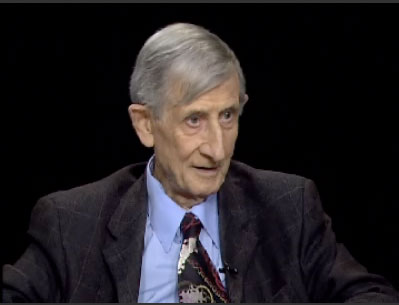
CHARLIE ROSE: Freeman Dyson is here. He has spent a lifetime grappling with some of the toughest problems in science and beyond. As a young physicist, he achieved worldwide recognition by merging three competing theories of quantum physics. Dyson has since become a best- selling author on topics from biotechnology to extraterrestrial
intelligence.
In recent years, he has emerged as a critic of climate change. In March, "The New York Times" profiled him in an article called, "The Globing Warming Heretic." The piece asked, "How did Freeman Dyson, revered scientist, liberal intellectual, problem solver, wind up infuriating the environmentalists?"
We'll ask that and more. I'm pleased to have Freeman Dyson back at this table. Welcome.
FREEMAN DYSON: Thank you.
CHARLIE ROSE: I'll get to this in a moment, but you really stirred them up when you talked about global warming, don't you?
FREEMAN DYSON: So, that article, of course, is totally misleading. Global warming is a very small part of my concern. ...
[...]

...Genetic engineering is now at a point where computer science was around the mid-eighties. The early PCs were limited as to purpose and network. In two and a half decades, the computer has led us into a digial world in which every aspect of lives has been affected. According to Moore's Law, the performance of computers doubles every 18 months. Genetic engineering is following a similar growth. On the last weekend in July, Craig Venter and George Church met in Los Angeles to lead a seminar on synthetic genetic engineering for John Brockman's science forum Edge.org.
Genetic engineering under Church has been following the grwoth of computer science growing by a factor of tenfold per year. After all, the cost of sequencing a genome dropped from three billion dollars in 2000 to around $50 000 dollars as Stanford University's Dr. Steven Quake genomics engineer announced this week. 17 commercial companies already offer similar services. In June, a "Consumer Genetics" exhibition was held in Boston for the first time. The Vice President of Knome, Ari Kiirikki, assumes that the cost of sequencing a genome in the next ten years will fall to less than $1,000. In support for this development, the X-Prize Foundation has put up a prize of ten million dollars for the sequencing of 100 full genomes within ten days for the cost of less than $10,000 dollars per genome sequenced.
It is now up to the companies themselves to provide an ethical and legal standing to commercial genetic engineering. The States of New York and California have already made the sale of genetic tests subject to a prescription. This is however only a first step is to adjust a new a new commercialized science which is about to cause enormous changes similar to those brought about be computer science. Medical benefits are likely to be enormous. Who knows about dangers in its genetic make-up, can preventive measures meet. The potential for abuse is however likewise given. Health insurances and employers could discriminate against with the DNS information humans. Above all however our self-understanding will change. Which could change, if synthetic genetic engineering becomes a mass market, is not yet foreseeable. For example, Craig Venter is working on synthetic biofuels. If successful, such a development would re-align technology, economics and politics in a fundamental way. Of one thing we can already be certain. The question of whether genetic engineering will becomes available for all is no longer on the table. It has already happened.

Von aktuellen Entwicklungen aus der schönen neuen Welt der Genom-Sequenzierung berichtet Andrian Kreye: "Am letzten Juliwochenende trafen sich Craig Venter und George Church in Los Angeles, um für John Brockmans Wissenschaftsforum Edge.org ein Seminar über synthetische Gentechnik zu leiten. Die Gentechnik, so Church, habe die Informatik dabei längst hinter sich gelassen und entwickle sich mit einem Faktor von zehn pro Jahr. Immerhin - der Preis für die Sequenzierung eines Genoms ist von drei Milliarden Dollar im Jahr 2000 auf rund 50.000 Dollar gefallen, wie der Ingenieur der Stanford University Dr. Steven Quake diese Woche bekanntgab. 17 kommerzielle Firmen bieten ihre Dienste schon an."

An essay on how language influences thought from the pop-science anthology "What's Next: Dispatches on the Future of Science" has been posted on The Edge. Author Lera Boroditsky, an assistant professor of psychology, neuroscience and symbolic systems at Stanford, writes:
Most questions of whether and how language shapes thought start with the simple observation that languages differ from one another. And a lot! Let's take a (very) hypothetical example. Suppose you want to say, "Bush read Chomsky's latest book." Let's focus on just the verb, "read." To say this sentence in English, we have to mark the verb for tense; in this case, we have to pronounce it like "red" and not like "reed." In Indonesian you need not (in fact, you can't) alter the verb to mark tense. In Russian you would have to alter the verb to indicate tense and gender. So if it was Laura Bush who did the reading, you'd use a different form of the verb than if it was George. In Russian you'd also have to include in the verb information about completion. If George read only part of the book, you'd use a different form of the verb than if he'd diligently plowed through the whole thing. In Turkish you'd have to include in the verb how you acquired this information: if you had witnessed this unlikely event with your own two eyes, you'd use one verb form, but if you had simply read or heard about it, or inferred it from something Bush said, you'd use a different verb form.
She brings up experiments and other examples involving use of language and direction, time, color and gender, all of which seem to demonstrate that yes, language shapes how we think.
But my favorite is this example above. Only a linguist -- or perhaps a social scientist -- would put Chomsky in a hypothetical.

Man steigt, heißt es, nicht zweimal in denselben Fluss. Aber man hofft doch, als derselbe ans Ufer zurückzukehren. Nur im Horizont dieses Bildes zeigt sich die Radikalität der Frage, die der Literaturagent John Brockman von der Organisation "Edge" (Edge - die Website) der wissenschaftlichen Gemeinschaft vorgelegt hat: „Welche Entwicklung könnte zu Ihren Lebzeiten alles ändern?" Wie zu jedem Jahreswechsel fordert Brockman mit seiner Frage auf der Website von Edge die Phantasie der Wissenschaftler heraus, den Mut zum großen Gedanken. Es antworten oft hochdekorierte Forscher wie Ian Wilmut, Craig Venter oder Daniel Dennett, die in (Natur-)Wissenschaftlern und Technikern und nicht mehr im Literaten oder Historikern den zeitgemäßen Typus des Intellektuellen sehen.
Fasst man den Grundtenor der mehr als einhundertfünfzig Antworten zusammen, so gehört die Zukunft den Genetikern, Neurobiologen und Informatikern oder jedenfalls solchen Wesen, die sich die Ergebnisse neurobiologischer, informationstechnologischer und genetischer Forschung zunutze machen. Ob sie noch sinnvollerweise Menschen genannt werden sollten, ist dabei eine berechtigte Frage. ...

Das Versagen der Linken im Gaza-Krieg
In der "SZ" erinnert sich Sibylle Lewitscharoff an ihre Zeit bei der Gruppe Spartacus Bolschewiki-Leninisten. Die "NZZ" hat in Detroit in die vielen Gesichter des Nichts gesehen. Und die "FAZ" erkennt in der chinesischen Markenpiraterie die Intelligenz des Volkes.
Frankfurter Allgemeine Zeitung, 10.01.2009...Weiteres: Wie es aussieht, "wenn die Intelligenz von sich selber träumt", weiß Thomas Thiel seit der Umfrage des Magazins edge.org unter hochdekorierten Naturwissenschaftlern zu der Frage: "Welche Entwicklung könnte könnte zu Ihren Lebzeiten alles ändern?"

Talk about change was more plentiful in 2008 than loose coins in an old couch.
Despite all the lip-flapping, that place where gods and devils dwell -- the details -- was largely unexplored.
The Obama administration will soon offer its ideas for reviving the economy and reshaping America's foreign policy. But politicians aren't the only ones who can remake the world.
Scientists have at least as much power to transform our lives and history. What "game-changing scientific ideas and developments" do they expect to occur during the next few decades?
That's the question John Brockman, editor of the Web site edge.org, posed to about 160 cutting-edge minds in his 11th annual Edge Question. As in years past, they responded with bold, often thrilling, sometimes chilling, answers.

• Edge contributors answer "What will change everything?"
GJ: We were talking abut great thiigs on the Internet in science...so you read Edge.org' question of the year?
JH: Yes, the annual question from John Brockman, the science book impressario. He's got this great site edge.org 2hich we've talked about before and every year he asks this question and he's asks this ever-growing stable of people, primarily scientists but a of of quasi-scientist pundits to respond this question. The question this year is "What will change everything".
GJ: Yes, Good New Year's Day reading.

Al rito solar del Año Nuevo, el concierto de Viena (me paso las dos horas de valses, fantaseando con el frío de fuera, y la choucroute caliente y morosa que le espera al primer concertino: todo lo que me gusta me da hambre) y los saltos en Garmisch Partenkirchen se ha unido ya la pregunta de Edge. Al despuntar el alba, y con todas las ilusiones intactas, Brockman&Guests sacuden la resaca, preguntan y se responden. Lo hacen desde 1998 y este año proponen: «Qué es lo que va a cambiarlo todo?» El subtítulo lleva una consoladora precisión: se trata de cambios y desarrollos científicos que podamos ver en vida. El resumen de las ideas de Edge, la navajita más afilada de la cultura contemporánea, siempre es complicado. Excepto, claro está, en el caso de los dos o tres artistas que figuran cada año a modo de sansivieras: todas sus respuestas se pueden ignorar. Deberás fiarte, pues, de mi gusto y de mis obsesiones. También de las limitaciones del formato de la carta. Y, principalmente, de mis límites: no entiendo todas las respuestas. En todo caso,aquí tienes el catálogo completo.
1. Una nueva mente. Internet es la auténtica inteligencia artificial de nuestro tiempo. «En lugar de decenas de genios intentando programar una inteligencia artificial en un laboratorio universitario, hay mil millones de personas ejercitando los tenues destellos de inteligencia que emergen entre los cuatrillones de hipervínculos en la web.» Kevin Kelly
2. El homo evolutis. El desarrollo de las células madres y las nuevas prótesisllevan a una conclusión: «Lo que hoy es interesante, 200 años después del nacimiento de Darwin, es que estamos tomando el control de forma directa y deliberada sobre la evolución de muchas especies, incluida la nuestra». Juan Enríquez
3. El fin de la violencia. Las neurociencias podrán inhabilitar las condiciones cerebrales que facilitan el comportamiento violento. «Quiza descubriríamos un factor común entre los patrones del cerebro de alguien que está a punto de asesinar a un niño y un jefe de estado firmando un proyecto de ley para iniciar un programa de armamento nuclear, o un ingeniero que está diseñando un nuevo tipo de bombas racimo. Todos ellos aceptan a un cierto nivel intelectual que es perfectamente correcto que sus actos causen daño o la muerte a otros humanos. Los cerebros de todos ellos, quizá, experimentan el patrón D, el “patrón de la muerte”». Karl Sabbagh.
4. El cambio de lo real, lo posible y lo imaginable. Y lo que es su consecuencia: el cambio en el programa moral de los seres humanos: «Ahora deja correr la imaginación. ¿Qué haría un chimpancé con la maquinaria generativa que tiene el hombre cuando realiza cómputos en el lenguaje, las matemáticas y la música? ¿Se podría imaginar lo antes inimaginable? ¿Y si le diéramos a un genio como Einstein los componentes clave que hicieron de Bach otro genio distinto? ¿Podría Einstein imaginar ahora diferentes dimensiones de la musicalidad? Estas mismas manipulaciones neuronalesincluso hoy son posibles al nivel genético.» Marc Hauser
5. La revolución en la enseñanza. Internet conseguirá ampliar de modo exponencial la noción de maestro, que ya no dependerá del azar: «En el pasado el éxito de cada uno dependía más bien de la suerte de contar con un gran mentor o profesor en el vecindario. La inmensa mayoría no ha tenido la suerte. Pero hoy, una joven nacida en África, tendrá probablemente acceso,en diez años, a un móvil con pantalla de alta resolución, conexión web y más potencia que el ordenador que tienes hoy. Podemos imaginarla adquiriendo cara a cara la comprensión, y eligiendo los grandes profesores del mundo. Tendrá una oportunidad para ser lo que puede ser. Y puede acabar siendo la persona que salve el planeta para nuestros nietos.» Chris Anderson
6. El fin de Babel. Observa este párrafo. «Aunque la comunicación de masas requiere de técnicas de traducción que superan nuestras capacidades actuales, las bases de esta tecnología ya se ha [sic] establecido y muchos de nosotros vivirá [sic] para ver una revolución en la traducción automática que va a cambiar todo lo relacionado con la cooperación y la comunicación en todo el mundo.» (Daniel L. Everett). El párrafo se ha traducido automáticamente del inglés.
7. La telepatía. Freeman Dyson habla desde sus 85 años. No espera ver grandes cambios en lo que le queda de vida. Pero anuncia que la telepatíadejará de ser una superstición. Y puede que comprenda e incluya a todos los seres vivientes. Este párrafo fascinante: «Cuando la radiotelepatía se extiende de los humanos a otras especies animales surge otro conjunto de oportunidades y responsabilidades. Experimentaremos entonces, directamente, el placer del vuelo de un pájaro o de una manada de lobos cazando, el dolor de un ciervo herido o de un elefante muerto de hambre. Sentiremos en nuestras propias carnes la comunidad de vida a la cual pertenecemos. No puedo evitar tener la esperanza de que compartir nuestros cerebros con nuestros semejantes nos convertirá en mejores gestores de nuestro planeta.»
8. El cambio llegará por donde no se le espera. Carlo Rovelli bordea el pesimismo, y está tentado de pensar que el progreso es un sueño. Pero se recupera y anota: «El tractor. La humilde máquina rural que ha cambiado nuestra vida quizá más que la rueda o la electricidad. ¿Otro ejemplo? La higiene. Nuestra esperanza de vida casi se ha duplicado gracias a poco más que lavarse las manos y darse duchas. El cambio llega a menudo por donde no se le espera. La famosa nota de los altos directivos de IBM al comienzo de la historia de la computadora consideraba que “no había mercado para más de unas pocas decenas de ordenadores en el mundo”».
9. La infancia perpetua. Alison Gopnikn ve en el mantenimiento de la plasticidad infantil del cerebro el gran horizonte. Los niños y su cerebro abierto son el I+D de la Humanidad. Pero se pregunta: «Si somos niños para siempre, ¿quiénes serán los padres? Si somos todos niños ¿quiénes serán los adultos?»
10. Cerebro Ctrl+c/Ctrl+v. Descarga de conciencia. Y tal vez su descargo. David Eagleman no cre que la medicina sea capaz de controlar el desgaste del cuerpo de una manera decisiva. Pero vislumbra un camino alternativo: «Mucho antes de que entendamos cómo funciona el cerebro, seremos capaces de copiar digitalmente la estructura del cerebro y de descargar la mente consciente a una computadora.»
11. Una muy, muy buena batería, dice el físico John D. Barrow sin dar más detalles, ni falta que hace.
12. El teléfono móvil. El matemático Keith Devlin casi se disculpa en estos términos: «[El móvil] pone la conectividad global, el inmenso poder computacional y el acceso a todo el saber mundial amasado durante muchos siglos, en manos de cualquiera. El mundo nunca ha estado antes, jamás, en esa situación. Eso lo cambiará realmente todo. Desde el modo en que los individuos viven sus vidas, al modo en que la riqueza y el poder se distribuyen en todo el planeta. Es la tecnología democratizadora definitiva. Y si mi respuesta parece menos afilada o científicamente sexy que muchas de las otras que habéis recibido, creo que sólo demuestra lo drástico y omnipresente que el cambio ha sido ya.»
13. La vida eterna. Frank J. Tippler es uno de los grandes físicos universales. Tiene algo de muy particular, sin embargo: es creyente y confía ciegamente en la eternidad: «Desarrollaremos la tecnología definitiva que, al transferirse con manos vacilantes a nuestros sucesores finales, las inteligencias artificiales y las descargas (downloads) humanas, nos permitirán expandirnos en el espacio interestelar, asaltar el universo, y vivir para siempre.»
14. El fin del Co2. Atiende: «Una serie de placas solares, que en conjunto, cupieran en una esquina de Tejas, podrían generar 3 terawatios. En el transcurso de diez años, 3 terawatios podrían proveer la suficiente energía para eliminar todo el exceso de carbono que la raza humana ha añadido a la atmósfera desde que comenzó la Revolución Industrial. Por lo que afecta a las emisiones de carbono, esto arreglaría el problema.»
15. La curiosidad. Daniel Dennett necesita poco comentario: «El sexo recreativo, la comida recreativa y la percepción recreativa (alucinógenos, alcohol), han sido populares desde la época romana, pero ahora estamos al borde de las autotransformaciones recreativas que dejarán pequeñas las modificaciones con las que se dieron el gusto los romanos. Cuando ya no necesitas comer para seguir vivo, o procrear para tener vástagos, o moverte para tener una aventura, cuando los instintos residuales hacia estas actividades puedan ser desactivados mediante la manipulación genética, no quedará ninguna constante humana. Excepto, quizás, nuestra incesante curiosidad.»
16. Neurocosmética. Marcel Kinsbourn ha visto en la cirugía cosmética las resistencias y luego el asentimiento. Piensa que sucederá lo mismo respecto a la estimulación cerebral profunda. «La experiencia muestra que aquellas reservas respecto a la autenticidad son teóricas. La nariz retocada, el pecho, los muslos o el tono de la piel se convierten en la nueva realidad de la persona, sin importantes reacciones sociales adversas. Incluso los transplantes faciales son ya viables. Las consideraciones que surjan de la estimulación cerebral profunda están presentes, a escala menor, en la cirugía cosmética.»
17. La escritura de la vida. Estas tremendas palabras de Craig Venter: «Tal como hemos aprendido en los 3.5 miles de millones de evolución convertiremos miles de millones de años en décadas y cambiaremos, no sólo conceptualmente, el modo como vemos la vida misma.»
18. La verdad. Sam Harris descubre en las investigaciones neurológicas el detector de mentiras perfecto. «Cuando se evalua el coste social del engaño, uno debe considerar todas las fechorías: infidelidades matrimoniales, estafas Ponzi, asesinatos premeditados, atrocidades terroristas, genocidios, etc., que están nutridas y apuntaladas, a cada momento, por las mentiras. Visto en este contexto más amplio, el engaño se plantea en sí, quizá por encima de la violencia, como el principal enemigo de la cooperación humana. Imagina cómo cambiaría nuestro mundo si, cuando la verdad importara realmente, se hiciese imposible mentir.»
Ahora, querido amigo, cierra la pantalla y vuelve a Zapatero, a Rajoy y a don José Montilla.
(Links: Verónica Puertollano)
·
Correspondencias / Nicolás
Estimado Arcadi: Dudo mucho que internet consiga ampliar la noción de maestro (y mucho menos en modo exponencial). Y si lo consiguiera no podría deshacerse del factor azar que usted (y Anderson) atribuye al encuentro maestro-alumno. En cuanto a la joven nacida en África que dentro de diez años tendrá “el oro y el moro”, dudo también que llegue a ser realidad (hoy debe ser mi día de la incertidumbre); a no ser que la joven sea sobrina de rey déspota magrebí o descendiente de blanca familia bóer sudafricana (aunque también podría ser la niña de Rajoy, si ésta hubiera nacido en Melilla).
Un cordial saludo de un escéptico maestro.
Pd: De los otros diecisiete deseos también tengo mis dudas que se cumplan. ¿Por qué? Pues por que en el mundo -incluida Cataluña- siguen interviniendo personajes como Zapatero, Rajoy, Bush, Olmert, Ahmanideyah… incluso, don José Montilla.
·
Correspondencias / Raúl Gay
Estimado Arcadi Espada.
Acabo de ver los vídeos colgados en youtube de su conferencia “Democracia versus Teocracia”. En un momento dado, usted dice que no hay periodistas ateos, que en su trayectoria sólo ha conocido a 3.
Bien, aquí un cuarto periodista ateo.
Felicidades por su trabajo. Un saludo,
Raúl Gay, redactor de informativos de Aragón Televisión.
·
Correspondencias / Claudio Ortega
Sr. Espada,
Al igual que usted, también he comenzado el año con valses y Edge. La verdad es que soy mucho más aficionado a los primeros. Las encuestas del segundo, en las que siempre están los previstos (más algunas sorpresas: ¿qué pinta Brian Eno?) me suenan a propuestas para el guión de un capítulo de Star Trek.
Aún así, me han llamado la atención tres respuestas. Una ya la ha citado usted: la de Gopnik, preguntándose quienes serán los padres. Yo lo leo en un tono algo más negro: el precio que hay que pagar por aprender es el riesgo de no saber tomar decisiones. Al fin tendrá razón Azúa, en que la adolescencia llega ya hasta los cuarenta años.
Pero veo que a usted no menciona las otras dos entradas que más me han llegado.
La de Sheldrake, pronosticando la bancarrota (credit crunch) del materialismo, que lleva ya unos cuantos decenios pidiéndonos paciencia, emitiendo pagarés que posiblemento no tendrá fondos para respaldar. Este autor lo ve como la condición para una ciencia ‘más libre y más divertida’.
Y luego está Taleb, especialista en ver plumeros, recordándoles a los médicos que los grandes avances de la medicina han sido la mejora de las condiciones higiénicas y la chiripa de los antibióticos. La medicina debe olvidar la arrogancia heredada de la Ilustración y aprender que uno de los componentes del conocimiento está en saber dónde detenerse. Esto me ha recordado la valiente entrevista de Punset con su oncólogo, al principio de la cual le venía a decir: pero bueno, después de lo que yo me he dedicado a explicar por el mundo sobre los avances en conocimientos, ¿todo lo que tenéis para ofrecerme es la salvajada de la quimio?
En fin, comentarios que me han llamado la atención, sin duda por mis preocupaciones personales y que, si me tomo la libertad de comentarle, es porque han sido leídos en buena medida con alguna de sus reflexiones y lecturas recomendadas en mente.
Aprovecho para desearle lo mejor para el año que empezamos.
·
Correspondencias / Antonio Donaire
A propósito del comentario del Sr. Claudio Ortega, querría confirmarle y rectificarle al mismo tiempo una de sus afirmaciones relativas a los médicos. Entre los “grandes avances de la medicina” por “chiripa” hay que incluir (y no excluir, como quizá parece deducirse de la anécdota que cuenta del Sr. Punset y su oncólogo) la quimioterapia aplicada como anticancerígeno (ver “agentes basados en platino” ). En efecto, el descubrimiento del cisplatino es un ejemplo paradigmático de pura serendipia. Saludos.
·
Correspondencias / Rafael Pérez Domínguez
Estimado Arcadi Espada:
Estoy impresionado por la enumeración de sus “Impíos deseos al empezar el año” de 3 de enero en El Mundo. Impresionado también por su entusiasmo y su fe al enunciarlos. Yo no puedo compartir ni la fe ni el entusiasmo.
¿Fe en “Internet como la auténtica inteligencia artificial de nuestro tiempo”? Internet transmite una millonésima parte de la información disponible, formalizando una especie de enorme Reader’s Digest actualizado. En cuanto a la formación de opinión, los millones de participantes en blogs y otros artilugios de comunicación y debate no solemos hacer sino reproducir, en una redundancia multiplicada por millones, las informaciones y reflexiones emitidas previamente por un contado número de fuentes difusoras. De ahí no nace una nueva inteligencia, un nuevo saber: se trata de un juego de espejos múltiplemente reflectante, de un eco que va y viene con mil voces que repiten siempre la originaria. Mi profesión es la informática y, para trabajar, internet es imprescindible, pero como supuesto gran avance cultural de la humanidad permítame una boutade: “Internet, ¡bah!”
¿Fe en las neurociencias para erradicar la violencia? ¿Lobotomías en racimo? ¿La neurociencia como supresora de la necesidad del derecho positivo, como erradicadora de los conflictos interhumanos e interestatales? ¿Hacia el fin del Estado por la neurociencia? ¡Bah, la neurociencia!
¿Fe en alguna revolución de la enseñanza porque una joven africana pueda disponer de móvil con pantalla de alta resolución? ¿Educación individual, no grupal, no social, mediante charlas de gurús internacionales, sin acceso a los textos históricos, literarios, morales, culturales? ¡Bah, la educación por pantalla!
¿Fe en la traducción automática como solucionadora de los problemas de comunicación interhumana? Sí, una cierta fe, pero: la dificultad de comunicación no es sólo resultado de la diferencia de lenguas, sino fundamentalmente de la diferencia de culturas. ¡Pero vale, traduzcamos automáticamente!
¿Fe en la telepatía, en las descargas de cerebro para la vida eterna, en la no necesidad de comer ni procrear (¡este Dennett!), en…? Estupendo, lo tengo todo en mi reducidísima colección de novelitas de ciencia-ficción. ¡Bah, telepatía, vida eterna…!
Y luego está la fe y el entusiasmo por cosas como las manipulaciones genéticas de Venter (**). Y, sobre todo, la fe y el entusiasmo por el cambio de lo real, lo posible y su consecuencia de cambio del paradigma moral. Con ésta me quedo como resumen para hacer la única reflexión que me parece interesante de todo esto: ¿pero es que todo lo que es posible hacer debe ser hecho? ¿No cabe negar el permiso para acometer determinadas acciones que son posibles pero que puedan ser consideradas como indeseables o como temibles? ¿Estamos condenados a tal automatismo? ¿Es Venter quien decide lo que será hecho, puesto que descubre que puede ser hecho y muestra cómo hacerlo? El carácter taumatúrgico de que se está revistiendo la ciencia y a la ciencia, ¿nos va a impedir decir NO a determinadas posibilidades tecnológicas? ¿Cualquier negativa a proseguir por determinados caminos posibles está condenada a ser aplastada por el omnipotente positivismo científico? ¿Ninguna Vieja Advertencia, ningún Viejo Temor, ninguna consideración sobre la Vieja Sabiduría Heredada contendrá el inexorable desarrollo que comenzó con el Pecado Original en que Adán y Eva decidieron comer del Fruto Prohibido para llegar a ser Como Dioses? ¿Este es el tremendo avance humano: hacer imposible de evitar cualquier transformación que resulte posible? ¿Este es el límite a la libertad humana? Ciertamente, el mito del Pecado Original que nos hizo Como Dioses se me hace cada día más actual y más amenazador.
Será que soy un antiguo. Pero creo que, junto al descubrimiento de posibilidades de acción humana, hay que reivindicar los principios de búsqueda de sabiduría y reclamación de libertad contenidos en la frase “Qué hacer” y en su contraria “Qué no hacer”.
—————————
(**) Muy curiosamente, Venter diverge radicalmente de Darwin y del moderno darwinismo al acometer experimentos que habría, ortodoxamente, que calificar de “creacionistas”, por completo ajenos al azar cromosómico y a la bobada de la “selección natural por presión adaptativa” (bobada porque jamás tal presión creó ni una sola especie, sino que se limita a destruir aquellas mutaciones que no consiguen sobrevivir).
Se queja usted en su “El insoportable” de 2 de enero de que Darwin describe un mundo sin Dios: pero es que su descripción es, lamentablemente, errónea. Curiosamente, Venter está a punto de describir un mundo con Dios, al intentar realizar transformaciones que empiezan por sintetizar un ADN y aspiran a llegar a crear una célula viva y de ahí en adelante, sin mezcla de azar ni selección natural alguna, en una emulación del Dios creador primigenio ideado por el hombre y abrazado como razonable por toda la humanidad. Si es que lo es, la paradoja me parece divertida. Venter no crea un mundo sin Dios, hipótesis que, coincido con usted, carece de historia y resulta, en consecuencia, inimaginable. No, Venter confirma el creacionismo de Dios por el procedimiento de mostrar que él está llegando a hacer cosas “como Dios”, según el programa de acción humana iniciado por Eva al morder de la manzana.
Tiene usted razón, el calado de Darwin es infinitamente menos profundo que el de Freud o Marx. No podría ser de otra manera: Freud y Marx trabajan sobre la realidad y la transforman, Darwin se limita a filosofar. ¿Y por qué resulta Darwin insoportable?: a una pequeña minoría, entre la que me encuentro yo mismo, porque nos parece que su filosofía de la naturaleza carece del menor rigor científico, porque confunde la selección natural que no hace otra cosa sino destruir variedades inviables con la selección natural que no hace sino estrechar el contenido genómico de las especies por cruces homocigóticos, porque le resulta indispensable defender la herencia de los caracteres adquiridos, porque hace crecer el cuello de la jirafa para que coma de las ramas más altas, porque no consigue describir la aparición de una sola especie, porque…; y a la mayoría, a la inmensa mayoría, Darwin les resulta insoportable porque les niega su propia cultura, su propia antropología, sin proporcionarles a cambio nada, ni el menor beneficio, ni siquiera, repito, el de la plausibilidad científica.

The artist and composer responds to this year's Edge.org question: What will change everything?
 [PHOTO: BRIAN ENO/EAMONN MCCABE]
What would change everything is not even a thought. It's more of a feeling.
Human development thus far has been fueled and guided by the feeling that things could be, and are probably going to be, better. The world was rich compared to its human population; there were new lands to conquer, new thoughts to nurture, and new resources to fuel it all. The great migrations of human history grew from the feeling that there was a better place, and the institutions of civilisation grew out of the feeling that checks on pure individual selfishness would produce a better world for everyone involved in the long term.

Every year, John Brockman — who runs the nonprofit Edge Foundation in New York — asks a gaggle of forward-thinking people a provocative question.

Leading thinkers - includingCraig Venter and Ian McEwan - have marked New Year 2009 by predicting what will be the next big thing to shape the future.
 [PHOTO: IAN MCKEWAN/PHILIP HOLLIS]
[Caption: Ian McEwan: predicts the full flourishing of solar technology as one of the next 'big things']
A 150-strong group of scientists, authors, musicians, philosophers and other respected experts were posed the question "What will change everything?"
Their task was set by Edge, an online intellectual discussion group, which claims its membership comprises "the most interesting minds in the world".
The responses spanned new methods of energy production, the dawn of telepathy, freely available artificial intelligence and the colonisation of the Milky Way."

Dawkins speculates about how a human-chimp hybrid or the discovery of a living Homo erectus would change the way we see the world. — James Randerson
In a late response to Edge.org's annual New Year challenge to the world's leading thinkers, Prof Richard Dawkins has submitted his entry. Edge.org asked scientists, philosophers, artists and journalists "What will change everything?"
Dawkins – author of The Selfish Gene and The God Delusion – muses on the effect of breaking down the barrier between humans and animals, perhaps by the creation of a chimera in a lab or a "successful hybridisation between a human and a chimpanzee".
Here's what he had to say.

Annual science survey asks: "What game-changing scientific ideas and developments do you expect to live to see?" Among the answers:
• West Antarctica and sleeping giants
• Quantum laptops
• Mind-reading ...

The predictions range from miracle cures and world peace to economic ruin and nuclear war. If there is a theme to the World Questions 2009, an online survey of some of the world's top thinkers, it would seem to be inconsistency.
Published yesterday on intellectual website edge.org, the survey asked 150 leading scientists, artists and commentators for their views on the single biggest change likely to affect the world during their lifetimes.
The wide range of answers they gave provides a snapshot of the hopes - and fears - that may come to define our times.

Scientists and other experts rattle off options for averting climate catastrophe
Meanwhile, the mysterious Edge Foundation released its annual question for 2009, asking smart folks of all disciplines to name what new idea or technology will "change everything." Responses range all over, but there are a few climate-related responses, including British novelist Ian McEwan's prediction that solar technology will really take off and Stanford climatologist Stephen H. Schneider's guess that rapid melting of Greenland's ice sheets will wake up the world to the need to take concerted action on curbing C02 emissions.

If you're familiar with The Edge's annual survey of scientists, science writers and scientific types, you know how fascinating the answers are. Follow the link above to get started reading them -- and then share in the comboxes your own answer to the question, and how you reached that conclusion

Annual science survey asks: "What game-changing scientific ideas and developments do you expect to live to see?" Among the answers:
• West Antarctica and sleeping giants
• Quantum laptops
• Mind-reading ...


Regular Radar contributorLinda Stone sent this in to be posted today.
...Venter imagines creating life from synthetic materials and expects that our view of life, itself, will be transformed.
Nobel Laureate, Frank Wilczek, believes everything will continue to become smaller, faster, cooler, and cheaper -- with its implications of an Internet on steroids and exciting new designer materials.

Futurology is notoriously hit-and-miss. According to 2001: A Space Odyssey, we should already be using suspended animation to send humans to Jupiter
"Through science we create technology and in using our new tools we recreate ourselves." So says the intro to edge.org's annual New Year challenge to the world's greatest thinkers.This year it is asking "What will change everything – What game-changing scientific ideas and developments do you expect to live to see?" And as ever, the great and the good have responded to the call. ...

What game-changing ideas can we expect to see in OUR lifetimes?
As each year winds to a close, John Brockman, literary agent representing some of the finest minds in science and technology and the founder of Edge Foundation, poses a provocative question to an international community of physicists, psychologists, futurists, thought leaders, and dreamers. Brockman is a master convener, both online and in real life. This year’s annual Edge question, What will change everything?, generated responses from Freeman Dyson, Danny Hillis, Martin Seligman, Craig Venter, and Juan Enriquez, to name a few. Here are a few highlights.

Printing – electricity – radio – antibiotics: after them, nothing was the same. Intellectual impresario John Brockman asks a select group of thinkers, “What will change everything?”...

[Caption: Ian McEwan muses that we will look back and 'wonder why we ever thought we had a problem when we are bathed in such beneficent radiant energy'. Photograph: Getty]
Flying cars, personal jetpacks, holidays on the moon, the paperless office – the predictions of futurologists are, it seems, doomed to fail. The only thing predictable about the future is its unpredictability.
But that has not stopped edge.org – the online intellectual salon – asking which ideas and inventions will provide humanity's next leap forward. In its traditional New Year challenge to the planet's best thinkers it asks, "What will change everything – What game-changing scientific ideas and developments do you expect to live to see?"

GENETICS REVOLUTION
Craig Venter wants to email life (Craig Venter will Lebewesen e-mailen)
By Christian Stöcker
A pioneer in the field of genetics can envision a fantastic future in which genetic codes are sent by email and then reassembled as living beings at the other end. Or so Craig Venter forecast at an Internet conference in Munich. He also hopes to solve the problem of global warming—with designer microbes. ...
|
CRAIG VENTER: LIFE VIA EMAIL |

It is a dense network. At the annual gathering of the digital elite, organized by Burda Media in Munich, cell phone networks have barely enough capacity. WLAN and UMTS are groaning under their full load, as everyone calls, surfs the Internet, types—everywhere you look people have their Smartphones and their laptops, and the crowds of Blackberry devotees now also have an iPhone handy.
The event is called DLD. Previously this stood for the "Digital Lifestyle Day," but it is now "Digital Life, Design." The attendees are first-rate—in part because the event is so opportune: many of the international business stars to whom the publisher pays tribute in Munich will subsequently travel on to Davos for the World Economic Forum. And so this year we are running into people like Richard Dawkins and Marissa Mayer of Google in the hallways. And Jason Calacanis, who invented the concept of blogging, chatted with Wikipedia founder Jimmy Wales—oh yeah, and even Naomi Campbell will make an appearance today.
Bio-revolutionaries amidst technology fans
The excitement is palpable, latching on to topics like the new markets in India and China, social networks, and above all the mobile network. Although it possible that this last issue seems especially urgent because everyone is constantly trying to get on the Internet, and failing.
Amidst all the enthusiasm for technology, one conversation had more explosive potential than the talking points of all the old and new digital entrepreneurs put together. Only hardly anybody noticed. DLD is always so crowded that you have to stand for the interesting events. But when genetics entrepreneur Craig Venter and genetics revolutionary Richard Dawkins, who took on the entire religious Right with his antireligious tomeThe Selfish Gene, got up on stage yesterday to talk about a "gene-centric world view," noticeably fewer people were standing than is often the case. And this even though their talk contained more revolutionary statements and wild forecasts by far than the other presentations looking toward future.
Venter, who last made headlines when he published his personal genome in full on the Internet, made brazen claims, but nobody reacted. Venter insisted that climate change represents a much greater risk to humanity than genetic engineering, which could actually help fight it. For example, with genetically manipulated microbes capable of absorbing CO2: "We can change the environment through genetic engineering." John Brockman, who is the literary agent of both Dawkins and Venter, had the role of moderator, but let Dawkins take over. When Venter began to speak of specific genetically engineered correctives for the environment, however, he abruptly woke up. Somebody once explained to him that when you talk about these subjects in Germany, "it causes an uproar—but everyone appears so calm!" And he is right.
"Life is becoming technology"
The momentum was building and, always one to provoke, Venter was on the ball. Dawkins' was inevitably the role of Devil's advocate and he asked whether Venter considers that all life is technology. "Life is machinery," he answered, "which as we learn how to manipulate it, becomes a technology." Dawkins, who wore shirt sleaves and an eccentric white and gray tie, and who came across a bit like a friendly math teacher, suddenly found himself delivering a tentative warning: the unchecked intermingling of gene pools could have unforeseen consequences. He drew a parallel to the unforeseen devastation that introducing new microbes, plants, or animal species can cause to ecosystems.
Dawkins knows what he is talking about—in the '70s he acheived fame with his book entitled The Selfish Gene. At the start of his talk, he declared that "genes are information." From this Venter transitioned into the depiction of a future in which genetic information could be sent over email for the receiver to reassemble as a living being: "We can already reconstruct a chromosome in the laboratory." Last October, the Guardian already reported that Venter would soon be the first to create an entirely artificial life form—something he is accomplishing even as he speaks of a future in which genes are software and humans, at their discretion, can produce life that conforms to their wishes. The question of what happens when genes, which behave all too selfishly in Dawkins' own portrayal of them, breed freely did not come up.
At the same time as this staggering conversation took place on the podium, between a radical genetic engineer and a mastermind in the science of genetics, who evoked a future with artificially designed life and DNA-printers that is already emerging from their current scientific revolution, directly next door a group of Web Entrepreneurs and venture capitalists were engaged in a heated discussion about social networks and earning opportunities. But next to the two dignified grey haired figures onstage, they suddenly seemed a little colorless—almost even a little outdated.
Translated by Karla Taylor
German Language Original

I've been traveling in Central America for the past few weeks, so I'm late on blogging a number of things -- including this. Each year, EDGE.org's John Brockman asks a new question, and a bunch of tech/sci/internet folks reply. This year's question: What have you changed your mind about?
Science is based on evidence. What happens when the data change? How have scientific findings or arguments changed your mind?
I was one of the 165 participants, and wrote about what I learned from Boing Boing's community experiments, under the guidance of our community manager Teresa Nielsen Hayden: Link to "Online Communities Rot Without Daily Tending By Human Hands."

Even IT gurus have the right to think twice.
This year the online salon Edge.org has drawn a lot of attention for the annual question it put out to a mixture of scientists and artists: What have you changed your mind about?
Contributors range from actor Alan Alda to folk singer Joan Baez, but some of the real gems came from technology visionaries who decided to take a second look at their original visions.
[Note to Globe and Mail: It's "the mathematician physicist John C. Baez", not his cousin the "folk singer Joan Baez", daughter of the physicist Albert Baez.]

"Flip-Flops" werden im Englischen verächtlich Menschen genannt, die plötzlich ihre Meinung ändern. Was bei Politikern oft als ein Zeichen von Opportunismus interpretiert wird, gehört in der Wissenschaft zum Wesen. Dennoch ist es auch unter Forschern und Forscherinnen nicht üblich, sich öffentlich zu einem Sinneswandel zu bekennen. Genau das haben sie aber nun gemacht. Bereits zum elften Mal hat der New Yorker Literaturagent John Brockman namhaften Wissenschaftlern zum Jahreswechsel knifflige Fragen gestellt. Diesmal lauten sie "Wobei haben Sie Ihre Meinung geändert? Und warum?"
Die Antworten von insgesamt 165 Forschern und Expertinnen sind unterschiedlich und oft amüsant: Der Biologe Richard Dawkins erklärt, warum Meinungswandel kein evolutionärer Nachteil sind; die Philosophin Helena Cronin zeigt, dass es unter Männer zwar mehr Nobelpreisträger gibt, aber auch mehr Trottel; und Anton Zeilinger erzählt von seinem Irrtum, die Quantenphysik einst für "nutzlos" gehalten zu haben. ...

Honorable mention (links.sfgate.com/ZBZY): It's not a top 10 list. It's not even a top 100. It has nothing to do with fashion or trends or politics or the year's coolest iPod accessories. It is intellectual hotbedEdge.org's annual question, this time a profound doozy: "What have you changed your mind about. Why?"
As of now, 165 of the world's finest minds have responded with some of the most insightful, humbling, fascinating confessions and anecdotes, an intellectual treasure trove of proof that flip-flopping is a very good thing indeed, especially when informed/inspired by facts and shot through with personal experience and laced with mystery and even a little divine insight. Best three or four hours of intense, enlightening reading you can do for the new year. Read it now.
Then flip it over and answer the same question for yourself.

Eines der anregendsten intellektuellen Spiele findet sich jedes Jahr im Januar auf der Website Edge.org, wenn Wissenschaftler und Künstler im "World Question Center" auf die Frage des Jahres antworten. 2007 prügelte man mit Vehemenz auf die Religionen ein, und so klingt schon die Frage für 2008 wie ein erneuter Generalangriff auf die Seligen: "Welche Ihrer Meinungen haben Sie einmal geändert?" Ist die Religion doch der Ort der göttlichen Wahrheit, die sich nicht begründen muss und nicht bezweifelt werden kann. Wenn er einer Partei angehöre, hatte der Agnostiker Camus auch gesagt, dann der des Zweifels. Keine Konfrontation sollte mehr gescheut werden. Die letzte Heimat der Unverzweifelten bleibt dagegen der Glaube. Was Edge angeht, wird diese Erwartung jedoch enttäuscht. ...

BUENOS AIRES, jan. 8 (UPI) — On the occasion of the new year, the most sublime thinkers of the world have recognized that, from time to time, they are obliged to rectify their views.
When addressing topics as diverse as evolution man, the laws of physics and differences sex, a group of scientists and philosophers, among Which includes Steven Pinker, Daniel Dennett, Paul Davies and Richard Wrangham, have confessed, all of them Without exception, they have changed their minds, reports Madrimasd.org.
This exhibition of scientific modesty has occurred As a result of the questions, coinciding with New year, annually raised the website edge.org, which has obtained responses from more than 120 of the most Important thinkers in the world.
A recurring theme in the answers is that what distinguishes science from other forms of knowledge and faith is that new ideas based on quickly replace old ones when they are based on evidence produced by tests. Accordingly, in the intellectual scope there is nothing of shameful in recognizing that one has changed positions.

... As in the past, these world-class thinkers have responded to Web site editor John Brockman's impossibly open-ended questions with erudition, imagination and clarity.
In explaining why they have cast aside old assumptions, the respondents' short essays tackle an array of subjects, including the nature of consciousness, the existence of the soul, the course of evolution and whether reason will ultimately triumph over superstition.
Two of the most interesting answers may signal a cease-fire in the gender wars.
In 2005, Harvard President Lawrence *. Summers was assailed for suggesting that innate differences might explain why there are few top women scientists. Now Diane F. Halpern, a psychology professor at Claremont Mc-Kenna College and a self-described "feminist," says Summers was onto something.
"There are real, and in some cases sizable, sex differences with respect to cognitive abilities," she writes.
Her views are echoed by Helena Cronin, a philosopher at the London School of Economics.
"Females," she writes, "are much of a muchness, clustering around the mean." With men, "the variance — the difference between the most and the least, the best and the worst — can be vast." Translation: There may be fewer female geniuses in certain fields, but there are also fewer female morons...

What is the coolest online forum, one where scientists and great minds from all over the world exchange opinions and ideas, and the one that keeps the scientific debate alive? Almost certainly it’s edge.org, an American website whose most ardent supporters include, to quote some of the best known, Richard Dawkins, the famous and controversial evolutionary biologist and author of The Selfish Gene; Brian Eno, the visionary music producer; psychologist Steven Pinker; and physicists like Alan Guth or Gino Segré, who are changing the present vision of the universe. This where you’ll run into debates that count, thanks also to a device that has started a cultural trend: every year edge.org asks an artful question that the big brains who haunt its electronic pages are invited to answer. This year’s question is: What have you changed your mind about? Why?
The mea culpa flocked in in great numbers and from prestigious sources, (more than a hundred in a few days), revealing that the greatest minds are changing their opinions on a lot of subjects, from the expansion of the universe to evolution, from the meaning of science to the workings of the human brain through the value of the Roman Empire in front of the barbarians.

John and George’s New Year resolutions; John softens his pessimism about neuroscience ; The soccer club theory of terrorism; The trouble with relying on experts; How George got hooked on garage-band science; Happiness is a burning bridge.

Margaret Wente Comment Column; Second Thoughts
If you want to start your year with a jolt of fresh thinking, I have just the thing. Each year around this time, a Web-based outfit called the Edge Foundation asks a few dozen of the world's brightest scientific brains one big question. This year's question: What have you changed your mind about?
The answers address a fabulous array of issues, including the existence of God, the evolution of mankind, climate change and the nature of the universe. Some of the most provocative responses deal with the bonanza of new evidence from the fast-evolving fields of genetics, neuroscience and evolutionary biology. This is the intellectual equivalent of a New Year's dip in the lake - bracing, possibly shriek-inducing, and bound to wake you up. For the full menu, go to www.edge.org. Meantime, here's a taste. ...

CULTURE
Change of Mind Could Spur A Hardening of the Heart
• EDGE -- JAN. 4
When scientists and other prominent intellectuals change their mind about important things, their new outlook often is gloomier.
That, at least, is the theme of responses to a survey conducted by online science-and-culture publication the Edge, which asked some influential thinkers: "What have you changed your mind about? Why?" ... d
...Fittingly, Harvard University psychologist Daniel Gilbert says he has changed his mind about the benefits of changing one's mind. In 2002, a study showed him that people are more satisfied with irrevocable decisions than with ones they can reverse. Acting on the data, he proposed to his now-wife. "It turned out that the data were right: I love my wife more than I loved my girlfriend."

Ralph Waldo Emerson called consistency the hobgoblin of little minds, yet we live in a world where 'flip-floppers' are treated with contempt. An ambitious new survey of top thinkers, however, serves as a reminder of how healthy it is to change one's mind
Sandro Contenta
Staff Reporter
...Challenging this complacency is a project by the Edge Foundation, a group promoting discussion and inquiry into issues of our time. To kick off the New Year, the group put this statement and question to many of the world's leading scientists and thinkers:
"When thinking changes your mind, that's philosophy. When God changes your mind, that's faith. When facts change your mind, that's science. What have you changed your mind about?"
Answers, posted on the website www.edge.org, came from 164 people, many of them physicists, philosophers, psychologists and anthropologists. They ring like scientific odes to uncertainty, humility and doubt; passionate pleas for critical thought in a world threatened by blind convictions. In short, they're calls for more people who can change their minds. ...

RFQ: What Have You Changed Your Mind About? (Plus: Last Chance on the Coin Contest)
...University of Virginia psychologist Jonathan Haidt says he used to consider sports and fraternities to be the height of American celebration of stupidity. "Primitive tribalism, I thought. Initiation rites, alcohol, sports, sexism, and baseball caps turn decent boys into knuckleheads. I'd have gladly voted to ban fraternities, ROTC, and most sports teams from my university." But Haidt has changed his mind: "I had too individualistic a view of human nature. I began to see us not just as chimpanzees with symbolic lives but also as bees without hives. When we made the transition over the last 200 years from tight communities (Gemeinschaft) to free and mobile societies (Gesellschaft), we escaped from bonds that were sometimes oppressive, yes, but into a world so free that it left many of us gasping for connection, purpose, and meaning. I began to think about the many ways that people, particularly young people, have found to combat this isolation. Rave parties and the Burning Man festival are spectacular examples of new ways to satisfy the ancient longing for communitas. But suddenly sports teams, fraternities, and even the military made a lot more sense." ...

Plato Had a Bad Year [John Derbyshire]
For an exceptionally high quotient of interesting ideas to words, this is hard to beat. ... What a feast of egg-head opinionating!
If there's a common tendency running through many of these pieces, it is the fast-rising waters of naturalism, released by a half-century of discoveries in genetics, evolutionary biology, and neuroscience, submerging every other way of looking at the human world.
We are part of nature, a twig on the tree of life. If we are to have any understanding of ourselves, we must start from that. Final answers to ancient questions are beginning to come in. You may not be happy about the answers; but not being happy about them will be like not being happy about Heisenberg's Uncertainty Principle.

At the beginning of each year is a great event in the Anglo-Saxon culture, or rather, in the social life of that culture...The event is called the Edge Annual Question, bringing together much of the most interesting
Anthropologist Richard Wrangham has introduced a subtle shift in the explanation of the evolutionary history of man: he once believed it to be caused by eating meat, now he believes that the decisive factor is the kitchen, ie, changing from raw to cooked. The response from the musician Brian Eno explains how he went from revolution to evolution, and how he left Maoism for Darwin. ...

Even the best minds of this world sometimes have to accept that they were wrong. Scientists to answer the question of Edge Foundation, which they change their mind — and why.
The responses of the intellectuals are personal, sometimes very technical, but also political. They cover a wide range of what people employed: Climate change, the difference between men and women, but also the question of the existence of God.

UN'ASSOCIAZIONE CULTURALE HA CHIESTO A LUMINARI E
FILOSOFI DI RACCONTARE I PROPRI ERRORI
Quando lo scienza confessa: ho sbagliato
Dalle teorie sull'evoluzione alle differenze tra razze,
in rete i mea culpa degli studiosi
LONDRA — «Quando pensare modifica la tua opinione è filosofia, quando Dio ti fa cambiare idea è fede. Quando i fatti ti fanno vedere le cose in modo diverso è scienza». Questa l'introduzione al quesito per l'anno posto da un'associazione culturale cui aderiscono i principali pensatori del momento, da Richard Dawkins, lo zoologo britannico autore del libro culto Il gene egoista e più recentemente L'illusione di Dio, allo psicologo Steven Pinker passando per il musicista produttoreBrian Eno.
Se nel 2006 aveva domandato ai suoi iscritti quale fosse l'idea più pericolosa e nel 2007 su che cosa si sentissero ottimisti, per il 2008Edge (il sito è www.edge.org) ha lanciato una provocazione: su cosa avete cambiato idea? E perché? L'obiettivo era spingere gli scienziati, gli scrittori e i ricercatori che utilizzano regolarmente il sito ad ammettere, in un certo senso, i propri errori.
Centinaia di loro hanno raccolto l'invito (a tanta solerzia ha forse contribuito il fatto che le ultime edizioni delle risposte sono state pubblicate sotto forma di libro), rivelando una gamma di dietro front tra il clamoroso e il simpatico.

It's becoming something of a New Year ritual. For almost a decade, the website www.edge.org has been asking a selection of eminent thinkers and scholars to answer a single question and publishing the results on 1 January.
In the past it has presented such posers as "What do you believe is true, even though you cannot prove it?" and "What is the most important invention of the past 2,000 years?"
This year Edge wanted to know: "What have you changed your mind about and why?" As usual, it's a good question. And the responses of the likes of Steven Pinker and Helena Cronin are as fascinating and weighty as one would imagine.

This year's Big Question at Edge from John Brockman, et al., is this, What have you changed your mind about? This is, at least, an interesting question, so I'll start by saying that what I've changed my mind about is whether, in general, the Edge's annual question is worth reading. Okay, sometimes it is.
That said, are any specific answers to this year's Big Question worth reading? Somewhat surprisingly, yes. Granted, some of the answers are just wankery, scientists and others saying that they used to think we wouldn't solve Problem X, and now they think we will, someday, etc. Or, worse yet, there is a passel of up-with-the-environment puffery, where the previously unconverted become carbon holy-rollers. ...
Here are a couple worth reading. Feel free to add more.
Economist Dan Kahneman on the aspiration treadmill
Clay Shirky on science and religion
Nassim Taleb on .... nothing (okay, incomplete, but I still like the semiotic pun)...

Even the world’s best brains have to admit to being wrong sometimes: here, leading scientists respond to a new year challenge
Lewis Smith, Science Reporter
The new year is traditionally a time when people tend to look back and try to work out where it all went wrong – and how to get it right in the future.
The new year is traditionally a time when people tend to look back and try to work out where it all went wrong – and how to get it right in the future.
This time the Edge Foundation asked a number of leading scientists and thinkers why they had changed their minds on some of the pivotal issues in their fields. The foundation, a chat forum for intellectuals, posed the question: “When thinking changes your mind, that’s philosophy. When God changes your mind, that’s faith. When facts change your mind, that’s science. What have you changed your mind about? Why?”
The group’s responses covered controversial issues, including climate change, whether God or souls exist and defining when humanity began.
This time the Edge Foundation asked a number of leading scientists and thinkers why they had changed their minds on some of the pivotal issues in their fields. The foundation, a chat forum for intellectuals, posed the question: “When thinking changes your mind, that’s philosophy. When God changes your mind, that’s faith. When facts change your mind, that’s science. What have you changed your mind about? Why?”
The group’s responses covered controversial issues, including climate change, whether God or souls exist and defining when humanity began.

chrisd writes
"The Edge 2008 question (with answers) is in. This year, the question is: 'What did you change your mind about and why?'. Answers are featured from scientists as diverse as Richard Dawkins, Simon Baron-Cohen, George Church,David Brin, J. Craig Venter and the Astronomer Royal, Lord Martin Rees, among others. Very interesting to read. For instance, Stewart Brand writes that he now realizes that 'Good old stuff sucks' and Sam Harris has decided that 'Mother Nature is Not Our Friend.' What did Slashdot readers change their minds about in 2007?"

What did you change your mind about in 2007? The world's intellectual elite spread some New Year humility.
James Randerson, science correspondent
Since I wrote my piece on this year's show of scientific humility for the New Year's day paper some big names have added their thoughts to the mix.
Here's evolutionary biologist Richard Dawkins on how being a "flip-flopper" is no bad thing in science...
The controversial geneticist Craig Venter has had a change of heart about the capacity of our planet to soak up the punishment humanity is throwing at it...
There are also interesting contributions from Simon Baron-Cohen, the University of Cambridge autism researcher who has changed his mind about equality; psychologist Susan Blackmore, who has gone from embracing the paranormal to debunking it; and artist and composerBrian Eno, who was once seduced by Maoism, but now believes it is a "monstrosity".
What did you change your mind about in 2007?

Helena Cronin, a philosopher at the London School of Economics, turns her attention to why men appear far more successful than women, by persistently walking off with the top positions and prizes in life — from being heads of state to winning Nobels.
Dr Cronin used to think it was down to sex differences in innate talents, tastes and temperament. But now she believes it has also something to do with the fact that women cluster around a statistical average, whereas men are more likely to be represented at the extreme ends of the normal spectrum — both at the top and the bottom.
Some replies to the Edge question ponder the perennial problem of God. Professor Patrick Bateson of Cambridge University has changed his mind on what to call himself after meeting a virulent creationist. He is no longer an agnostic but an atheist. Meanwhile the actor and writer Alan Alda said that he has changed his mind about God — twice.
What have you changed your mind about? Why?

...I eventually offered some ideas and he jumped on one: my skepticism about the term "social software" after Clay Shirky's "Social Software Summit" in November 2002. As it turns out, Clay was right and I was wrong. This was a powerful meme indeed, just five years early.
Here's what I wrote for the 2008 Edge question. As I suspected, it's a meager offering at a remarkable feast of the intellect. Use it, if you must, as an entry point to an amazing group of reflections on science, culture, and the evolution of ideas. Reading the Edge question is like being invited to dinner with some of the most interesting people on the planet.

The changes of mind that gave philosophers and scientists new insights
James Randerson, science correspondent
They are the intellectual elite, the brains the rest of us rely on to make sense of the universe and answer the big questions. But in a refreshing show of new year humility, the world's best thinkers have admitted that from time to time even they are forced to change their minds.
When tackling subjects as diverse as human evolution, the laws of physics and sexual politics, scientists and philosophers, includingSteven Pinker, Daniel Dennett, Paul Davies and Richard Wrangham, all confessed yesterday to a change of heart.
The display of scientific modesty was brought about by the annual new year's question posed by the website edge.org, which drew responses from more than 120 of the world's greatest thinkers.

What have you changed your mind about, and why? John Brockman’s Edge put the question to over a hundred scientists and scholars... more»


NORMAL, Ill. -- To get some idea of the brouhaha currently enveloping linguists, occupants of a usually quiet corner of the ivory tower, suppose a high-school physics teacher found a hole in the theory of relativity.
Students of language consider Noam Chomsky the Einstein of their discipline. Linguistics is a very old science, but beginning in the 1950s, Chomsky so revolutionized the field that linguists refer to the time prior to his work as B.C., or before Chomsky.
They may have to add another marker: A.D., after Dan.
Daniel Everett, a faculty member at Illinois State University, has done field work among a tiny tribe in the Amazon. He reports that their obscure language lacks a fundamental characteristic that, according to Chomsky's theory, underlies all human language.
With that declaration, Everett pitted himself against a giant in the field, and modest ISU against the nation's elite universities. In the process, he drew national attention to this arcane field and enveloped scholars around the world in a battle that plays out over and over in -- this is academia, after all -- conferences and seminars. ...

In 2005, the American anthropologist Daniel Everett published an article in Current Anthropology in which he presented his insights into Pirahã life, acquired over years spent living with the tribe. Pirahã culture, Everett claimed, was unique: it was totally focused on immediate experience and it lacked basic number skills, a vocabulary for colours, a past perfect tense and a creation myth....

Has a remote Amazonian tribe upended our understanding of language?
Dan Everett believes that Pirahã undermines Noam Chomsky’s idea of a universal grammar.
[ED. NOTE: Thanks to the New Yorker for making available the link to John Colapinto's article.]

When Robert R. Provine tried applying his training in neuroscience to laughter 20 years ago, he naïvely began by dragging people into his laboratory at the University of Maryland, Baltimore County, to watch episodes of "Saturday Night Live" and a George Carlin routine. They didn't laugh much. It was what a stand-up comic would call a bad room.
So he went out into natural habitats — city sidewalks, suburban malls — and carefully observed thousands of "laugh episodes." He found that 80 percent to 90 percent of them came after straight lines like "I know" or "I'll see you guys later." The witticisms that induced laughter rarely rose above the level of "You smell like you had a good workout.""Most prelaugh dialogue," Professor Provine concluded in "Laughter," his 2000 book, "is like that of an interminable television situation comedy scripted by an extremely ungifted writer."He found that most speakers, particularly women, did more laughing than their listeners, using the laughs as punctuation for their sentences. It's a largely involuntary process. People can consciously suppress laughs, but few can make themselves laugh convincingly.
"Laughter is an honest social signal because it's hard to fake," Professor Provine says. "We're dealing with something powerful, ancient and crude. It's a kind of behavioral fossil showing the roots that all human beings, maybe all mammals, have in common."

How neuroscience is transforming the legal system.

...Two of the most ardent supporters of the claim that neuroscience requires the redefinition of guilt and punishment are Joshua D. Greene, an assistant professor of psychology at Harvard, and Jonathan D. Cohen, a professor of psychology who directs the neuroscience program at Princeton. Greene got Cohen interested in the legal implications of neuroscience, and together they conducted a series of experiments exploring how people's brains react to moral dilemmas involving life and death. In particular, they wanted to test people's responses in the f.M.R.I. scanner to variations of the famous trolley problem, which philosophers have been arguing about for decades. ...
...Michael Gazzaniga, a professor of psychology at the University of California, Santa Barbara, and author of "The Ethical Brain," notes that within 10 years, neuroscientists may be able to show that there are neurological differences when people testify about their own previous acts and when they testify to something they saw. "If you kill someone, you have a procedural memory of that, whereas if I'm standing and watch you kill somebody, that's an episodic memory that uses a different part of the brain," he told me. ...
...In a series of famous experiments in the 1970s and '80s, Benjamin Libet measured people's brain activity while telling them to move their fingers whenever they felt like it. Libet detected brain activity suggesting a readiness to move the finger half a second before the actual movement and about 400 milliseconds before people became aware of their conscious intention to move their finger. Libet argued that this leaves 100 milliseconds for the conscious self to veto the brain's unconscious decision, or to give way to it — suggesting, in the words of the neuroscientist Vilayanur S. Ramachandran, that we have not free will but "free won't.". ...
...The legal implications of the new experiments involving bias and neuroscience are hotly disputed. Mahzarin R. Banaji, a psychology professor at Harvard who helped to pioneer the I.A.T., has argued that there may be a big gap between the concept of intentional bias embedded in law and the reality of unconscious racism revealed by science. When the gap is "substantial," she and the U.C.L.A. law professor Jerry Kang have argued, "the law should be changed to comport with science" — relaxing, for example, the current focus on intentional discrimination and trying to root out unconscious bias in the workplace with "structural interventions," which critics say may be tantamount to racial quotas. . ...
...Others agree with Greene and Cohen that the legal system should be radically refocused on deterrence rather than on retribution. Since the celebrated M'Naughten case in 1843, involving a paranoid British assassin, English and American courts have recognized an insanity defense only for those who are unable to appreciate the difference between right and wrong. (This is consistent with the idea that only rational people can be held criminally responsible for their actions.) According to some neuroscientists, that rule makes no sense in light of recent brain-imaging studies. "You can have a horrendously damaged brain where someone knows the difference between right and wrong but nonetheless can't control their behavior," saysRobert Sapolsky, a neurobiologist at Stanford. "At that point, you're dealing with a broken machine, and concepts like punishment and evil and sin become utterly irrelevant. Does that mean the person should be dumped back on the street? Absolutely not. You have a car with the brakes not working, and it shouldn't be allowed to be near anyone it can hurt.". ...

SAN FRANCISCO, March 8 — A new company founded by a longtime technologist is setting out to create a vast public database intended to be read by computers rather than people, paving the way for a more automated Internet in which machines will routinely share information.
The company, Metaweb Technologies, is led by Danny Hillis, whose background includes a stint at Walt Disney Imagineering and who has long championed the idea of intelligent machines.
He says his latest effort, to be announced Friday, will help develop a realm frequently described as the “semantic Web” — a set of services that will give rise to software agents that automate many functions now performed manually in front of a Web browser.
The idea of a centralized database storing all of the world’s digital information is a fundamental shift away from today’s World Wide Web, which is akin to a library of linked digital documents stored separately on millions of computers where search engines serve as the equivalent of a card catalog.
In contrast, Mr. Hillis envisions a centralized repository that is more like a digital almanac. The new system can be extended freely by those wishing to share their information widely.
On the Web, there are few rules governing how information should be organized. But in the Metaweb database, to be named Freebase, information will be structured to make it possible for software programs to discern relationships and even meaning.
For example, an entry for California’s governor, Arnold Schwarzenegger, would be entered as a topic that would include a variety of attributes or “views” describing him as an actor, athlete and politician — listing them in a highly structured way in the database.
That would make it possible for programmers and Web developers to write programs allowing Internet users to pose queries that might produce a simple, useful answer rather than a long list of documents.
Since it could offer an understanding of relationships like geographic location and occupational specialties, Freebase might be able to field a query about a child-friendly dentist within 10 miles of one’s home and yield a single result.
The system will also make it possible to transform the way electronic devices communicate with one another, Mr. Hillis said. An Internet-enabled remote control could reconfigure itself automatically to be compatible with a new television set by tapping into data from Freebase. Or the video recorder of the future might stop blinking and program itself without confounding its owner.
In its ambitions, Freebase has some similarities to Google — which has asserted that its mission is to organize the world’s information and make it universally accessible and useful. But its approach sets it apart.
“As wonderful as Google is, there is still much to do,” said Esther Dyson, a computer and Internet industry analyst and investor at EDventure, based in New York.
Most search engines are about algorithms and statistics without structure, while databases have been solely about structure until now, she said.
“In the middle there is something that represents things as they are,” she said. “Something that captures the relationships between things.”
That addition has long been a vision of researchers in artificial intelligence. The Freebase system will offer a set of controls that will allow both programmers and Web designers to extract information easily from the system.
“It’s like a system for building the synapses for the global brain,” said Tim O’Reilly, chief executive of O’Reilly Media, a technology publishing firm based in Sebastopol, Calif.
Mr. Hillis received his Ph.D. in computer science while studying artificial intelligence at the Massachusetts Institute of Technology.
In 1985 he founded one of the first companies focused on massively parallel computing, Thinking Machines. When the company failed commercially at the end of the cold war, he became vice president for research and development at Walt Disney Imagineering. More recently he was a founder of Applied Minds, a research and consulting firm based in Glendale, Calif. Metaweb, founded in 2005 with venture capital backing, is a spinoff of that company.
Mr. Hillis first described his idea for creating a knowledge web he called Aristotle in a paper in 2000. But he said he did not try to build the system until he had recruited two technical experts as co-founders. Robert Cook, an expert in parallel computing and database design, is Metaweb’s executive vice president for product development. John Giannandrea, formerly chief technologist at Tellme Networks and chief technologist of the Web browser group at Netscape/AOL, is the company’s chief technology officer.
“We’re trying to create the world’s database, with all of the world’s information,” Mr. Hillis said.
All of the information in Freebase will be available under a license that makes it freely shareable, Mr. Hillis said. In the future, he said, the company plans to create a business by organizing proprietary information in a similar fashion.
Contributions already added into the Freebase system include descriptive information about four million songs from Musicbrainz, a user-maintained database; details on 100,000 restaurants supplied by Chemoz; extensive information from Wikipedia; and census data and location information.
A number of private companies, including Encyclopaedia Britannica, have indicated that they are willing to add some of their existing databases to the system, Mr. Hillis said.

Las tragedias individuales, dice Anderson, venden muchos más periódicos y atraen muchos más televidentes que las tendencias generales
A menudo, después de abrir el periódico, ver las noticias o vivir algún suceso especialmente triste, acaba uno con la idea de que el mundo era mucho mejor antes y que vamos rumbo a la decadencia, soledad, podredumbre y extrema violencia. En algunas partes y épocas efectivamente es así. Pero no lo es en general...Dos amigos míos me recordaron, en escritos de fin de año, que hay mucho que criticar, afrontar, cambiar, pero también hay mucho que celebrar. Chris Anderson escribió sobre el extremo sobrerreportaje que ocurre cuando hay un incidente terrorista, accidente masivo o desastre natural. Esto ocurre porque, en la mayoría del mundo, este tipo de muertes violentas no son lugar común. Hay grandes reportajes precisamente porque son sucesos excepcionales.Las tragedias individuales, dice Anderson, venden muchos más periódicos y atraen muchos más televidentes que las tendencias generales. "Perro ataca inocente infante" es mucho más poderoso que "la pobreza se redujo en un 1 por ciento". Pero aunque la segunda nota es mucho menos atractiva en términos mediáticos significa salvar y mejorar muchas más vidas.
Mucho se ha escrito sobre cómo la red, Google, Yahoo, Skype, You Tube eliminan distancias y reducen el costo de la comunicación, de lograr comunicación y obtener información global a casi cero. El resultado de estar siempre conectados a todas partes a todas horas es que las distancias se reducen y que individuales dramas mundiales entran, cada vez más, a nuestras casas a diario. Podemos enterarnos 24 x 7 sobre incendios, bombas, asaltos, torturas, desapariciones, violaciones y escándalos políticos en cualquiera de los casi 200 países del planeta. Una foto, un testimonial, un videoclip de 15 segundos, nos acercan a más y más dramas individuales. Cada historia nos convence, un poquito más, de que vivimos en mundo cruel, duro y violento...


AN IDEA may be dangerous either to its conceiver or to others, including its proponents. Four hundred years ago, heliocentricity was acutely dangerous to Galileo, whom it led before the Holy Inquisition. Two and a half centuries later, Darwin's notions on natural selection and the evolution of species jeopardised the certainties and imperilled the livelihoods of many professional Christians. To this day, the idea that God does not exist is dangerous enough to get atheists murdered in America.
The editor of this anthology of dangerous ideas, John Brockman, is, among other things, the publisher of Edge, the "Third Culture" website (www.edge.org). He has already published What We Believe but Cannot Prove, to which this volume is a companion. Each year, Brockman asks a question of his contributors. Last year's was: "What is your dangerous idea?" He meant not necessarily a new idea, or even one which they had originated, but one which is dangerous "not because it is assumed to be false but because it might be true". This volume, with an introduction by Steven Pinker and an afterword by Richard Dawkins, publishes the responses given in 2006 by 108 of "Today's Leading Thinkers on the Unthinkable".
...There is much in many of these brief essays to astonish, to be appalled at, to mull over or to wish for. Some of them suffer from galloping emailographism, that mannerism of the hasty respondent whose elliptical prose can make even the most pregnant idea indigestible. But most of them, from the three-sentence reminder by Nicholas Humphrey of Bertrand Russell's dangerous idea ("That it is undesirable to believe in a proposition when there is no ground whatever for supposing it true") to the five pages of V.S. Ramachandran on Francis Crick's "Astonishing Hypothesis" (that what we think of as our self is merely the activity of 100 billion bits of jelly, the neurons which constitute the brain), are vitally engaging to anyone with an ounce of interest in matters such as being or whatever
...Mind you, there is one glimpse of the future which rings grotesque enough to be plausible, Gerald Holton's "Projection of the Longevity Curve", in which we see a future matriarch, 200 years old, on her death bed, surrounded by her children aged about 180, her grandchildren of about 150, her great-grandchildren of about 120, their offspring aged in their 90s, and so on for several more generations. A touching picture, as the author says, "But what are the costs involved?"

See what Marc Hauser, Drew Endy, Joshua Greene, and others have to say about where their fields are going in 2007
By Edit Staff
Cosmology and Particle Physics
On the theoretical side, particle phenomenologists will continue to develop physics beyond the Standard Model; string theorists are connecting more strongly to cosmology and astrophysics; and cosmologists are investigating models of dark matter, dark energy, and modified gravity. ...
—Sean Carroll, Caltech
Synthetic Genomics
The goal of synthetic biology is to make possible the engineering of living organisms that behave as expected. Progress in the field is based on three new foundational technologies that go beyond classical genetic engineering: automated DNA synthesis, standardization, and abstraction. Synthesis enables direct construction of genetic material from raw chemicals and information. Standards and abstraction together provide the languages and grammars needed to define the information used by DNA synthesizers. 2007 should witness two important milestones for automated DNA synthesis (which enables direct construction of genetic material from raw chemicals and information). ...
—Drew Endy, MIT
Neuroscience
In the last five years the scientific study of morality has exploded. We're now probing the moral brain like never before, using functional neuroimaging, studies of neurological patients, and sophisticated cognitive testing techniques. As a result of this work, it's now clear (to some of us, at any rate) that moral decision-making is neither a pristine rational enterprise, nor simply a matter of emotional expression. ...
—Joshua Greene, Harvard University
High Energy Physics
The coming year will see a number of interesting developments as the Large Hadron Collider (LHC) goes online. The enormous amount of data generated by the LHC will force us to refine our methods—and explore new ones—for extracting and interpreting information from high energy collisions. This work should lead to new insights into the masses of elementary particles and the consequences of various models for particle physics and cosmology. ...
—Lisa Randall, Harvard University
[...]

A Harvard researcher believes that humans have an innate sense of right and wrong, but others say morality is mostly learned
Last week, Harvard professor Marc Hauser dropped in to his daughter Sofia's kindergarten class and presented the children with a moral dilemma. You must all keep your eyes closed for 30 seconds, he told them. If none of you raises your hand during that time, you will each get a sheet of stickers when it's over. But if one of you raises your hand, only that child will get all the stickers.
The task brought immediate cries of protest, Hauser recalled. "But that's not fair!" some children exclaimed, shocked at the idea that one child could hog all the stickers.
Some might say that the kindergartners, in their short lives, had already learned much about the nature of justice. But Hauser goes a step further: Morality, he argues, is influenced by cultural teachings but is also so deep and universal an aspect of human existence that it is effectively "hard-wired" into the brain, much like the instinct for language.
At work, he says, are principles as unconscious and yet powerful as the grammar rules we use when we speak -- and the challenge to scientists is to figure out what those built-in moral rules are and how they work.
To that end, Hauser and other researchers are experimenting with children, monkeys, on-line survey takers, brain-damaged patients, and even psychopaths and remote hunter-gatherers.
His theory that morality is based in biology has plunged Hauser into an intellectual fray that spans from the pages of The New York Times to the rows of students who take his evolution classes at Harvard.
A psychologist, evolutionary biologist, and anthropologist, Hauser has felt students grow restless as he talks about the underpinnings of morality. In one class, he said, a student complained, "I know where you're going: Because it's universal, it's biological, and therefore there's no role for religion."
Hauser recalls responding: "I'm not saying you shouldn't derive meaning from religion. I'm just telling you that at some level, the nature of the moral judgments that you make and I make are the same, even though I don't go to church and you do."

Why do you believe in God?
I have been asking people this question for most of my adult life. In 1998, Frank Sulloway and I presented the query in a more official format – along with the question "Why do you think other people believe in God?" – in a survey given to 10,000 Americans. Just a few of the answers we received:
- A 22-year-old male law student with moderate religious convictions (a self-rated five on a nine-point scale), who was raised by very religious parents and who today calls himself a deist, writes, "I believe in a creator because there seems to be no other possible explanation for the existence of the universe," yet other "people believe in God to give their lives purpose and meaning."
-
A 43-year-old male computer scientist and Catholic with very strong religious convictions (a nine on the nine-point scale) "had a personal conversion experience, where I had direct contact with God. This conversion experience, and ongoing contacts in prayer, form the only basis for my faith." Other people believe in God, however "because of (a) their upbringing, (b) the comfort of the church, and (c) a hope for this contact."
-
A 36-year-old male journalist and evangelical Christian with a self-rated eight in religious conviction writes: "I believe in God because to me there is ample evidence for the existence of an intelligent designer of the universe." Yet, "others accept God out of a purely emotional need for comfort throughout their life and use little of their intellectual capacity to examine the faith to which they adhere."
-
A 40-year-old female Catholic nurse with very strong religious convictions (a nine on the nine-point scale) says that "I believe in God because of the example of my spiritual teacher who believes in God and has unconditional love for people and gives so completely of himself for the good of others. And since I have followed this path, I now treat others so much better." On the other hand, she writes that "I think people initially believe in God because of their parents and unless they start on their own path– where they put a lot of effort into their spiritual part of their life–they continue to believe out of fear."When Sulloway and I noticed the difference between why people believe in God and why they think other people believe in God, we decided to undertake an extensive analysis of all the written answers people provided in our survey. In addition, we inquired about family demographics, religious background, personality characteristics, and other factors that contribute to religious belief and skepticism. We discovered that the seven strongest predictors of belief in God are:
1. being raised in a religious manner
2. parents' religiosity
3. lower levels of education
4. being female
5. a large family
6. lack of conflict with parents
7. being younger
In sum, being female and raised by religious parents in a large family appears to make one more religious, whereas being male, educated, in conflict with one's parents, and older appears to make one less religious. As people become older and more educated, they encounter other belief systems that lead them to see the connection between various personal and social influences and religious beliefs. This helps explain the differences we observed in reasons people give for their own beliefs versus the reasons they attribute to other people's beliefs. From the responses we received in a preliminary survey, we created a taxonomy of eleven categories of reasons people give for their own and others' beliefs. The five most common answers given to the question Why do you believe in God?:
1. The good design / natural beauty / perfection / complexity of the world or universe (28.6 per cent)
2. The experience of God in everyday life (20.6 per cent)
3. Belief in God is comforting, relieving, consoling, and gives meaning and purpose to life (10.3 per cent)
4. The Bible says so (9.8 per cent) 5. Just because / faith / the need to believe in something (8.2 per cent)
And the six most common answers given to the question Why do you think other people believe in God?:
1. Belief in God is comforting, relieving, consoling, and gives meaning and purpose to life (26.3 per cent)
2. Religious people have been raised to believe in God (22.4 per cent)
3. The experience of God in everyday life (16.2 per cent)
4. Just because / faith / the need to believe in something (13.0 per cent)
5. Fear death and the unknown (9.1 per cent)
6. The good design / natural beauty / perfection / complexity of the world or universe (6.0 per cent)
Notice that the intellectually based reasons offered for belief in God – "the good design of the universe" and "the experience of God in everyday life" – which occupied first and second place when people were describing their own beliefs dropped to sixth and third place, respectively, when they were describing the beliefs of others. Indeed, when reflecting on others' beliefs, the two most common reasons cited were emotion-based (and fear-averse!): personal comfort ("comforting, relieving, consoling") and social comfort ("raised to believe").
Sulloway and I believe that these results are evidence of an intellectual attribution bias, in which people consider their own beliefs as being rationally motivated, whereas they see the beliefs of others as being emotionally driven. By analogy, one's commitment to a political belief is generally attributed to a rational decision ("I am for gun control because statistics show that crime decreases when gun ownership decreases"), whereas another person's opinion on the same subject is attributed to need or emotional reasons ("he is for gun control because he is a bleeding-heart liberal"). This intellectual attribution bias appears to be equal opportunity on the subject of God. The apparent good design of the universe, and the perceived action of a higher intelligence in daily activities, are powerful intellectual justifications for belief. But we readily attribute other people's belief in God to their emotional needs and how they were raised

Le marché boursier se distingue à bien des égards. Ainsi, dans la vie de tous les jours, l'enthousiasme, l'optimisme et la confiance sont des valeurs importantes. Mais à la Bourse, ces belles qualités peuvent devenir des pièges coûteux.
Le paradoxe, c'est que notre monde en général est en manque d'optimisme, alors même qu'il y en a probablement trop dans les marchés financiers.
Le site Web Edge.org offre un lieu d'échange à un grand nombre de scientifiques, philosophes, penseurs et intellectuels de tous genres. Le consulter est fascinant. La quantité et la qualité des interventions qu'on y trouve sont vraiment exceptionnelles.
Au début de chaque année, John Brockman, éditeur d'Edge.org, pose une question fondamentale à ses participants. En 2006, la question était "Quelle est votre idée dangereuse?"
Cette année, sa question est "À propos de quoi êtes-vous optimiste?" Et des personnalités comme le psychologue Steven Pinker, le philosophe Daniel Dennett, le biologiste Richard Dawkins, le psychologue Mihalyi Csikszentmihalyi, le biologiste et géographe Jared Diamond, le physicienFreeman Dyson, le psychologue Daniel Goleman et des dizaines d'autres y ont répondu.
[...]

Le marché boursier se distingue à bien des égards. Ainsi, dans la vie de tous les jours, l'enthousiasme, l'optimisme et la confiance sont des valeurs importantes. Mais à la Bourse, ces belles qualités peuvent devenir des pièges coûteux.
Le paradoxe, c'est que notre monde en général est en manque d'optimisme, alors même qu'il y en a probablement trop dans les marchés financiers.
Le site Web Edge.org offre un lieu d'échange à un grand nombre de scientifiques, philosophes, penseurs et intellectuels de tous genres. Le consulter est fascinant. La quantité et la qualité des interventions qu'on y trouve sont vraiment exceptionnelles.
Au début de chaque année, John Brockman, éditeur d'Edge.org, pose une question fondamentale à ses participants. En 2006, la question était "Quelle est votre idée dangereuse?"
Cette année, sa question est "À propos de quoi êtes-vous optimiste?" Et des personnalités comme le psychologue Steven Pinker, le philosophe Daniel Dennett, le biologiste Richard Dawkins, le psychologue Mihalyi Csikszentmihalyi, le biologiste et géographe Jared Diamond, le physicien Freeman Dyson, le psychologue Daniel Goleman et des dizaines d'autres y ont répondu.

Dare to question. Most don't. Indeed, many people get alarmed, agitated, when difficult questions are posed.
Questioning settled assumptions forces people to think, which can be a frightening, radical exercise.
Consider the "dangerous ideas" listed here: "Do women, on average, have a different profile of aptitudes and emotions than men?
Were the events in the Bible fictitious — not just the miracles, but those involving kings and empires? Do most victims of sexual abuse suffer lifelong damage? Did Native Americans engage in genocide and despoil the landscape? Do men have an innate tendency to rape?
Are suicide terrorists well-educated, mentally healthy, and morally driven? Are Ashkenazi Jews, on average, smarter than Gentiles because their ancestors were selected for the shrewdness needed in money lending? ...
Steven Pinker, in his introduction, calls these "dangerous ideas - ideas that are denounced not because they are self-evidently false, not because they advocate harmful action, but because they are thought to corrode the prevailing moral order"....
...psychologist Daniel Gilbert employs just 131 words to shoot down the thought "that ideas can be dangerous".
Paradoxically, he states "the most dangerous idea is the only dangerous idea: The idea that ideas can be dangerous."
Whew! I was worried for a moment. Like the meaning of life, there's no simple answer. Which is why so many, desperate for certainty, shy away books like this.
Personally, I relish such questions, and if you have any sort of an open, enquiring mind, then so will you.
[...]

The Edge Foundation, an intellectual group of leaders from various fields, has issued its question of the year: What are you optimistic about? While we might rephrase the question to eliminate that irksome preposition, the point today is that genomic heavyweight George Church has sent in his response, and it's worth a read.
Church predicts that 2007 will be the year of the personal genome, with the mainstream public finally getting involved (and interested) in the field and its consequences. "I am optimistic that while society is not now ready, it will be this year," Church writes. Check out his full response here.
And for the record—it's people like George Church who keep us optimistic. Thanks, George!
[...]

Valentine’s Day is nearly upon us, that sweet Hallmark holiday when you can have anything your heart desires, so long as it’s red. Red roses, red nighties, red shoes and red socks. Red Oreo filling, red bagels, red lox.
As it happens, red is an exquisite ambassador for love, and in more ways than people may realize. Not only is red the color of the blood that flushes the face and swells the pelvis and that one swears one would spill to save the beloved’s prized hide. It is also a fine metaphoric mate for the complexity and contrariness of love. In red we see shades of life, death, fury, shame, courage, anguish, pride and the occasional overuse of exfoliants designed to combat signs of aging. Red is bright and bold and has a big lipsticked mouth, through which it happily speaks out of all sides at once. Yoo-hoo! yodels red, come close, have a look. Stop right there, red amends, one false move and you’re dead.
Such visual semiotics are not limited to the human race. Red is the premier signaling color in the natural world, variously showcasing a fruitful bounty, warning of a fatal poison or boasting of a sturdy constitution and the genes to match. Red, in other words, is the poster child for the poster, for colors that have something important to say. “Our visual system was shaped by colors already in use among many plants and animals, and red in particular stands out against the green backdrop of nature,” said Dr. Nicholas Humphrey, a philosopher at the London School of Economics and the author of “Seeing Red: A Study in Consciousness.” “If you want to make a point, you make it in red.”
What is it, then, to see red, to see any palette at all? Of our famed rods and cones, the two classes of light-sensing cells with which the retina at the back of each eye is supplied, the rods do the basics of vision, of light versus shadow, tracking every passing photon and allowing us to see by even a star’s feeble flicker, though only in gunmetal shades of black, white and grim. It is up to our cone cells to capture color, and they don’t kick in until the dawn’s earylish light or its Edisonian equivalent, which is why we have almost no color vision at night.
Cones manage their magic in computational teams of three types, each tuned to a slightly different slice of the electromagnetic spectrum, the sweeping sum of lightwaves that streams from the sun. As full-spectrum sunlight falls on, say, a ripe apple, the physical and chemical properties of the fruit’s skin allow it to absorb much of the light, save for relatively long, reddish lightwaves, which bounce off the surface and into our greedy eyes. On hitting the retina, those red wavelengths stimulate with greatest fervor the cone cells set to receive them, a sensation that the brain interprets as “healthy, low-hanging snack item ahead.”
In fact, human eyes, like those of other great apes, seem to be all-around fabulous fruit-finding devices, for they are more richly endowed with the two cone types set to red and yellow wavelengths than with those sensitive to short, blue-tinged light. That cone apportionment allows us to discriminate among subtle differences in fruit ruddiness and hence readiness, and may also explain why I have at least 40 lipsticks that I never wear compared with only three blue eye shadows.
Whatever the primary spur to the evolution of our rose-colored retinas, we, like most other animals with multichromatic vision, have learned to treat red with respect. “In the evolution of languages,” Dr. Humphrey writes, “red is without exception the first color word to enter the vocabulary,” and in some languages it’s the only color word apart from black and white. It’s also the first color that most children learn to name, and that most adults will cite when asked to think of a color, any color.
Red savors the spice of victory. Analyzing data from Olympic combat sports like boxing and tae kwon do, in which competitors are randomly assigned to wear red shorts or blue, Dr. Russell Hill and his colleagues at the University of Durham in Britain found that the red-shorted won their matches significantly more often than would be expected by chance alone. What the researchers don’t yet know is whether the reds somehow get an subconscious boost from their garb, or their blue opponents are felled by the view. After all, said Dr. Geoffrey Hill, a biology professor at Auburn University in Alabama and no relation to Russell Hill, “I’ve seen some of my biggest, toughest students, these tough, athletic guys, faint right to the floor at the sight of one drop of bird’s blood.”
Red refuses to be penned down or pigeonholed. It has long been the color of revolution, of overthrowing the established order. “Left-wing parties in Europe have all been red,” Dr. Humphrey said, “while the conservatives, in Britain and elsewhere, go for blue.” Yet in the United States, the color scheme lately has been flipped, and the red states are said to be the guardians of traditional values, of mom and pop, of guns and red meat.
Context, too, changes red’s meaning. A female bird may be attracted to the bright scarlet sheen of a male’s feathers or of a baby bird’s begging mouth, but will assiduously avoid eating red ladybugs that she knows are packed with poisons.
Given red’s pushy reputation, design experts long thought people felt uncomfortable and worked poorly when confined to red rooms. But when Dr. Nancy Kwallek, a professor of interior design at the University of Texas at Austin, recently compared the performance of clerical workers randomly assigned for a week to rooms with red, blue-green or white color schemes, she found that red’s story, like the devil, is in the details. Workers who were identified as poor screeners, who have trouble blocking out noise and other distractions during the workday, did indeed prove less productive and more error prone in the red rooms than did their similarly thin-skinned colleagues in the turquoise rooms. For those employees who were rated as good screeners, however, able to focus on their job regardless of any ruckus around them, the results were flipped. Screeners were more productive in the red room than the blue. “The color red stimulated them,” she said, “and they thrived under its effects.”
And the subjects assigned to the plain-vanilla settings, of a style familiar to the vast majority of the corporate labor force? Deprived of any color, any splash of Matisse, they were disgruntled and brokenhearted and did the poorest of all.

'What are you optimistic about?" editor John Brockman asked some of the world's leading scientists on his Web site, www.edge.org.
As I've yet to complete my unified theory of the universe, he did not include me in his survey. If he had, I'd have answered: Just about everything.
As I reported in last week's column, Brockman's respondents were forward-looking, describing cutting-edge research that will help combat global warming and other looming problems. My optimism is anchored in the past.
By almost any measure -- greater wealth, better health, diminishing levels of violence -- the world is good and getting better. My only regret is that I am alive today because tomorrow will be even brighter.
Where to start with the good news? How about with the Big Kahuna: During the 20th century, life spans for the average American rose from 44 years to 77 as we tamed age-old scourges such as smallpox, malaria, polio and plague.

...You might think scientists would be the optimistic exception here. Science, after all, furnishes the model for progress, based as it is on the gradual and irreversible growth of knowledge. At the end of last year, Edge.org, an influential scientific salon, posed the questions "What are you optimistic about? Why?" to a wide range of thinkers. Some 160 responses have now been posted at the Web site. As you might expect, there is a certain amount of agenda-battling, and more than a whiff of optimism bias. A mathematician is optimistic that we will finally get mathematics education right, a psychiatrist is optimistic that we will find more effective drugs to block pessimism (although he is pessimistic that we will use the, wisely). But when the scientific thinkers look beyond their own specializations to the big picture, they continue to find cause for cheer - foreseeing an end to war, for example, or the simultaneous solution of our global warming and energy problems. The most general grounds for optimism offered by these thinkers, though, is that big-picture pessimism so often proves to be unfounded. The perennial belief that our best days are behind us is, it seems, perennially wrong.
Such reflections may or may not ease our tendency toward global pessimism. But what about our contrary tendency to be optimistic - indeed, excessively so - in our local outlook? Is that something we should, in the interests of cold reason, try to disabuse ourselves of? Optimism bias no doubt causes a good deal of mischief, leading us to underestimate the time and trouble of the projects we undertake. But the mere fact that it is so widespread in our species suggests it might have some adaptive value. perhaps if we calculated our odds in a more cleareyed way, we wouldn't be able to get out of bed in the morning. ...

Edgie's Chris Anderson of TED and Robert Provine of University of Maryland as the proponents of optimism on program concerning Optimism and the Doomsday Clock

What Is Your Dangerous Idea?, edited by John Brockman (Simon & Schuster, £12.99)
The results of the 2005 Question at edge.org, posed by Steven Pinker, are in. Apart from an exasperating section about "memes" (are they still fashionable?) and a few Eeyorish dullards, it's a titillating compilation. Physicist Freeman Dyson predicts that home biotech kits will become common; others posit that democracy may be a blip and "on its way out", that "heroism" is just as banal as evil, and that it will be proven that free will does not exist. There are also far-out but thought-provoking notions: that, given the decadent temptations of virtual reality, the only civilisations of any species that survive to colonise the galaxy will be puritan fundamentalists; or that the internet may already be aware of itself. I particularly enjoyed cognitive scientist Donald D Hoffman's gnomic pronouncement that "a spoon is like a headache", and mathematician Rudy Rucker's robust defence of panpsychism, the idea that "every object has a mind. Stars, hills, chairs, rocks, scraps of paper, flakes of skin, molecules". Careful what you do with this newspaper after you've read it.

El foro virtual Edge propone buscar razones, no simplemente deseos, para el optimismo. Edge es un club que reúne, segén ellos mismos, algunas de las mentes más interesantes del mundo. Su propósito es estimular discusiones en las fronteras del conocimiento. La intención es llegar al borde del conocimiento mundial, acercándose a las mentes más complejas y refinadas, juntarlas en un foro y hacerlos que se pregunten las preguntas que ellos mismos se hacen. La fundación actúa, de este modo, como surtidora de problemas y alojamiento de réplicas. Cada ano se constituye como Centro Mundial de Preguntas.

C’est la double question posée par John Brockman, éditeur de Edge à plus de 160 “penseurs de la troisième culture, ces savants et autres penseurs du monde empirique qui, par leur travail ou leurs écrits prennent la place des intellectuels traditionnels en rendant visibles les sens profonds de nos vies, en redéfinissant autant qui nous sommes que ce que nous sommes”.
Ça change des unes constamment catastrophiques de nos médias habituels.
Quelques exemples:
Brian Eno estime que la réalité du réchauffement global est de plus en plus acceptée et que cela pourrait donner lieu à un premier cas de gouvernance globale. D’où sa principale source d’optimisme: “le pouvoir croissant des gens. Le monde bouge, communique, se connecte et fusionne en des blocs d’influence qui transfèreront une partie du pouvoir des gouvernements nationaux prisonniers de leurs horizons à court terme dans des groupes plus vaques, plus globaux et plus consensuels. Quelque chose comme une vraie démocratie (et une bonne dose de chaos dans l’intérim) pourrait être à l’horizon”.
Xeni Jardin de BoingBoing, est optimiste après avoir suivi les travaux de la Forensic Anthropology Foundation du Guatemala, un groupe qui se consacre à identifier les morts assassinés par la dictature en s’appuyant sur des logiciels open source, des ordinateurs recyclés et l’aide de laboratoires américains pour l’analyse de l’ADN. “Quant au moins une personne croit que la vérité ça compte, il y a de l’espoir,” conclue-t-elle.
Quant à Howard Rheingold, dans une phrase qui fait penser à l’ambigüité de ses “Smart Mobs”, il fonde son optimisme sur le fait que “les outils de la production et de la distribution culturelle sont dans les poches de ceux qui ont 14 ans.” Sa confiance n’est pas aveugle mais il préfère les “digital natives” qui produisent, aux vieux qui se contentaient de recevoir l’information.
Mon optimisme à moi se situe à l’intersection des technologies de l’information et d’une nouvelle culture de la participation sociale qui est en train de s’inventer un peu partout dans le monde. A mesure qu’ils s’en servent un nombre croissant de personnes et d’organisations (souvent informelles et transitoires) de tous ordres se rendent compte du potentiel perturbateur des technologies de l’information. Ils commencent à s’en servir, à se les approprier et grignottent ainsi du terrain face aux pouvoirs traditionnels. Aucune promesse de paradis là-dedans mais, dans le meilleur des cas, l’identification – à temps – de nouveaux espaces d’affrontements que nous pouvons donc encore espérer configurer.
Et vous… Dans quel domaine êtes-vous optimiste? Et pourquoi?

Welcome in the New Year with the Guardian's science team as they ask what we can be optimistic about in 2007. Thinkers such as the Darwinian philosopher Dan Dennett and psychologist Steven Pinker are looking forward respectively to the end of religion and war in 2007—or at least, the beginning of the end. Hear more predictions from web guru and editor of Edge magazine John Brockman.

The affair called to mind a certain meme that I had mentally buried (in the Digg user's sense) but am now forced to revisit with a more open mind. In the November Discover, tech ponderer Jaron Lanier expressed his dismay over the increasing prevalence of "wisdom of crowds" approaches to aggregating information online. See especially Wikipedia and Digg as instances of this phenomenon, also called Web 2.0. Lanier must consider that term itself a masterpiece of framing; he sees a growing glorification of online wisdom-aggregation, and has dubbed the trend Digital Maoism. ...
Anyway, this sort of asymmetrical flamewar doesn't seem to be Lanier's main objection to Digital Maoism. A while back at the Edge.org, on which big brains convene to butt heads, Lanier's argument was abbreviated thusly:
The problem is [not Wikipedia itself but] in the way the Wikipedia has come to be regarded and used; how it's been elevated to such importance so quickly. And that is part of the larger pattern of the appeal of a new online collectivism that is nothing less than a resurgence of the idea that the collective is all-wise, that it is desirable to have influence concentrated in a bottleneck that can channel the collective with the most verity and force. This is different from representative democracy, or meritocracy.

EVERY YEAR SINCE 1996, the online salon Edge has e-mailed a question to scientists and thinkers about the state of the world. This year's question was: "What are you optimistic about?" Below are excerpts of some of the responses. For full responses (and those of other contributors), go to http://www.edge.org .

OPTIMISM IS almost a dirty word these days. Global warming, the situation in Iraq, poverty, AIDS and other seemingly unsolvable problems can make us feel a bit blue. To our rescue comes John Brockman, from the Edge World Question Center. This year's poser: What are you optimistic about? "While conventional wisdom tells us that things are bad and getting worse, scientists and the science-minded among us see good news in the coming years." This is the 10th anniversary of the Annual Question; 160 thinkers weighed in.

...Into my season of gloom, a ray of hope arrived the other day via the Internet, benefit of the Web site called Edge.
As I understand it, Edge is an electronic gathering place for scientists, artists and other creative thinkers. Most of them are out traveling on the far reaches of the high-tech superhighway, sending us their postcards from a few years in the future. ...
Chris Anderson, who is the curator for an intellectual gathering called the TED Conference, makes a similar point. He says that the number of armed conflicts has declined worldwide by 40 percent in the past decade.
If the world seems ever more threatening, it is because we are wired to respond more strongly to threats than we are to good news. Besides, good news such as scientific discovery and economic progress is largely under-reported in the media, while disaster and doom are hugely over-reported.
I was cheered by the optimism of a science writer who thinks that we will soon have a technological breakthrough that will make solar energy dirt cheap long before the big energy crunch arrives. He's not sure which of the many bright ideas he has written about will be the one that works, but he has faith in the scientists who are pushing at the boundaries of the technology. ...
The Edge contributors fanned the flame of optimism in me in the season of darkness.

THE new year is a time for reflection and re-evaluation. It is a process that can leave one feeling up and optimistic or distinctly depressed. If you need some reasons to be cheerful, read on.
The impact of science and technology has been overwhelmingly positive. In a few hundred years life has been transformed from short and brutish to long and civilised. Improvements are spreading (admittedly too slowly) around the planet. Of course, some discoveries and inventions have led to serious problems, but science and technology often provide ways to monitor and alleviate those problems, from ozone destruction to overproduction of greenhouse gases.
And further benefits are coming. To take one example from this issue, researchers have made a drug to treat hepatitis C that should be affordable even in poor countries . Then there is the extent to which cellphones are improving life for the world's poor, the numerous ideas for harnessing energy from sunlight, that human intelligence can be increased and that a revolution in personal genomics is in the wings. These ideas come from www.edge.org, which asked 160 scientists and intellectuals what they are optimistic about. One way or another the answers should give you a warm glow - either because you agree, or because they make you angry.
If you are still left thinking your glass is half empty, check out the submission by Randolph M. Nesse of the University of Michigan, Ann Arbor. He predicts that we will find a way to block pessimism. The consequences may not be all good, but it's a safe bet that science and technology will come to the rescue.

The assigned purpose of the influential Web magazine, Edge, is lofty enough. It’s to seek out the most complex and sophisticated minds, put them in a room together, and have them ask each other the questions they are asking themselves.
Recently, Edge asked a group of world class scientists and thinkers its 10th Anniversary Question: “What are you optimistic about and why? Among the respondents were leading American philosopher Daniel C Dennett and evolutionary biologist Richard Dawkins— both pretty rabid proponents of atheism.
Dennett was of the opinion that within 25 years religion will command little of the awe it instils in people today and their fascination for it will disappear. He said the spread of information through the Internet, television and cell phones will generally and irresistibly undermine the mindsets requisite for religious fervour.
Dawkins maintained that once scientists discover the so-called “theory of everything” it would be the end of the road as far as faith was concerned. “This final scientific enlightenment,” he said, “will deal an overdue death blow to religion and other juvenile superstitions.”
What are we to make of these grand pronouncements?

...Thanks in part to the actions of a few jihadists in September 2001, it is believers who stand accused, not freethinkers. Among the prominent atheists who now sermonize to the believers in their midst are Dr. Dawkins, Daniel C. Dennett ("Breaking the Spell") and Sam Harris ("The End of Faith" and, more recently, "Letter to a Christian Nation"). There are others, too, like Steven Weinberg, the Nobel Prize-winning physicist, Brooke Allen (whose "Moral Minority" was a celebration of the skeptical Founders) and a host of commentators appalled by the Intelligent Design movement. The transcript of a recent symposium on the perils of religious thought can be found at a science Web site called edge.org.
There are many themes to the atheist lament. A common worry is the political and social effect of religious belief. To a lot of atheists, the fate of civilization and of mankind depends on their ability to cool -- or better, simply to ban -- the fevered fancies of the God-intoxicated among us.
Naturally, the atheists focus their peevishness not on Muslim extremists (who advertise their hatred and violent intentions) but on the old-time Christian religion. ("Wisdom dwells with prudence," the Good Book teaches.) They can always haul out the abortion-clinic bomber if they need a boogeyman; and they can always argue as if all faiths are interchangeable: Persuade American Christians to give up their infantile attachment to God and maybe Muslims will too. In any case, they conclude: God is not necessary, God is impossible and God is not permissible if our society -- or even our species -- is to survive. ...

The folks over at Edge.org, a small corner of the interwebs filled with some of the most surprisingly literary smarty-pants science types, asked their Question of 2007: What are you optimistic about?
Not that we were asked, but Seattlest is optimistic that someone will figure out that whole time-travel business, so we can go back and see James Brown in 1964. We did not see him the two times he performed in Seattle since we moved here (2000 at the EMP opening and again in 2003) and each time we neglected to buy tickets, we thought that despite the fact that it would never compare to JB in '64, we'd regret our inaction someday. And so we do.
Video of either Seattle show is nowhere to be found online, so instead we present to you what we will see in person someday, even if it means we have to scrounge up a battered old DeLorean: ...


...Here is the response of Meagan McArdle, not exactly a religious fundamentalist but probably smarter than the 150 scientists and intellectuals put together:Let me see if I can phrase this in a way that Mr Dennett might understand: if smoking made us live forever, it would be very, very popular. Even if it didn't make you live for ever, but could convince enough people that it might, it would be very, very popular. And anyone who thinks that they have the same caliber of evidence for atheism that we do for the carcinogenicity of tobacco needs to have his ego examined for possibly fatal inflammation.
As I make my way through life and try to sort things out, I need the help of both dreamers and thinkers. I just wish they would keep their missions straight, although the intellectuals lately encroach more into the wishful-thinkers' territory than the artists do into the scientists'. At least I never heard Lennon sing, "Imagine quantum physics, it would make Einstein cry . . ."

Edge.org, 25. Dezember Einen der interessantesten theoretischen Artikel über die Internetöffentlichkeit und das Web 2.0 hat im letzten Jahr Jaron Lanier in Edge geschrieben: "Digital Maoism", wo der Autor den Kult der "Schwarmintelligenz" angreift, der sich seiner Meinung nach in Phänomenen wie Wikipedia manifestiert. In einem neuen Artikel für Time, der in Edge dokumentiert ist, greift Lanier seine These noch einmal auf: "Wikipedia hat eine Menge jener Energie aufgesaugt, die vorher in individuelle, eigenständige Websites gesteckt wurde, und gießt sie in eine ein- und gleichförmige Beschreibung der Realität. Ein anderes Phänomen steckt in vielen Blogprogrammen, die die User geradezu dazu einladen, sich unter Pseudonym zu äußern. Das hat zu einer Flut anonymer Unflätigkeiten in den Kommentaren geführt."

[I'm Confident About Energy, the Environment, Longevity, and Wealth; I'm Optimistic (But Not Necessarily Confident) Of the Avoidance Of Existential Downsides; And I'm Hopeful (But Not Necessarily Optimistic) About a Repeat Of 9-11 (Or Worse)]
Optimism exists on a continuum in-between confidence and hope. Let me take these in order.
I am confident that the acceleration and expanding purview of information technology will solve the problems with which we are now preoccupied within twenty years.
Ray Kurzweil is inventor and technologist. The shortened contribution appeared on New Years in the Internet magazine Edge (www.edge.org) (http://www.edge.org), on scientists and their Optimism for the coming year.

With the new year comes new resolutions, and new questions, including the new Edge.org question. The science super-hero club house that brought you dangerous ideas in 2006 wants to bring you optimism in 2007.
Extra-Credit Reading
Juan Enriquez, A Knowledge Driven Economy Allows Individuals to Lead Millions Out of Poverty In a Single Generation, The Edge Annual Question 2007, Edge
Steven Pinker, The Decline of Violence, The Edge Annual Question 2007, Edge
Clay Shirky, Evidence, The Edge Annual Question 2007, Edge
Chris DiBona, Widely Available, Constantly Renewing, High Resolution Images of the Earth Will End Conflict and Ecological Devastation As We Know It, The Edge Annual Question 2007, Edge
Paul Steinhardt, Bullish on Cosmology, The Edge Annual Question 2007, Edge
James O’Donnell, Scientific Discoveries Are Surprisingly Durable, The Edge Annual Question 2007, Edge

• WWW.EDGE.ORG Jan. 1
Each year the Edge, a Web site that aims to bridge the gap between scientists and other thinkers, asks a question of major figures associated with the science world. This year's query: "What are you optimistic about? Why?"
Some respondents, such as biologist and entrepreneur J. Craig Venter, said he was hopeful science's empirical, evidence-based methods would be extended "to all aspects of modern society."
But some scientists clearly were hoping to limit expectations. Robert Trivers, a Rutgers University biologist, says the good news is "there is presently no chance that we could extinguish all of life -- the bacterial 'slimosphere' alone extends some 10 miles into the earth -- and as yet we can only make life truly miserable for the vast majority of people, not extinguish human life entirely."

Conventional wisdom tells us that things are bad and getting worse. Yet according to Edge — the heady website for world-class scientists and thinkers, and the brainchild of author and entrepreneurial idea man, John Brockman, there's good news ahead. Each year, through their World Question Center, they pose a provocative query to their high-minded community.

... Carlo Rovelli, a physicist at the Mediterranean University in Marseilles, France, believes that 'the divide between rational scientific thinking and the rest of our culture is decreasing'. 'In the small world of the academia, the senseless divide between science and the humanities is slowly evaporating. Intellectuals on both sides realize that the complexity of contemporary knowledge cannot be seen unless we look at it all,' he writes.
According to Chris DiBona, Open Source Programs Manager, Google Inc, 'Widely available, constantly renewing, high resolution images of the Earth will end conflict and ecological devastation as we know it.'
Ernst Pöppel, a neuroscientist at Munich University, is optimistic about fighting 'monocausalitis', the tendency to search for one single explanation for a phenomenon or event. 'Biological phenomena can better be understood, if multicausality is accepted as a guiding principle,' he writes.
An eagerly-awaited collider carries Maria Spiropulu's hopes for 2007. Dr Spiropulu is a physicist at CERN. 'Being built under the Jura on the border of Switzerland and France the Large Hadron Collider is a serious reason of optimism for experimental science. It is the first time that the human exploration and technology will offer reproducible 'hand-made' 14 TeV collisions of protons with protons. The physics of such interactions, the analysis of the data from the debris of these collisions [the highest energy such] are to be seen in the coming year,' she writes.

...It doesn’t matter whether you’re making a resolution for the new year or a new day. The point is to change who you are. It’s not always a case of completely transforming yourself: you just want to be recognized as something other than one of David Berreby’s zombies.
An online forum conducted by Edge.org recently asked a slew of scientists and intellectuals what they are optimistic about. Berreby, the author Us and Them: Understanding Your Tribal Mind, said he was hopeful that the idea of a “zombie identity is coming to an end, or at least being put into greater context. I’ll let Berreby explain the notion of a zombie identity himself.
“(It’s) the intuition that people do things because of their membership in a collective identity or affiliation,” he writes. “It's a fundamental confusion that starts with a perhaps statistically valid idea (if you define your terms well, you can speak of ‘American behaviour’ or ‘Muslim behaviour’ or ‘Italian behaviour’)—and then makes the absurd assumption that all Americans or Muslims or Italians are bound to behave as you expect, by virtue of their membership in the category (a category that, often, you created).”

Daniel C. Dennett, a philosopher and cognitive scientist at Tufts University who has written extensively about free will, said that “when we consider whether free will is an illusion or reality, we are looking into an abyss. What seems to confront us is a plunge into nihilism and despair.”...
A vote in favor of free will comes from some physicists, who say it is a prerequisite for inventing theories and planning experiments.
That is especially true when it comes to quantum mechanics, the strange paradoxical theory that ascribes a microscopic randomness to the foundation of reality. Anton Zeilinger, a quantum physicist at the University of Vienna, said recently that quantum randomness was “not a proof, just a hint, telling us we have free will.” ...
If by free will we mean the ability to choose, even a simple laptop computer has some kind of free will, said Seth Lloyd, an expert on quantum computing and professor of mechanical engineering at the Massachusetts Institute of Technology.
Every time you click on an icon, he explained, the computer’s operating system decides how to allocate memory space, based on some deterministic instructions. But, Dr. Lloyd said, “If I ask how long will it take to boot up five minutes from now, the operating system will say ‘I don’t know, wait and see, and I’ll make decisions and let you know.’ ”
Why can’t computers say what they’re going to do? In 1930, the Austrian philosopher Kurt Gödel proved that in any formal system of logic, which includes mathematics and a kind of idealized computer called a Turing machine, there are statements that cannot be proven either true or false. Among them are self-referential statements like the famous paradox stated by the Cretan philosopher Epimenides, who said that all Cretans are liars: if he is telling the truth, then, as a Cretan, he is lying.
One implication is that no system can contain a complete representation of itself, or as Janna Levin, a cosmologist at Barnard College of Columbia University and author of the 2006 novel about Gödel, “A Madman Dreams of Turing Machines,” said: “Gödel says you can’t program intelligence as complex as yourself. But you can let it evolve. A complex machine would still suffer from the illusion of free will.”

The World Question Center at www.edge.org every year asks scientists, doctors, philosophers and educators a question.
The question for 2006 was "What is your dangerous idea?"
Princeton University professor of astrophysics Piet Hut posted this idea:
"In everyday experience, time flows, and we flow with it. In classical physics, time is frozen as part of a frozen spacetime picture. And there is, as yet, no agreed-upon interpretation of time in quantum mechanics.
"What if a future scientific understanding of time would show all previous pictures to be wrong, and demonstrate that past and future and even the present do not exist? That stories woven around our individual personal history and future are all just wrong? Now that would be a dangerous idea."
We hope we've reassured you, dear reader, that those crow's feet do not really exist. They are just an illusion.
Still, here on Earth, we like to celebrate the passage of time. Like we did last night. That's why our head hurts this morning and we don't have much of an appetite.

Intellectual impresario John Brockman puts his annual Edge question to leading thinkers...

Each year, John Brockman's EDGE asks a single question for the new year, and publishes the responses online. For 2007: ...
Respondents include many whose work has appeared on Boing Boing before, including: J. Craig Venter, Sherry Turkle, Danny Hillis, Jaron Lanier, Rodney Brooks, David Gelernter, Kevin Kelly, Freeman Dyson, George Dyson, Rudy Rucker, Mihalyi Csikszentmihalyi, Clay Shirky, Ray Kurzweil, and Clifford Pickover.
Link to index.
Several of us from BoingBoing participated: here's Cory's response ("Copying Is What Bits Are For"), here's Pesco's ("We're Recognizing That the World Is a Wunderkammer"), here's mine (" Truth Prevails. Sometimes, Technology Helps.").

Posted by Hemos on Monday January 01, @08:43AM
from the explain-yourself dept.

Five issues, insights, and observations shaping our perspective, from the editors of Seed.
1 The Edge Annual Question — 2007
What are you optimistic about? Why? Tons of brilliabnt thinkers respond. Check out our own editor-in-chief's answer here.

People's fascination for religion and superstition will disappear within a few decades as television and the internet make it easier to get information, and scientists get closer to discovering a final theory of everything, leading thinkers argue today.
The web magazine Edge (www.edge.org) asked more than 150 scientists and intellectuals: "What are you optimistic about?" Answers included hope for an extended human life span, a bright future for autistic children, and an end to violent conflicts around the world.
Philosopher Daniel Denett believes that within 25 years religion will command little of the awe it seems to instil today. The spread of information through the internet and mobile phones will "gently, irresistibly, undermine the mindsets requisite for religious fanaticism and intolerance".
Biologist Richard Dawkins said that physicists would give religion another problem: a theory of everything that would complete Albert Einstein's dream of unifying the fundamental laws of physics. "This final scientific enlightenment will deal an overdue death blow to religion and other juvenile superstitions."

• 'Jeremiahs' list their great hopes for 2007
• More romance, better old age and better death
Scientists often find themselves accused of pessimism. From the gravity of their public warnings about the dangers of climate change or bird flu, they have earned a reputation as Jeremiahs with a bleak view of human nature and humanity’s future.
It is a charge most researchers contest vigorously: science, they say, is a profoundly optimistic pursuit. The idea that the world can be understood by gathering evidence, to the ultimate benefit of its citizens, lies at its heart. It is not just about problems, but about finding the solutions.
The breadth of this optimism is revealed today by the discussion website Edge.org — often likened to an online scientific “salon” — which marks every new year by inviting dozens of the world’s best scientific minds to answer a single question. For 2007, it is: “What are you optimistic about?” The answers show that even in the face of such threats as global warming and religious fundamentalism, scientists remain positive about the future.

"Woran glaubst du, obwohl du es nicht beweisen kannst?", wollte Edge-Herausgeber John Brockman letztes Jahr wissen. Zuvor waren Fragen wie "Welches ist die wichtigste unerzählte Geschichte?", "Was ist die bedeutsamste Erfindung der letzten zweitausend Jahre?", "Was sind die akutesten wissenschaftlichen Probleme?" oder schlicht "Was nun?", die in die Runde geworfen worden. Mit der Fragestellung für 2006 ist es gelungen, die Atmosphäre der Dringlichkeit im Generellen noch weiter anzuheizen. "Was ist deine gefährlichste Idee?", will Edge wissen. Geantwortet haben 172 Wissenschaftler, die sich als der ![[extern]](http://www.heise.de/tp/r4/icons/inline/extlink.gif) Third Culture-Community zugehörig begreifen und das Ideal eines Intellektuellentypus hochhalten, der den Naturwissenschaften statt der Literatur als Leitdisziplin zugewandt ist.
Third Culture-Community zugehörig begreifen und das Ideal eines Intellektuellentypus hochhalten, der den Naturwissenschaften statt der Literatur als Leitdisziplin zugewandt ist.

La afirmación políticamente más incorrecta, a cuyo autor pueden acusarlo de racista si no de nazi, es que hay grupos humanos cuyas características genéticas los hacen más inteligentes que otros.
Lo malo es que esto lo afirman algunos científicos al contestar a la pregunta que hace cada año The Edge (www.edge.org), órgano de un club de sabios de todo el planeta que se plantean problemas aparentemente simples que son comple- jísimos. La cuestión de 2006, que responderán hasta 2007 miles de investigadores, la presentó Steven Pinker, psicolingüista, profesor de psicología en Harvard. Recuerda Pinker que la historia de la ciencia está repleta de descubrimientos que fueron considerados social, moral y emocionalmente peligrosos; los más obvios, la revolución copernicana y la darwiniana.

Most of the contributors appear to have interpreted "dangerous" as meaning something like "subversive," challenging to one or another received orthodoxy. ... In that spirit, here is my dangerous idea: Every child in school deserves an individual IQ test. ... And the corollary: Every statistical analysis of school- and district-level data should include individual IQ as one of the variables measured. ... Why is that subversive? Because so many people, especially in education, are terrified to admit that individual IQ has anything to do with academic achievement, because it is not evenly distributed demographically.

The results (collected at www.edge.org) give an insight into how philosophically minded scientists are thinking: the result is somewhere between a multi-disciplinary seminar and elevated high table talk. The responses to Brockman's question do not directly engage with each other, but they do worry away at a core set of themes. Many agree that neuroscience at the micro level and evolutionary psychology at the macro level have abolished free will. Richard Dawkins is typical: "Assigning blame and responsibility is an aspect of the useful fiction of intentional agents that we construct in our brains as a means of short-cutting a truer analysis of what is going on in the world." Holding people responsible for their behaviour is, in his view, completely irrational.

Theories of social nets and their relationship with the contemporary sociology, dangerous ideas of scientists on Radio3 Scienza on Radio3.

Forget for a moment the substance of the arguments in defense of Darwin, Intelligent Design and the Bible. These arguments will take care of themselves in real time, by the clock and according to the calendar. No one proves or disproves any of the theories about the origin of our planet.
But how we choose to conduct these debates, the knowledge we bring to the argument, is crucially important. Intellectual revolutions have a way of changing how we think. The way we frame the argument, the idols, gods or the God we celebrate, ultimately informs politics and dictates policy.
You could visit a provocative cyber salon known as The Edge (www.edge.org) to test yourself against the edgiest thinking on these subjects. John Brockman, who likes being described as a "cultural impresario," poses a question every year that would tempt an answer from Dr. Faustus. This year he asks contributors for "dangerous ideas." "The history of science is replete with discoveries that were considered socially, morally, or emotionally dangerous in their time; the Copernican and Darwinian revolutions are the most obvious," he writes. "What is your dangerous idea? An idea you think about (not necessarily one you originated) that is dangerous not because it is assumed to be false, but because it might be true?"

What is a dangerous idea? One not assumed to be false, but possibly true?What do you believe is true even though you cannot prove it?" These are the questions of the last two years that Edge Foundation asked of 120 free thinkers. The audacious and stimulating answers have been reproduced by in hundreds of newspapers such as The New York Times or Frankfurter Allgemeine Zeitung. Among the hundreds of ideas are the demonstration of life in other planets, or that life has been a unique chance of existing; concerns over the fact that there are genetic differences relating to intelligence between ethnic groups and between the sexes; the inference that global warming is not so worrisome, the notion that there are alternatives to the free market.

Free will does not exist. We are not always created equal. Science will never be able to address our deepest concerns. These are just three of some of the most controversial theories advanced by some of the world's leading thinkers in answer to the question: "What is your dangerous idea?"
The survey, conducted by the New York-based Website The Edge, produced 116 responses that were all the more striking for being put forward by experts in relevant fields.
Nobel Laureate Eric Kandel argues, for instance, that by observing someone's brain activity we know what they're going to do even before they do, which begs the question "Is one to be held responsible for decisions that are made without conscious awareness?" Free will, he says, is therefore an illusion.
Geneticist J. Craig Venter argues that "there are strong genetic components associated with most aspects of human existence", from intelligence to willpower, and that a growing awareness of these essential inequalities will lead to more social conflict.
So next time you fall off your cabbage soup diet or alcohol-free January plan, don't beat yourself up, just tell yourself you lack the willpower gene.

Der New Yorker Literatur-Agent John Brockman schafft es immer wieder zum Jahreswechsel, auf seiner Website einen "Think Tank" aus namhaften Wissenschaftlern und KŸnstlern zu versammeln. Viele Dutzend Persšnlichkeiten der unterschiedlichsten Fachrichtungen antworten ihm jeweils auf eine bestimmte Frage. Diesmal bat Brockman seine Adressaten um "gefŠhrliche Ideen", die schon bald vielleicht Šhnliche Verwerfungen bewirken kšnnten wie die Darwinsche Evolutionstheorie oder die Kopernikanische Revolution. Wir stellen kurze Auszuge, die Kernthesen, aus einigen Antworten vor.

canvassed scientists for their "most dangerous idea." David Buss, a psychologist at the University of Texas, chose "The Evolution of Evil."
The dangerous idea is that all of us contain within our large brains adaptations whose functions are to commit despicable atrocities against our fellow humans — atrocities most would label evil.
The unfortunate fact is that killing has proved to be an effective solution to an array of adaptive problems in the ruthless evolutionary games of survival and reproductive competition: Preventing injury, rape, or death; protecting one's children; eliminating a crucial antagonist; acquiring a rival's resources; securing sexual access to a competitor's mate; preventing an interloper from appropriating one's own mate; and protecting vital resources needed for reproduction. ...
The danger comes from people who refuse to recognize that there are dark sides of human nature that cannot be wished away by attributing them to the modern ills of culture, poverty, pathology, or exposure to media violence.

Each Christmas, the Manhattan literary agent John Brockman gives his pals a "riddle me this."
A year ago he brain-teased: "What do you believe is true even though you cannot prove it?" And this time: "What is your dangerous idea?" Brockman's challenge is noteworthy because his buddies include many of the world's greatest scientists: Freeman Dyson, David Gelertner, J. Craig Venter, Jared Diamond, Brian Greene. Yet their ideas, delineated in brief and engaging essays, are not just for tech-heads. The 119 responses Brockman received to the most recent question -- posted at www.edge.org -- are dangerous precisely because they so often stray from the land of test tubes and chalkboards into the realms of morality, religion and philosophy.

"The danger rests with what we already know: that we are not all created equal."
Genome sequencing pioneer Craig Venter suggests greater understanding of how genes influence characteristics such as personality, intelligence and athletic capability could lead to conflict in society (Edge.org magazine, 1 January)

He asked his roster of thinkers - V.S. Ramachandran, Paul Davies, Daniel Dennett, Jared Diamond, Daniel Goleman, Matt Ridley, Simon Baron-Cohen, Mihaly Csikszentmihalyi and Martin Seligman, among the most famous - to nominate an idea, not necessarily their own, they consider dangerous not because it is false, but because it might be true.
Two ideas with enormous ramifications for the arts resonated though the tens of thousands of words of text.

Per quanto spaventevole e surreale possa apparire l'idea di ventiquattrore senza connessione alcuna, se non con i propri pensieri o con la mancanza dei suddetti, considerare la solitudine addirittura una minaccia per l'umanità così come la conosciamo sembrerebbe una provocazione. E infatti lo è. Sul filo del paradosso, così ha risposto il neurobiologo californiano Leo Chalupa alla domanda posta dalla rivista Edge: qual è, secondo lei, l'idea più pericolosa oggi in circolazione? Pericolosa non perché è falsa, ma perché potrebbe rivelarsi vera? Chalupa argomenta appunto che l'iper-informazione che ci bombarda è una forma di totalitarismo, serve a intasare l'attività neuronale, cioè a impedirci di pensare. E che un'intera giornata di solitudine sarebbe perciò eversiva: molti, pensando e ripensando, metterebbero in discussione la società in cui viviamo.

Laweb Edge.org penjarà l’1 de gener la pregunta de l’any. La del 2005 va ser resposta per 120ments de l’anomenada ‘tercera cultura’, que van reflexionar sobre l’enunciat “Què creus que és veritat tot i no
poder-ho demostrar?”. Amb l’any nou, coneixeremla nova pregunta i, sobretot, les noves respostes.

Who controls humans? God? The genes? Or nevertheless the computer? The on-line forum Edge asked its yearly question — and the answers raised more questions.
Once a year self-styled head of the Third Culture movement and New York literary agent John Brockman asks his fellow thinkers and clients a question, who publishes their answers every New Year's Day in his online forum edge.org. Thus Mr. Brockman fulfills the promise that is the basic principle of Third Culture.
The sciences are asking mankind's relevant questions he says, while the humanities busy themselves with ideological skirmishes and semantic hairsplitting. It is about having last words, which have never been as embattled as in the current context of post-ideological debates and de-secularization. That's why this year's question 'What is your dangerous idea' seemed unusually loaded. Since it's inception in 1998 the forum had mainly dealt with the basic questions of science culture per se. But maybe that's why this year the debate has brought out the main concerns of Third Culture more direct than in the years before.

...Richard Dawkins, of Oxford University, said our increased understanding of how our brains work would lead to difficult questions in defining morality.
"As scientists, we believe that human brains, though they may not work in the same way as man-made computers, are as surely governed by the laws of physics," Dawkins said.
"When a computer malfunctions, we do not punish it. We track down the problem and fix it, usually by replacing a damaged component, either in hardware or software. Isn't the murderer or the rapist just a machine with a defective component? Or a defective upbringing? Defective education? Defective genes?" he said. ...

Global warming can be overcome himself. ??? ???? ??. Schools should be prohibited. ????? ???? ?? ??? ??. Must learn to love bacteria. ?? ??? ??? ? ??? ?? ? ??(The Edge)? ????, ??????, ???, ??????, ????, ?????? ? ????? ??? ??? ??? ?????? ?? ? ?? ?????. Headquartered in New York, the Internet magazine, The Edge (The Edge) by physicists, evolutionary biologists, philosophers, computer scientists, psychologists and other experts against science reporter, What is dangerous is the answer to water are. ? ??? ??·????? ??? ?3? ?? ??? ???? ??? ??? ?? ? ?? 1?1? ? ???? ????(www.edge.org)? ?? ??. The Edge emerged as the social and natural scientists Article 3 of the culture of the target members questions of the year every year on January 1 after throwing them in the webpage (www.edge.org) is carrying on. ????? ??? ?? ?? ????? ???? ??? ?? ????. Living in the modern era of uncertainty, the wisdom of a scholar is to give. ??? ?? 117?? ????. This year 117 people replied. ???? ??? ??, ????. Summary of typical responses, are introduce

"TechCrunch's Vivek Wadhwa has a great article that takes a look at difference between startups and "established" tech companies and what they each mean to the economy and innovation in general. Wadhwa examines statistics surrounding job creation and innovation and while big companies may acquire startups and prove out the business model, the risk and true innovations seems to be living at the startup level almost exclusively. 'Now let’s talk about innovation. Apple is the poster child for tech innovation; it releases one groundbreaking product after another. But let’s get beyond Apple. I challenge you to name another tech company that innovates like Apple—with game-changing technologies like the iPod, iTunes, iPhone, and iPad. Google certainly doesn’t fit the bill—after its original search engine and ad platform, it hasn’t invented anything earth shattering. Yes, Google did develop a nice email system and some mapping software, but these were incremental innovations. For that matter, what earth-shattering products have IBM, HP, Microsoft, Oracle, or Cisco produced in recent times? These companies constantly acquire startups and take advantage of their own size and distribution channels to scale up the innovations they have purchased.'"
Link to Original Source

What you will find emerging out of the 117 essays written in response to the 2006 Edge Question — "What is your dangerous idea?" — are indications of a new natural philosophy, founded on the realization of the import of complexity, of evolution. Very complex systems — whether organisms, brains, the biosphere, or the universe itself — were not constructed by design; all have evolved. There is a new set of metaphors to describe ourselves, our minds, the universe, and all of the things we know in it.

The cyber salon styles itself, with unabashed pomposity, as a purveyor of the Third Culture, a potpourri of current science, futurology and philosophy. An annual highlight is the Edge question, posed every January by Brockman to set the theme for the coming year. The 2006 teaser, announced yesterday, is this: what is your dangerous idea? Brockman describes it as “an idea you think about (not necessarily one you originated) that is dangerous not because it is assumed to be false, but because it might be true?”.
The answers have already started rolling in (Edge contributors have a particular disdain for the divine, so they probably haven’t got much to do at this time of year), and how very provocative they are. Here is my pick of the crop:
Kevin Kelly, editor-at-large of Wired magazine, cautions that the preservation of anonymity, usually viewed as admirable in this identity-obsessed world, is not necessarily a good thing. “There’s a dangerous idea circulating that . . . it is a noble antidote to technologies of control . . . Privacy can only be won by trust, and trust requires persistent identity,” he writes. He points to the damage done to the online encyclopaedia Wikipedia by its policy, now abandoned, of allowing anonymous sources to place information on its public records.
Mihalyi Csikszentmihalyi, the director of the Quality of Life Research Centre at Claremont Graduate University in California, argues that the simplicity of the free market cannot meet the complex needs of humankind. “The dangerous idea on which our culture is based is that the political economy has a silver bullet — the free market — that must take precedence over any other value, and thereby lead to peace and prosperity.
“It is dangerous because, like all silver bullets, it is an intellectual and political scam that might benefit some, but ultimately requires the majority to pay for the destruction it causes.” When health, the environment and public safety are eroded by the free market, he says, we should think carefully about allowing it to reign unchallenged.
-
THERE IS ONE dangerous idea that still trumps them all: the notion that, as Steven Pinker describes it, “groups of people may differ genetically in their average talents and temperaments”. For “groups of people”, read “races”.
With the advent of genetics, the tinkle of The Bell Curve, reviled for its thesis that whites are smarter than blacks, refuses to fade away. The idea of genetic racial difference — accepted for physical traits such as skin colour and hair texture — is discarded as irrelevant and even dangerous when applied to mental characteristics such as intelligence.
A pair of academics trod this perilous territory recently, when they suggested that the disease-causing genes unique to Ashkenazi Jews — such as those responsible for Tay-Sachs disease and Gaucher disease — continue to be passed on because they offer a counter benefit: enhanced intelligence.
Henry Harpending and Gregory Cochran, from the University of Utah, cite circumstantial evidence for their theory: a handful of papers that link those same disease-causing genes to increased neural growth. This, they suggest, fits with the observation that Ashkenazis favoured “cognitively demanding” jobs, such as setting up businesses.
The Bell Curve, incidentally, suggested that Ashkenazi Jews had the highest average IQ of any ethnic group. Einstein was an Ashkenazi (although it’s safe to assume he was so exceptional as to be untypical). The Utah academics, whose study has been denounced as “bullshit” by some commentators, point out that Jews — not necessarily Ashkenazi — punch well above their weight in the Nobel Prize league. They comprise 3 per cent of the American population but 27 per cent of US laureates.
Of course, others confronted with genius do not invoke genes, brains and diseases — rather a cultural emphasis among Jewish parents on scholarship and academic achievement. What . . . pushy Jewish mothers nagging their precious sons to do well? Now there’s a dangerous idea.

Mankind's increasing understanding of the way genes influence behaviour and the issue's potential to cause ethical and moral dilemmas is one of the biggest dangers facing society, according to leading scientists. The concerns were voiced as part of an exercise by the web magazine Edge, which asked more than 100 scientists and philosophers: "What is your dangerous idea?". The responses were published online yesterday.
Craig Venter, founder of the J Craig Venter Science Foundation, said the genetic basis of personality and behaviour would cause conflicts in society. He said it was inevitable that strong genetic components would be discovered at the root of many more human characteristics such as personality type, language capability, intelligence, quality of memory and athletic ability. "The danger rests with what we already know: that we are not all created equal," he said.

The composer John Cage leaned across the table and handed me a copy of Cybernetics by Norbert Wiener. The year was 1966. We were at a weekly dinner gathering of young artists at the townhouse of Fluxus pioneer Dick Higgins. Cage would cook a meal--a mushroom dish--and we would sit around discussing his latest ideas.
I had been invited to meet with Cage because of my work on The Expanded Cinema Festival at Film-maker's Cinematheque in New York, a month-long program in late 1965 of performances by artists, dancers, poets, film-makers, and “happenings” performers, the connecting thread being the incorporation of cinema into their work.
Painter Robert Rauschenberg mounted a kinetic collage, a living version of his famous art pieces of the 1960s. Sculptor Claes Oldenburg presented an oddly designed movie projector that looked like the sphinx, placed it on the stage and projected light onto the audience. Video artist Nam June Paik, standing on a step-ladder behind a large opaque screen, over a period of hours, slowly cut out an ever-widening square revealing more of himself to the audience. I was sitting next to the artist Joan Miró, who was in town for a dinner in his honor that evening at the Museum of Modern Art. Despite the curator’s pleadings, Miró refused to budge and sat through the entire performance.
It was during this period that I first became cognizant of science. The artists, unlike their literary counterparts, were avidly interested in, and reading, the scientists. I started reading books by physicists Jeans, Eddington, Einstein, and poets such as Wallace Stevens, who had deep insights into ideas in the sciences. I received an invitation to meet with Marshall McLuhan. I recall that we talked a lot about his theme that art can serve as a beacon — a distant early warning system that can tell the old culture what is beginning to happen, to interpret what scientists are doing. The value was not in explanation, or the popularizing of science; rather, it was in description, rendering visible the questions the scientists were asking.
Twenty-seven years later, in 1992, in an essay entitled "The Emerging Third Culture," I put forth the following argument:

The history of science is replete with discoveries that were considered socially, morally, or emotionally dangerous in their time; the Copernican and Darwinian revolutions are the most obvious. What is your dangerous idea? An idea you think about (not necessarily one you originated) that is dangerous not because it is assumed to be false, but because it might be true?
Respondents include many whose work has appeared on Boing Boing before, including: J. Craig Venter, Sherry Turkle, Danny Hillis, Jaron Lanier, Rodney Brooks, David Gelernter, Kevin Kelly, Freeman Dyson, George Dyson, Rudy Rucker, Mihalyi Csikszentmihalyi, Clay Shirky, Ray Kurzweil, and Clifford Pickover.

The Earth can cope with global warming, schools should be banned and we should learn to love bacteria. These are among the dangerous ideas revealed by a poll of leading thinkers.
ohn Brockman, the New York-based literary agent and publisher of The Edge website posed the question: what is your dangerous idea? in reference to a controversial book by the philosopher Daniel Dennett that argued that Darwinism was a universal acid that ate through virtually all traditional beliefs.
Brockman received 116 responses to his challenge from Nobel laureates, futurists and creative thinkers.

To celebrate the new year, online magazine Edge asked some leading thinkers a simple question: What do you believe but cannot prove? Here is a selection of their responses...

I've been browsing the "World Question Centre" at edge.org, the website for thinking folk with time on their hands. The 2005 Edgequestion is a good one: "What do you believe is true even though you cannot prove it?"
...Ian McEwan" makes a telling point. "What I believe but cannot prove," he says, "is that no part of my consciousness will survive my death." His enlightened fellow Edge contributors will take this as a given, but they may not appreciate its significance, which is that belief in an afterlife "divides the world crucially, and much damage has been done to thought as well as to persons by those who are certain that there is a life, a better, more important life, elsewhere." The natural gift of consciousness should be treasured all the more for its transience.

John Brockman, writer, publisher and events manager for the science elite, has asked a hundred researchers the question, What do you believe is true even though you cannot prove it? The answers are posted at his e-magazine Edge (www.edge.org), and they exert an unquestionable morbid fascination—those are the very ideas that scientists cannot confess in their technical papers.
Since the Big Bang, matter has been busy organizing itself on particles, atoms, stars, planets, organic compounds and (on Earth at least) bacteria, animals and conscious brains. That is what scientists think proved. But their unproven beliefs tell another story, or thousand others.
“I doubt that the Big Bang is the beginning of time, I strongly suspect that our history extends backwards before that”, writes in Edge Lee Smolin, theoretical physicist. He cannot prove it, but he believes it. As his colleague Lawrence Krauss believes, without proofs too, that “there are likely to be a large, and possibly infinite number of other universes out there, some of which may be experiencing Big Bangs at the current moment”.
God does not play dices, said Einstein, but Alexander Vilenkin thinks he played dices too much…

In a front-page article, Il Sole 24 Ore, Italy's largest financial daily, announced the "Edge Question Forum" in "Domenica", the weekend Arts & Culture section. The Forum, an ongoing project designed to bring third culture thinking to Italy, features excerpts from the Edgeresponses in addition to articles solicited rom Italian humanist intellectuals and scientists.

A wide cross-section of people from among the intelligentsia responded to this fundamental paradox of life. The cynic and the optimist, the agnostic and the believer, the rationalist and the obscurantist, the scientist and the speculative philosopher, the realist and the idealist-all converge on a critical point in their thought process where reasoning loses its power. Love, existence of God, primacy of the entity called consciousness or life were the issues that came within the purview of the deliberation.

What do you believe to be true but cannot prove? And what kind of problem does that pose to Scientists? Professor Richard Dawkins joins us for that and we invite your thoughts on the subject.
Fi Glover, Broadcasting House, BBC Radio 4: Now, what do you believe is true, but cannot prove? This enormous query has been posed by the big thinkers' website edge.org as their question for 2005. Now the website is the technological organ of The Edge Foundation, which set itself up in 1988 with the mandate to promote inquiry into and discussion of intellectual, philosophical, artistic, and literary issues, as well as to work for the intellectual and social achievement of society. And so far hundreds of big thinkers have been answering this question.
[male voice:] What do you believe is true, even though you cannot prove it? Great minds can sometimes guess the truth before they have either the evidence or arguments for it. It may be that it's okay not to be certain, but to have a hunch and to perceive on that basis.
BBC Radio 4: Well, the author and the novelist Ian McEwen gave the site the following answer:
[male voice:] What I believe, but cannot prove, is that no part of my consciousness will survive my death. I exclude the fact that I will linger, fadingly, in the thoughts of others, or that aspects of my consciousness will survive in writing. I suspect that many contributors to Edge will take this premise as a given—true, but not significant. However, it divides the world crucially, and much damage has been done to thought, as well as to persons, by those who are certain that there is a life—a better, more important life—elsewhere".
BBC Radio 4: And here's the response from Dan Dennett, who is a philosopher at Tufts University:
[male voice:] "I believe, but cannot yet prove, that acquiring a human language (an oral or sign language) is a necessary precondition for consciousness. It would follow that non-human animals and pre-linguistic children, although they can be sensitive, alert, responsive to pain and suffering, are not really conscious in this strong sense. This assertion is shocking to many people, who fear it would demote animals and pre-linguistic children from moral protection, but this would not follow."
BBC Radio 4: Well, now it's your turn. We at Broadcasting House would love your thoughts on this. Perhaps you could send them whilst I chat amicably to Professor Richard Dawkins, evolutionary biologist at Oxford University. Very good morning, Professor.
Professor Richard Dawkins: Good morning.
BBC Radio 4: What was your own response to the question?
Richard Dawkins: Well, my response was about Darwinism, which is my own field. Darwinism is the explanation for life on this planet, but I believe that all intelligence, all creativity, and all design anywhere in the universe is the direct or indirect product of Darwinian natural selection. It follows that design comes late in the universe, after a period of Darwinian evolution. Design cannot precede evolution and therefore cannot underlie the universe. That was my response.
BBC Radio 4: So this might take us toward a discussion of faith and the notion of faith. And being able to prove the substance of that faith is particularly relevant at the moment. I mean the Archbishop of Canterbury last week alluded to the fact that the tsunami should make every Christian question the existence of God. Would you or could you follow the same path of thinking, given what you have just told us.
Richard Dawkins: I think first one should say that the Archbishop of Canterbury was traduced and maligned by various people who said that he had questioned his own faith in God, which of course he did not. He said something much more cautious than that. And I'm sure he's right that this will cause people to question their faith in God.
However, the Edge question is about beliefs that are true even though you can't prove them. Faith is obviously an aspect of that and quite a number of the responses were beliefs that probably will be proved one way or the other one day, but we don't have yet the evidence to prove them. For example, more than one person conjectured that there was life elsewhere in the universe than here and that's a belief which doesn't require faith; it's something which in principle one day could be demonstrated.
On the other hand, if somebody said, "I believe that the way you see red is the same as the way I see red," then that seems to me to be in principle unprovable, which is a different kind of unproveability.
BBC Radio 4: It is a fantastically stimulating question isn't it? And although we might believe that science acts as a bastion of provable theory in a world that contains many mysteries, as you've just said, this often isn't the case, is it? Scientists start out with theories and seek to build the proof around them. And that's the excitement of science often.
Richard Dawkins: Very much so. It would be entirely wrong to suggest that science is something that knows everything already. Science proceeds by having hunches, by making guesses, by having hypotheses, sometimes inspired by poetic thoughts, by aesthetic thoughts even, and then science goes about trying to demonstrate it experimentally or observationally. And that's the beauty of science; that it has this imaginative stage but then it goes on to the proving stage, to the demonstrating stage.
BBC Radio 4: The Edge foundation, and the website, makes this statement that great minds can guess the proof before they have evidence or arguments for it. But is it only great minds? Don't most people function on a series of things they believe to be true, but never even seek to prove.
Richard Dawkins: Well, they do; you've got to be very careful about that because a lot of people really do simply assume things to be true, without really having any evidence, and that can be very dangerous. So, these intuitive feelings always should be followed up by an attempt to gather evidence. We should never go to war, we should never take drastic action on the basis of what we just, as a matter of faith, believe.
BBC Radio 4: One of our listeners, Adam, has sent us the following this morning; I wonder whether you could cast your big brain over it. He says, "I believe there is no such thing as time, even though we experience progression; in fact it is because there is no time that we can experience progression, and this includes acceleration and travel".
Richard Dawkins: Well that's fascinating. One of the contributors, I forget which, did actually say something rather similar and I think it's also the thesis of the physicist Ian Barbour in his rather stimulating book on the subject of time. This is a subject for a physicist to answer, rather than me. I guess that your correspondent probably is a physicist, actually. I think that physicists do have a rather different view of time from the view that we in the common sense word have.
BBC Radio 4: Another one comes from Margaret, who says, "I believe, but cannot prove that most of the viewing audience of Jerry Springer the Opera watched as a result of the protest and the protesters shot themselves in the foot." Would you agree?
Richard Dawkins: [Laughs] Well, that's a nice opinion and I think I do agree with that, but that's not of the same type as one of these statements that are true although you can't prove it. That's an opinion.
BBC Radio 4: Yes. It's just delightful to talk to you, Professor Dawkins; thank you very much indeed for joining us this morning.
We'd love to hear some more of your thoughts on this; what is it that you believe, but can't prove. Please send all of those to [email protected].
Once you start, you can't stop thinking about that question. It's like the crack cocaine of the thinking world.

Scientists, increasingly, have become our public intellectuals, to whom we look for explanations and solutions. These may be partial and imperfect, but they are more satisfactory than the alternatives.
So here is what I believe, without being able to prove it. If there are any answers to life's greatest questions, or if there are other questions that we should be asking instead, it is science that will provide them.

We all have hunches, beliefs we can barely explain, or even simply hopes or dreams that some might think of as crazy, or scoff at as irrational, or unproven. But that's just the point of hunches, isn't it? Sometimes we're even right. Diderot called the gift of those who guess the truth before being able to prove it the 'esprit de divination'.
hich is why the latest "grand question" posed by the publisher of the scientific website edge.org, John Brockman, to 120 scientists and thinkers, is so wonderful: "What do you believe is true even though you cannot prove it?"
The answers, which spill to 60,000 words and were published this week, provide a fascinating insight into conjecture - and the power of imagination. Even the empirically driven, it seems, have their own leaps of faith.
Many scientists and researchers believe in the unseen and the unknown - in true love, the power of a child's mind, in the existence of aliens.

Prof Richard Dawkins, the scourge of those who maintain their belief in a god, has declared that he, too, holds a belief that cannot yet be proved.
In a recent letter to a national newspaper, Prof Dawkins said believers might now be disillusioned with an omnipotent being who had just drowned tens of thousands of innocent people in Asia. "My naive guess was that believers might be feeling more inclined to curse their god than pray to him."
Now the Oxford University evolutionary biologist is among the 117 scientists, futurists and other creative thinkers who have responded to the question: "What do you believe is true even though you cannot prove it?" posed by John Brockman, a New York-based literary agent and publisher of Edge, a website devoted to science.

from the that-she-is-out-there dept.
An anonymous reader writes "That's what online magazine The Edge - the World Question Center asked over 120 scientists, futurists, and other interesting minds. Their answers are sometimes short and to the point (Bruce Sterling: 'We're in for climatic mayhem'), often long and involved; they cover everything from the existence of God to the nature of black holes. What do you believe, even though you can't prove it?

(Woran glauben Sie, ohne es beweisen zu können?)
It can be more thrilling to start the New Year with a good question than with a good intention. That's what John Brockman is doing for the eight time in a row. The New York based literary agent and pionieer of the "Third culture", in which the natural sciences and the humanities are meant to fuse, has posed a question to researchers and other scientific literati in 1998 for the first time. Then the question was: "Which questions do you ask youself?". In the meantime, Brockman has set up a World Question Center" at the internet site of his intellectual foundation Edge (www.edge.org). It is no accident that this years question refers to believes after a year in which America has shown its strong believing side. But what is it the reason-driven members of the Third Culture believe in? We supply a small selection of answers to this year's question."

Fourteen scientists ponder everything from string theory to true love.
"What do you believe is true even though you cannot prove it?"
This was the question posed to scientists, futurists and other creative thinkers by John Brockman, a literary agent and publisher ofEdge, a Web site devoted to science. The site asks a new question at the end of each year. Here are excerpts from the responses, to be posted Tuesday at www.edge.org.

Domanda intrigantissima, cui hanno già risposto, tra gli altri, intellettuali come John Barrow, Paul Davies, Richard Dawkins, Stanislas Dehaene, Daniel C. Dennett, Keith Devlin, Howard Gardner, Freeman Dyson, Leon Lederman, Janna Levin, Joseph LeDoux, Benoit Mandelbrot, Martin Rees, Steven Pinker, Carlo Rovelli, Craig Venter. I loro interventi saranno resi disponibili sul sito nei prossimi giorni. Il dibattito sarà seguito a livello internazionale, con anticipazioni in contemporanea di diversi interventi, dal «New York Times», dal «Frankfurter Allgemeine Zeitung» e, per l’Italia, dal Domenicale
del Sole-24 Ore.
Una nuova figura di intellettuale pubblico è venuta alla luce, e vi è un luogo in cui essa può esprimersi con grande libertà. Siamo certi che anche nel nostro Paese, più di quanto hanno fatto finora, non saranno in pochi a voler approfittare di questa opportunità.

L’interesse dei mezzi di comunicazione per questo tipo di figure intellettuali ha preso tre vie principali. La prima è la più evidente ma in un certo senso anche la più sorprendente; si tratta della pubblicazione di opere di divulgazione scientifica di altissimo livello, affidata non a divulgatori di professione ma a scienziati cui si chiede di presentare al grande pubblico il loro lavoro, senza fare troppe concessioni. Nata da un’idea di un agente letterario, John Brockman, ha permesso di far venire alla luce best-seller come L’istinto del linguaggio di S. Pinker, Armi acciaio e malattie di J. Diamond, I vestiti nuovi dell'imperatore di R. Penrose, L’universo elegante di B. Greene. Hanno sorpreso sia la qualità della scrittura che le vendite; evidentemente c'era un bisogno di opere di alto livello che le case editrici hanno saputo individuare.

"It is like having a front-row seat at the ultimate scientific seminar series."
— Matin Durani (Deputy Editor, Physics World)

"The greatest virtual research university in the world."
— Denis Dutton, Editor, Arts & Letters Daily

What do you believe to be true, even though you can’t prove it?John Brockman asked over a hundred scientists and intellectuals...

Nature abhors a vacuum. Gravitational force is inversely proportional to the square of the distance between two objects. Over the course of evolution, each species develops larger body sizes. If something can go wrong, it will.
Such are some of nature's laws as handed down by Aristotle, Newton, Edward Cope and Murphy. And regardless of their varying accuracy (and seriousness), it takes an enormous amount of daring to posit them in the first place. Think of it: asserting that what you observe here and now is true for all times and places, that a pattern you perceive is not just a coincidence but reveals a deep principle about how the world is ordered.
If you say, for example, that whenever you have tried to create a vacuum, matter has rushed in to fill it, you are making an observation. But say that "nature abhors a vacuum" and you are asserting something about the essence of things. Similarly, when Newton discovered his law of gravitation, he was not simply accounting for his observations. It has been shown that his crude instruments and approximate measurements could never have justified the precise and elegant conclusions. That is the power of natural law: the evidence does not make the law plausible; the law makes the evidence plausible.
But what kind of natural laws can now be so confidently formulated, disclosing a hidden order and forever bearing their creator's names? We no longer even hold Newton's laws sacred; 20th-century physics turned them into approximations. Cope, the 19th-century paleontologist, created his law about growing species size based on dinosaurs; the idea has now become somewhat quaint. Someday even an heir to Capt. Edward Aloysius Murphy might have to modify the law he based on his experience about things going awry in the United States Air Force in the 1940's.
So now, into the breach comes John Brockman, the literary agent and gadfly, whose online scientific salon, Edge.org, has become one of the most interesting stopping places on the Web. He begins every year by posing a question to his distinguished roster of authors and invited guests. Last year he asked what sort of counsel each would offer George W. Bush as the nation's top science adviser. This time the question is "What's your law?"
"There is some bit of wisdom," Mr. Brockman proposes, "some rule of nature, some lawlike pattern, either grand or small, that you've noticed in the universe that might as well be named after you." What, he asks, is your law, one that's ready to take a place near Kepler's and Faraday's and Murphy's.
More than 150 responses totaling more than 20,000 words have been posted so far at www.edge.org/q2004/q04_print.html. The respondents form an international gathering of what Mr. Brockman has called the "third culture" - scientists and science-oriented intellectuals who are, he believes, displacing traditional literary intellectuals in importance. They include figures like the scientists Freeman Dyson and Richard Dawkins, innovators and entrepreneurs like Ray Kurzweil and W. Daniel Hillis, younger mavericks like Douglas Rushkoff and senior mavericks like Stewart Brand, mathematicians, theoretical physicists, computer scientists, psychologists, linguists and journalists....

Everything answers to the rule of law. Nature. Science. Society. All of it obeys a set of codes...It's the thinker's challenge to put words to these unwritten rules. Do so, and he or she may go down in history. Like a Newton or, more recently, a Gordon Moore, who in 1965 coined the most cited theory of the technological age, an observation on how computers grow exponentially cheaper and more powerful... Recently, John Brockman went looking for more laws.
..."It's interesting to sit back and watch this crowd move the question in different directions that I hadn't intended," says Brockman, who has been posting answers to the annual question online since 1997... This year's results, published on edge.org, run the gamut from brainy principles to homespun observations in the tradition of Murphy's Law...If all this theorizing sounds a little high-flown, it's not, says Brockman. The important questions of life aren't restricted to an exclusive club - this just happens to be the intellectual company Brockman keeps.
" They're not sitting around looking at their work in awe and wonder," he says. "They're looking at experiments and empirical results and asking, `Where do we go from here?'"
... As for choosing a favorite among the crop of submissions, Brockman invokes a law of his own: "Nobody knows, and you can't find out."

The literary agent John Brockman, who makes over significant scientists into successful authors, has posted an intriguing question on his Edge website. He seeks suggestions for contemporary "laws", just as Boyle, Newton, Faraday and other pioneers gave their names to the rules of the physical universe. (That eminent pair, Sod and Murphy, soon followed suit.) Brockman advises his would-be legislators to stick to the scientific disciplines, and you can find their responses at www.edge.org.

Heisenberg has one, and so do Boyle and Maxwell: A scientific principle, law or rule with their moniker attached.... It isn't every day that a researcher discovers the uncertainty principle, an ideal gas law, or the mathematical structure of electromagnetism. And ours is the era of real-estate moguls, phone companies and others slapping their name on every building, stadium and arena in sight.... So, John Brockman, a New York literary agent, writer and impresario of the online salon Edge, figures it is time for more scientists to get in on the whole naming thing.... As a New Year's exercise, he asked scores of leading thinkers in the natural and social sciences for "some bit of wisdom, some rule of nature, some law-like pattern, either grand or small, that you've noticed in the universe that might as well be named after you."...The responses, to be posted soon on Mr. Brockman's Web site www.edge.org, range from the whimsical to the somber, from cosmology to neuroscience...You can find other proposed laws of nature on the Edge Web site. Who knows? Maybe one or more might eventually join Heisenberg in the nomenclature pantheon.
Because the last decade brought forth not only scientific successes, but also a new scientific culture, the struggle for the future no longer takes place in privileged circles, but on the public stage...The worldview with the greatest profile in this regard is the "third culture," because it attempts to find scientific answers to the most important questions facing humanity. New York literary agent John Brockman coined the term...and conducts its most important debating club on his internet platform, Edge (http://www.edge.org).
Because the last decade brought forth not only scientific successes, but also a new scientific culture, the struggle for the future no longer takes place in privileged circles, but on the public stage...The worldview with the greatest profile in this regard is the "third culture," because it attempts to find scientific answers to the most important questions facing humanity. New York literary agent John Brockman coined the term...and conducts its most important debating club on his internet platform, Edge (http://www.edge.org).

murky.waters writes "The responses to this year's Edge.org question have been published; basically, people were asked to imagine they were nominated as White House science adviser and the President asked them what are some important issues in science and what we should do about them. There are 84 responses, ranging in topic from advanced nanotechnology to the psychology of foreign cultures, and lots of ideas regarding science, technology, politics, and education. The responses were written by academics (e.g. Roger Schank, Marvin Minsky), journalists (Kevin Kelly), Nobel Laureates (Eric Kandel), and others (Alan Alda). Some of responses are politically loaded but the majority has either a more specialised proposal, or general remarks about our world. Many are absolutely fascinating: funny, insightful, interesting, hell even informative. ... One of the most public supporters of the Singularity 'religion', Ray Kurzweil, is a regular at Edge, and currently discussed issues range from said transhumanism to early-universe theories, and many other kinds of exciting and novel science."

If you had the President’s ear, what would you advise him was the most urgent scientific issue the country faces? Energy? Stem-cell research? Bioterror? Science teaching?...

At the end of every year, John Brockman, a literary agent and the publisher of Edge.org, a Web site devoted to science, poses a question to leading scientists, writers and futurists. In 2002, he asked respondents to imagine that they had been nominated as White House science adviser and that President Bush had sought their answer to "What are the pressing scientific issues for the nation and the world, and what is your advice on how I can begin to deal with them?" Here are excerpts of some of the responses.
Mapping the Planet • Professor PlayStation • Little Geniuses • Think Small • Science Without Secrets • Fending Off the Big One • Intellectual Globalization • Cassandras of the Labs • Really Popular Science

In a time when culture was still not numbered, the Count of Thüringen invited his nobles to the "Singers' War at the Wartburg," where he asked questions (if we are to believe Richard Wagner) that would bring glory, the most famous of which queried, "Could you explain to me the nature of love?" The publisher and literary agent, John Brockman, who now organizes singers' wars on the Internet, enjoys latching on to this tradition at the beginning of every year. (FAZ, January 9, 2001). His Tannhäuser may be named Steven Pinker, and his Wolfram von Eschenbach may go by Richard Dawkins, but it would do us well to trust that they and their compatriots could also turn out speculation on the count's favorite theme. Brockman's thinkers of the "Third Culture," whether they, like Dawkins, study evolutionary biology at Oxford or, like Alan Alda, portray scientists on Broadway, know no taboos. Everything is permitted, and nothing is excluded from this intellectual game. But in the end, as it takes place in its own Wartburg, reached electronically at www.edge.org, it concerns us and our unexplained and evidently inexplicable fate. In this new year Brockman himself doesn't ask, but rather once again facilitates the asking of questions. The contributions can be found from today onwards on the Internet. In conjunction with the start of the forum we are printing a selection of questions and commentary, at times in somewhat abridged form, in German translation. .... [click here]

Once a year, John Brockman of New York, a writer and literary agent who represents many scientists, poses a question in his online journal, The Edge, and invites the thousand or so people on his mailing list to answer it.
At the end of 1998, for example, he asked readers to name the most important invention in 2,000 years; the question generated 117 responses as diverse as hay and birth control pills. This year, Mr. Brockman offered a question about questions: "What questions have disappeared, and why?"
Here are edited excerpts from some of the answers, to be posted today at www.edge.org.....

Auch die Zukunft kommt nicht ohne Traditionen aus. Selbst eine mit Mlle. de Scud»ry zeitreisende Mme. de S»vign» m½œte sich nicht gar zu sehr wundern, wenn sie beim Netzsurfen auf ein Internetmagazin stieœe, das sich unerschrocken preziñs "Salon" nennt. Wo immer aber ein Salon zum Verweilen, Sinnieren und Brillieren lîdt, kann eine Preisfrage nicht weit sein.
Elektronisch funktioniert sie nicht viel anders als zu Zeiten der Aufklîrung und ihrer Debattierzirkel. In seinem Internetsalon (www.edge.org) verf½hrt der Verleger und Literaturagent John Brockman zum Anfang des Jahres gelehrte Koryphîen gern zu Antworten auf solche Fragen. Diesmal hat er den Ritus selbst thematisiert und fragt nach Fragen, die keiner mehr stellt. An die hundert Wissenschaftler, Philosophen und Publizisten der sogenannten "Dritten Kultur" nehmen am Spiel teil, haben aber die Spielregeln nicht alle gleich verstanden. Warum eine Frage verschwindet, kann schlieœlich viele Gr½nde haben. Vielleicht ist sie beantwortet, vielleicht auch nicht zu beantworten, was freilich in der Regel den intellektuellen Spieleifer um so heftiger stimuliert, vielleicht aber war die Frage auch von Anfang an nicht fragenswert......

Mr. Gelernter's argument is spelled out in "The Second Coming -- a Manifesto," an essay published last week in the German newspaper Frankfurter Allgemeine Zeitung, and posted on the Edge, a technology forum on he Web (www.edge.org).
As Microsoft prepares to announce its Next Generation Windows Services initiative this week, an influential computer scientist is circulating a thesis that challenges William H. Gates's vision of the future. .......
.Microsoft has based its reputation on refusing to lead and always following, and once again they're behind the wave here," said Mr. Gelernter, a respected Yale University computer scientist. "More and more people are coming to understand that the power of desktop machines is enormous and is largely wasted when you spend your time browsing on the Web.
Mr. Gelernter's argument is spelled out in "The Second Coming -- a Manifesto," an essay published last week in the German newspaper Frankfurter Allgemeine Zeitung, and posted on the Edge, a technology forum on he Web (www.edge.org).
Mr. Gelernter's critique has some influential supporters, including including Danny Hillis, a computer scientist who recently left Walt Disney's Imagineering research group to form a new company, Applied Minds; David Ditzel, a computer designer who is the founder of Transmeta Inc., a Silicon Valley microprocessor company; and Rodney
Brooks, director of the Massachusetts Institute of Technology's Artificial Intelligence Laboratory."David's criticisms of our current computing environments are eloquently stated, and I think widely shared," Mr. Brooks wrote in a recent comment posted on the Internet.
But Microsoft's head of research, Rick Rashid, countered that Mr. Gelernter was taking a long-term view of computing that might have little relevance for the current software market. "It's fairly predictable that David would be saying this," said Mr. Rashid, a Microsoft senior vice president. This has been his mantra throughout his career. ........
Click here for the article on "THE NEW YORK TIMES on the Web"

ON THE COVER
The network has changed our
way of thinking? Meet artists, intellectuals and
Scientists around the world. From Kevin Kelly to Brian Eno, from
Richard Dawkins, to Clay Shirky, to Nicholas Carr

That question was presented on Thanksgiving Day to Nobel laureates and other heavy thinkers by New York author and literary agent John Brockman. Brockman, who presides over an eclectic gathering of scientists and science buffs, started publishing the answers this week on the group's Web site. More than 100 participants have taken the bait so far, and their answers are as varied, and in some cases as strange, as the participants themselves.....This is not a group that accepts limitations gladly. Some fudged on the dates. Some eschewed the notion of an invention as some sort of gadget, opting instead for such things as the development of the scientific method, mathematics or some religions.

Could one inspire German scientists for such a brainstorming? Hardly. In German it is already difficult to find a good translation for this neural activity, leading to fantasy an fun. Brainstorming: "procedure to find the best solution of a problem by collecting spontaneous incidents (of the coworkers)", torments itself the Duden, the leading German dictionary. You can imagine the result.
Admitted, the "Hirngestuerm" (literally for brainstorming) does not supply necessarily serious results. But it provides a lot of fun - for English and American scientists often reason enough to take part in it. This applies also to the debates, which are taking place in the Internet-salon of literary agent John Brockman. On his web page Edge, the representatives of the so called "third culture" meet: Mostly scientists (and few philosophers), who are not only concerned with providing pure facts, but also search for deeper insight and the meaning of it all. For John Brockman, who is selling the rights for their popular scientific books, these researchers reveal already the " deeper meaning of our life", by redefining ", who and which we are ".

One of the Net's most prestigious, invitation-only free-trade zones for the exchange of potent ideas is opening its doors. A little. .....Starting Thursday, two or three selected dialogs a month at Edge -- founded in 1996 by author and literary agent John Brockman -- will be open for public reading and discussion in a special area on Feed.

Congratulations to John Brockman and the people at edge.org. This is an incredible source of new thoughts. I highly recommend it to DaveNet readers.....Sites like www.edge.org show what can be done when there's moderation and thoughtfulness and a little bit of editing. We can learn from each other. The world is not filled with bullshit. There are interesting new ideas, and new perspectives on old ideas

John Brockman is the premier literary agent of the digerati, so when he asked 1,000 scientists and other techno-thinkers to suggest the most important invention of the past 2,000 years, the responses sounded a lot like proposals for yet another millennial book.

Nobel laureate Prof. Philip Anderson, philosopher Daniel C. Dennett, biologist Prof Richard Dawkins and Sir John Maddox are among the 100 or so contributors who have nominated inventions randing from tha atomic bomb and board games to the Internet, Hindu-Arabic number system and anaethesia.

The list makes for an enjoyable read — if you can get over the participants' utter inability to remain within the question's 2000-year bounds. Suggesting that the most important invention of this era is the spirit of rebellion against arbitrary rules.

This special feature marks the first collaboration between FEED and Edge, John Brockman's invitation-only Internet forum, where hundreds of the world's leading scientists and thinkers share their thoughts on issues ranging from the meaning of numbers to genetics to affirmative action. Readers can visit the Edge site for even more nominations, and an post their own suggestions in the Loop. — The Editors

Was the light bulb more important than the pill? An online gathering of scientists nominates the most important inventions of the past 2,000 years. Some of their choices might surprise you.
Newsweek on Air — Related Audio
Interview by David Alpern